- PRESS RELEASE
26 October 2026
- Firms reported a further net tightening of bank loan interest rates and other loan conditions related to price and non-price factors.
- Bank loan availability declined by more than financing needs, widening the financing gap.
- In this survey round the sample composition changed substantially, with first-time respondents accounting for the majority of the sample. This makes it more challenging to interpret the responses to the numerical questions – such as those on expectations for selling prices, input costs and inflation – at this stage.
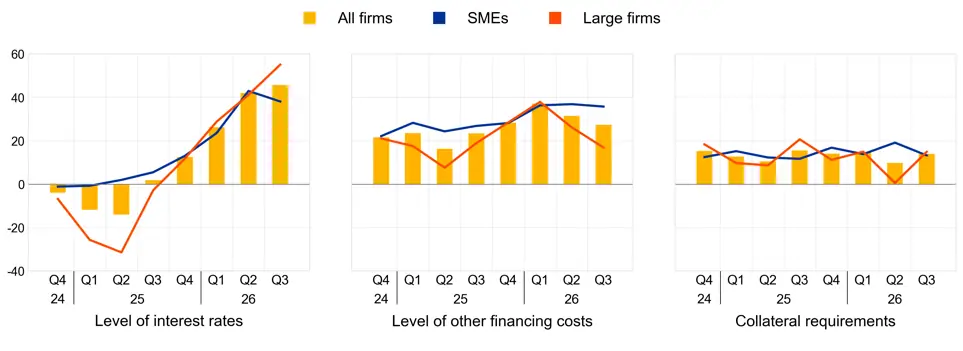
In the most recent round of the Survey on the Access to Finance of Enterprises (SAFE) in the euro area, covering the third quarter of 2026, euro area firms widely reported a further net increase in interest rates on bank loans (net 46%, compared with 42% in the previous quarter). Large firms reported increases more often (net 55%, up from 41%) than small and medium-sized enterprises (SMEs) (net 38%, down from 43%). At the same time, a net 27% of firms (down from 31% in the previous quarter) reported increases in other financing costs (i.e. charges, fees and commissions) and in collateral requirements (net 14%, up from 10%) (Chart 1).
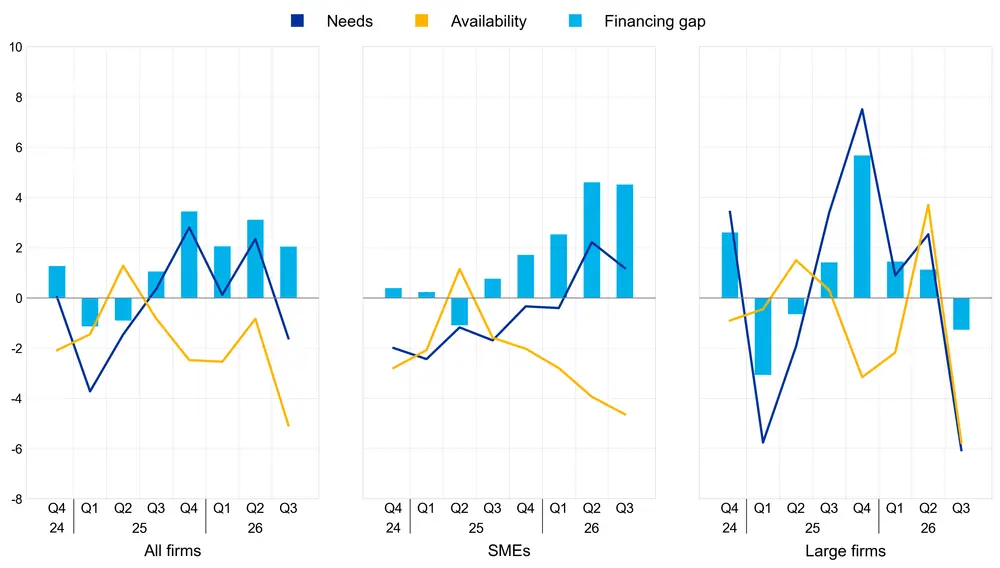
In this survey round, firms reported that the availability of bank loans had declined by more than their needs. Firms reported a decrease in the availability of bank loans in the third quarter of 2026 (-5%, compared with a net -1% in the second quarter of 2026), with both SMEs (net -5%, compared with -4%) and large firms (net -6%, down from 4%) reporting lower availability. At the same time, a net 2% of firms reported a decrease in their bank loan needs, while a net 2% reported an increase in the previous quarter. Developments in needs differed by firm size: SMEs reported broadly unchanged needs (net 1%, compared with 2%), while large firms reported a decrease (net -6%, down from 3%). As a result, the bank loan financing gap indicator, which captures the difference between changes in the need for and the availability of bank loans, was positive (net 2%, compared with 3% in the previous quarter) (Chart 2). Looking ahead, more firms expect the availability of external financing to decrease over the next three months.
Firms continued to perceive the general economic outlook as the main factor constraining the availability of external financing (net 31%, compared with 29% in the previous survey round), with large firms now more pessimistic than SMEs (net 35% and 29%, respectively). In this survey round, a net 9% of firms indicated that their firm-specific outlook, in terms of sales and profits, had a negative impact on the availability of external financing (after 10% in the previous survey round), while the impact of their capital position and creditworthiness remained positive.
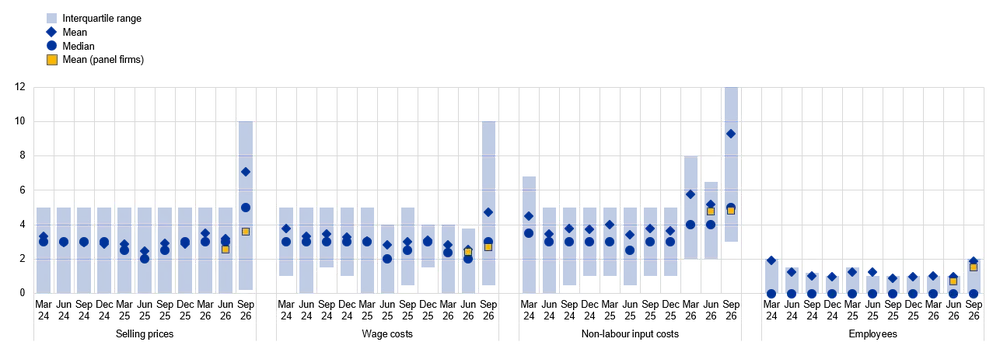
The substantial change in the sample composition in this survey round, with first-time respondents accounting for the majority of the sample, makes it challenging to interpret the responses to the numerical questions at this stage. The increase in selling price expectations was contained among firms that took part in both this round and the previous one, whereas selling price expectations rose significantly in the full sample (Chart 3).
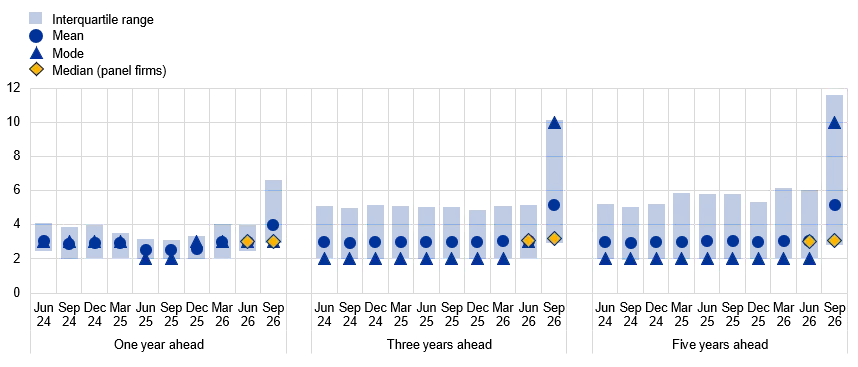
Similarly, firms’ median inflation expectations remained broadly unchanged among firms that took part in both the current and previous survey rounds, whereas they rose significantly in the full sample (Chart 4). The risk assessment for firms’ five-year-ahead inflation outlook was broadly unchanged.
The report published today presents the main results of the 40th round of the SAFE for the euro area. The survey was conducted between 26 August and 2 October 2026. In this survey round, around half of the firms were asked about changes in the period between July and September 2026. The remainder were asked about changes in the period between April and September 2026. Additionally, firms reported their expectations for euro area inflation, selling prices and other costs. The sample comprised 12,822 enterprises in the euro area, of which 11,917 (93%) had fewer than 250 employees.
For media queries, please contact: William Lelieveldt, tel.: +49 170 227 9090.
Notes
- The report on this round of the SAFE, together with the questionnaire and methodological information, is available on the ECB’s website.
- Detailed data series for the individual euro area countries and aggregate euro area results are available in the ECB Data Portal.
Chart 1
Changes in the terms and conditions of bank financing for euro area firms
Chart 2
Changes in euro area firms’ financing needs and the availability of bank loans
Chart 3
Expectations for selling prices, wages, input costs and employees one year ahead
Chart 4
Firms’ median expectations for euro area inflation at different horizons
CONTACTEuropean Central Bank
Directorate General Communications
- Sonnemannstrasse 20
- 60314 Frankfurt am Main, Germany
- +49 69 1344 7455
- media@ecb.europa.eu
Reproduction is permitted provided that the source is acknowledged.
Media contacts