
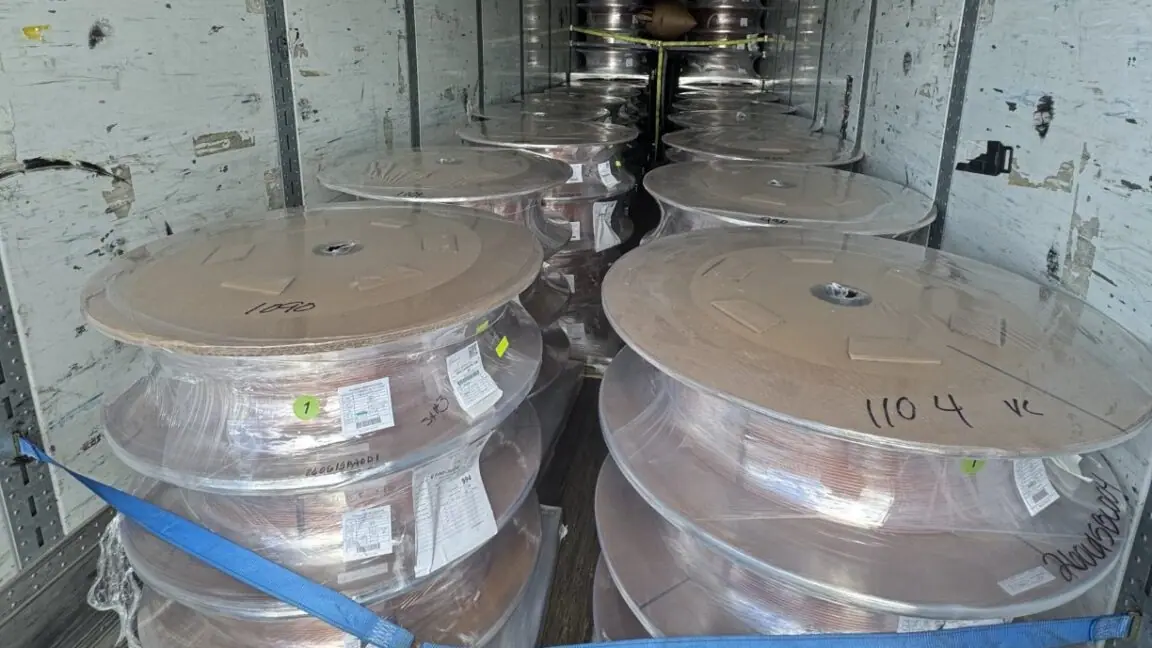
A trailer carrying “several hundred pounds” of “computer server equipment” worth $13 million was destined to land in Fayetteville, Georgia, “home to one of the largest data center developments in the country.” Two off-duty cops hired as escorts lost sight of the trailer after an unmarked sedan struck their car and forced the cops to stop as the trailer drove on. Gerardo Pachuca, a private investigator and former LASD cop investigating cargo theft, told NBC News that “the accident was not an accident. The bad guys wanted that load, so they intentionally took out the escorts.”
The same thing happened with another shipment out of California, headed to Texas, NBC News reported. Carrying “server rack components estimated to be worth around $10 million,” that trailer also sped off after the security escorts’ vehicle was struck by an SUV. And troublingly, in that case, it didn’t matter that the “cargo was also being monitored by an application tracking its location,” because “the tracking coordinates had apparently been spoofed.”
In that second case, the spoofing shows one of many ways that highway thieves have begun leveraging digital tactics to target data center shipments more precisely, experts warned.
Broadly, cargo thieves are infiltrating email accounts to find lucrative shipments, misdirecting shipments, disrupting GPS tracking, and using AI to create fake driver’s licenses to get accomplices hired as delivery drivers. LASD’s Sgt. David Pantoja told NBC News “that’s how most of it is being done,” which is a big shift from the past when highway thefts were largely opportunistic.
Ramping up security
As NBC News explained, these extreme examples where escorts were violently attacked are isolated events, but they’re part of a growing trend in high-end technology cargo thefts. Since 2025, there have been “nearly two dozen cargo theft incidents” in “states including California, Texas, and Utah,” and the “issue is only expected to grow” as AI firms continue to invest billions into data center infrastructure. Keith Lewis—head of operations at risk-assessment firm Verisk CargoNet, which tracks cargo thefts—told NBC News that “it’s like stealing pure gold bars,” and “it’s so much easier to steal this than to rob a bank.”