
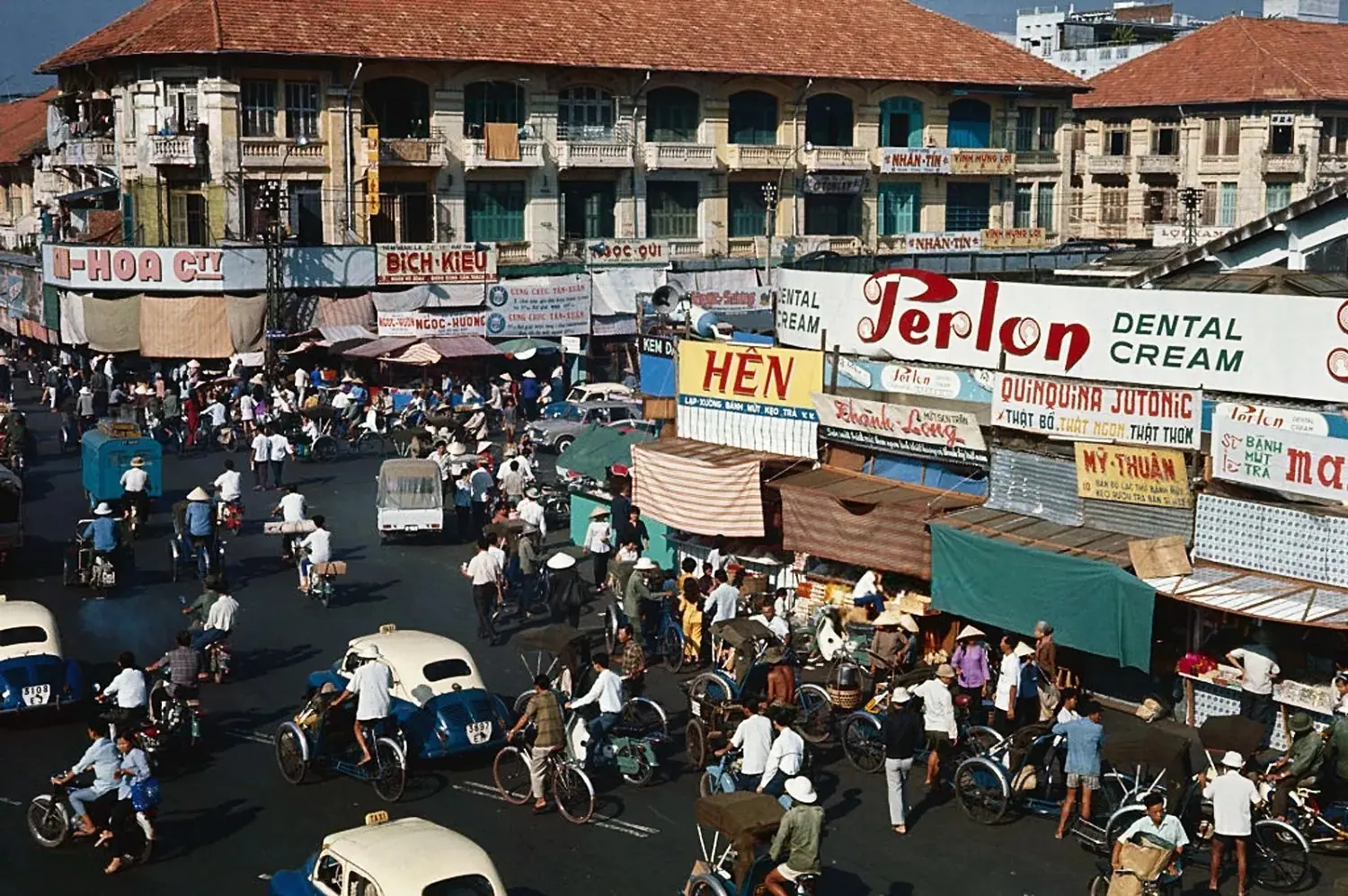
Born decades after the war ended, I never witnessed the upheavals my maternal grandparents’ generation lived through. The southwestern border region, where my maternal grandparents lived, was heavily affected by the fighting during the Vietnam War and later by the Southwestern Border War, so their experience of war goes beyond what postwar textbooks describe. It is the defining memory of their youth.
What always troubled me, however, is that when my maternal grandparents talked about the past, they didn’t speak only of bombs and loss. They also talked about everyday life under the Republic of Vietnam with a nostalgia I couldn’t understand as a child.
Yet, in what I learned at school, people harshly condemned that government and labeled it the “puppet regime.” This disconnect was highlighted recently when the Ministry of Education and Training’s use of the phrase “Sài Gòn government” in a history exam sparked debate, with some members of the public demanding a return to “puppet regime.” Once again, the gap between my family’s memories and what students learn every day unsettled me.
My maternal grandmother told me that before 1975, life in much of the South wasn’t only bombs and bullets. Families went to work, businesses ran, children went to school, and social life carried on. As an ordinary person who was never involved in politics, she remembers newspapers with diverse viewpoints and stories covering daily life, politics, and society.
Schooling back then was fairly accessible; though not wealthy, her mother could send several children to school without severe financial strain because public primary and secondary education was free. What struck me wasn’t just the tuition, but lines printed in textbooks urging students to care for their books so future classes could use them—a small detail reflecting a spirit of thrift and respect for knowledge.
In the years after reunification, she noted that life changed quickly under ration stamps, central planning, and the subsidy economy. For her, that period was much harder than the war. Not because she cared about ideology or politics, but because food, clothing, and basic necessities became scarce.
Those stories made me realize that ordinary people tend to judge a regime not by its political ideals but by their firsthand quality of life.
For a long time, I didn’t believe her. I assumed it was just an old person’s feeling that “the old days were always better.” I thought that the image of a developed Sài Gòn, a dynamic economy, or the title “Pearl of the Far East” was Western propaganda, believing all of Việt Nam’s development began entirely after 1975.
But as I grew older, I realized that history is often complex and cannot be reduced to a few pages of a textbook. I began asking questions:
Why do so many people who lived before 1975 remember things differently from what I was taught?
If the centrally planned economy was superior, why did nearly every country that adopted it eventually reform or abandon it?
If communism is history’s inevitable destination, why did the socialist systems of Eastern Europe and the Soviet Union collapse so quickly?
And what forced Việt Nam to launch Đổi Mới in 1986?
Seeking answers from domestic and international sources, I gradually realized that Việt Nam’s post-1945 history isn’t just a string of victories and achievements.
It includes policies that the state itself later acknowledged as mistaken, such as the Land Reform in the North and the post-1975 subsidy-based economic system, which contributed to years of economic and social crisis before Đổi Mới.
I also began to see Đổi Mới differently. It wasn’t the invention of a new model but a process of abandoning central planning and gradually accepting a market economy: opening trade, encouraging private enterprise, and integrating globally. Many of these policies already existed in other countries, including South Việt Nam before 1975.
This doesn’t mean that every policy of the Republic of Vietnam was right. It faced war, corruption, political instability, and heavy dependence on foreign aid before ultimately collapsing. But that ending doesn’t justify denying everything that once existed or treating every positive memory from that era as fabricated or wrong.
My search taught me that history is always more complex than black-and-white claims. A country can have recognizable achievements and also acknowledge its mistakes. Only by accepting history in all its light and dark shades can we truly understand the past, instead of simply repeating what we are taught to believe.
Until we do, genuine memories will always stand as firm rebuttals to so-called “official” accounts.
Myka283 wrote this op-ed article in Vietnamese andpublishedit in Luật Khoa Magazine on July 15, 2026. The Vietnamese Magazine translated it into English. The Vietnamese Magazine’s op-ed articles do not necessarily reflect the views or positions of its editorial board.