Port, a London-based startup transforms underutilised city spaces into electric vehicle hubs, today announces a €14.5 million funding round to further develop its proprietary AI Driver and autonomous delivery vehicles – building on top of an already active microhub network across the UK.
The round was led by EBRD and Balnord, with further participation from existing and new investors. Previously, PORT raised an initial €14.5 million through pre-Seed and Seed rounds, bringing total investment to date to €29 million.
Kamil Suda, Founder and CEO of PORT, says, “We believe robotised logistics does not start with the robot; it starts with the infrastructure, operations and data required to put robotics to work in the real world. We have spent years building that foundation. Now, with this investment, we are focused on the physical AI and robotics that will run on top of it.”
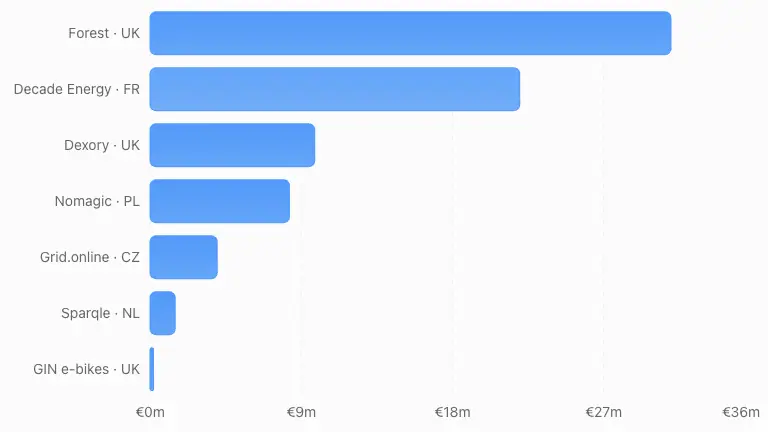
PORT’s latest investment comes amid a series of European funding announcements in last-mile logistics, electric mobility and robotics during 2026.
In the UK, London-based Forest secured €31 million in additional financing for its e-bike operations, while Dexory added €9.8 million for autonomous warehouse technology and GIN e-bikes received €215k in debt financing.
Elsewhere, Czechia’s Grid.online raised €4 million for shared parcel-delivery infrastructure, the Netherlands’ Sparqle secured €1.5 million for emission-free deliveries, Poland’s Nomagic raised €8.3 million for warehouse robotics, and France’s Decade Energy secured €22 million for depot electrification.
Together, these announcements represent approximately €76.8 million in reported financing, rising to €91.3 million when including PORT’s new round.
Ervin Luga, Head of Venture Capital Investments at EBRD, adds: “PORT’s impressive, proven commercial operation provides the ideal foundation for the next evolution of autonomous, robotic urban infrastructure. The environmental and economic advantages of driverless delivery are well established, but the missing real-world data layer has, so far, been a prohibitive limitation. PORT is actively building that data and already has the infrastructure in place to be able to make better use of it than anyone.”
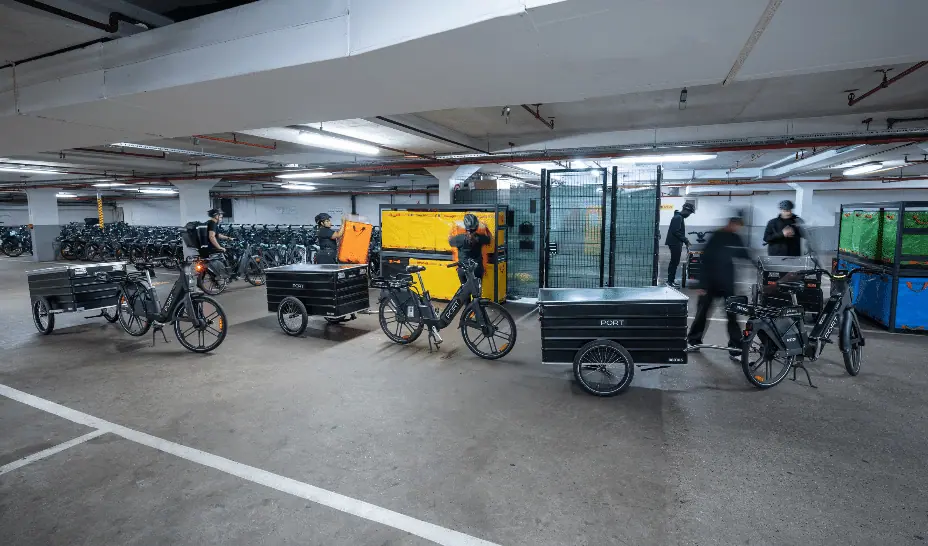
Established in 2020, PORT is building a vertically integrated autonomous urban logistics network, combining physical infrastructure, proprietary AI and robotics. The company operates 24 microhubs across the UK, counts with more than 50,000 couriers, offering e-bike subscriptions through a network of micro-hubs and charging stations, keeping bikes stored, charged and ready to pick up close to delivery hotspots.
Now, PORT is unveiling the autonomous evolution of that system. Using data from its e-bike fleet, the team is building a dedicated AI Driver which will ultimately enable autonomous deliveries using PORT’s own delivery robots.
A portion of PORT’s 3,500-strong e-bike fleet now carries NVIDIA-powered cameras and lidar, capturing real delivery data as couriers ride London’s streets. Because the bikes are already out on deliveries every day, each newly fitted bike adds to the data from its first shift, so PORT can grow data collection quickly without building a separate test fleet. PORT processes this footage to pick out the situations that matter for AI Driver training, from everyday kerbs, cyclists and drop-off points to rare edge cases.
It uses them to train its AI Driver specifically for urban delivery, the environment its autonomous robots will operate in.
When a bike returns to a PORT hub, its data uploads automatically over the hub’s fibre connection. Every delivery adds to the data used to train the AI Driver, which will go on to run PORT’s robots on the same streets the data was collected from.
PORT has developed 24 hubs across London, Manchester and Birmingham, using centralised underground car parks, warehouse space and railway arches to put 52,000 sq ft of underused urban space to work as logistics infrastructure. The central placement of PORT hubs is essential to the company’s autonomous, robotic future vision, which is only possible if robots are stored, loaded, and charged within a few miles of the delivery address.
In London, for example, PORT’s network already provides 92% coverage within a one-mile radius of the Congestion Charge Zone and 60 per cent coverage within two miles across inner London. Before the end of 2026, PORT will open a micro-hub in central Paris, its first launch outside the UK.
In the very near future, PORT is rolling out its next phase of development, involving an entirely new robotic delivery system, in partnership with the Royal Mail.
Jack Clarkson, Managing Director of Out-of-Home for Royal Mail, says: “We are always looking for solutions and partners to help elevate our customer proposition, reduce our costs and reach our sustainability goals. The PORT team are providing us with access to frontier technology and expertise that can help us unlock the next evolution of urban logistics. We want to be at the forefront of this last-mile innovation, and look forward to continuing and deepening our partnership.”
In September 2025, the team introduced trailers to the fleet, enabling e-bike couriers to provide parcel delivery services.
To date, PORT cargo bikes have delivered over 300,000 parcels. Each delivery reprotedly delivers approximately 90% lower emissions than the equivalent delivery via a diesel van.