
REPRISAL: To safeguard national sovereignty, economic security and the rights of Taiwanese investors, Taipei paused negotiations, a MOFA spokesman said
- By Kayleigh Madjar / Staff writer, with CNA
The Ministry of Foreign Affairs (MOFA) yesterday confirmed that Taiwan had suspended bilateral investment negotiations with Malaysia, following comments by Malaysian Prime Minister Anwar Ibrahim earlier this year that Taiwan is “a part of China.”
In a report by Norman Goh and Taipei-based reporter Thompson Chau (周浩霖) on Monday, Nikkei Asia said that Taiwan had shelved expanded bilateral trade talks with Malaysia originally scheduled for late last month.
Anwar in an interview with Al Jazeera in August said that he saw Taiwan “as part of China, period,” adding that this was “accepted by all.”
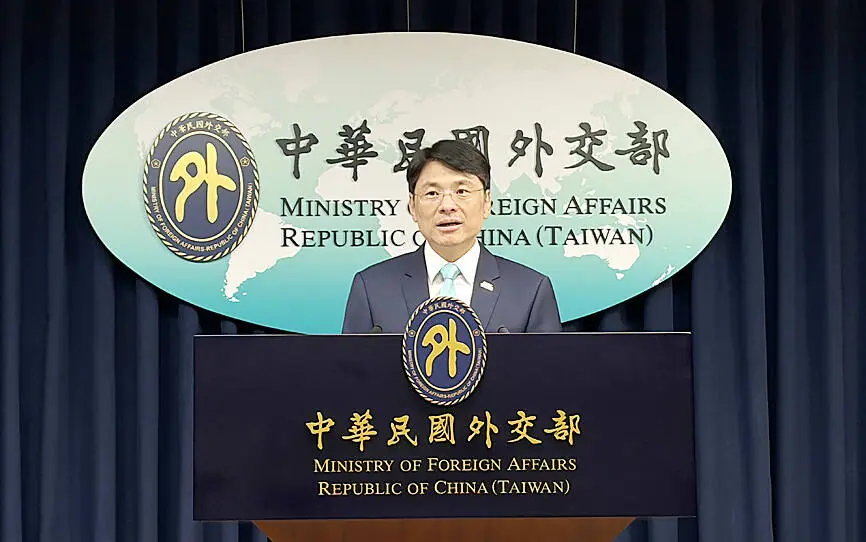
Ministry of Foreign Affairs spokesman Hsiao Kuang-wei speaks at a news conference in Taipei yesterday.Photo: CNA
Asked if he would condemn China for using force to “reunify” Taiwan, he said that if a Malaysian state attempted to break away, he would use force to “protect the sanctity and unity of” Malaysia.
MOFA at the time condemned the comments, saying that Anwar “absurdly implied that Taiwan is a separatist Chinese province and openly rationalized China’s stance on taking Taiwan by force.”
It also raised concern that his remarks could impact the confidence of Taiwanese enterprises looking to invest in Malaysia.
The Nikkei Asia report quoted from industry representatives concerned about the potential repercussions such political uncertainty might have on semiconductor investment, especially after many Taiwanese technology companies have expanded their operations in the country in the past few years.
Speaking at a news conference in Taipei yesterday, MOFA spokesman Hsiao Kuang-wei (蕭光偉) said that the ministry had previously expressed concern over Anwar’s remarks.
To safeguard national sovereignty, economic security and the rights of Taiwanese investors, the government has paused the bilateral investment negotiations, he said.
However, Taipei is continuing to communicate with Kuala Lumpur in the hope that the Malaysian government would look to the importance of their bilateral investment relationship and their long-established mutual trust, creating an opportunity to restart the talks, he added.
Commenting on ties with Paraguay, Hsiao said that Taiwan has been in close contact with the country’s new president, Pedro Alliana, and relations between the two remain close and cordial despite the impeachment of his predecessor.
Ambassador to Paraguay Ivan Lee (李岳融) had conveyed Taiwan’s congratulations to Alliana on his assumption of the presidency, Hsiao said, adding that both sides had agreed to continue their existing cooperation projects.
Alliana has maintained close and cordial relations with Taiwan for a long time, including during his tenure as president of the Paraguayan Chamber of Deputies before becoming vice president, he said.
Alliana has also repeatedly reaffirmed publicly that Taiwan is an important strategic ally of Paraguay, he said.
Hsiao also confirmed a Paraguayan media report published on Monday that Alliana had been scheduled to visit Taiwan later this month in his capacity as vice president.
However, the visit would be postponed in light of the domestic situation in Paraguay, Hsiao said, adding that the ministry would extend an invitation to Alliana to visit later.