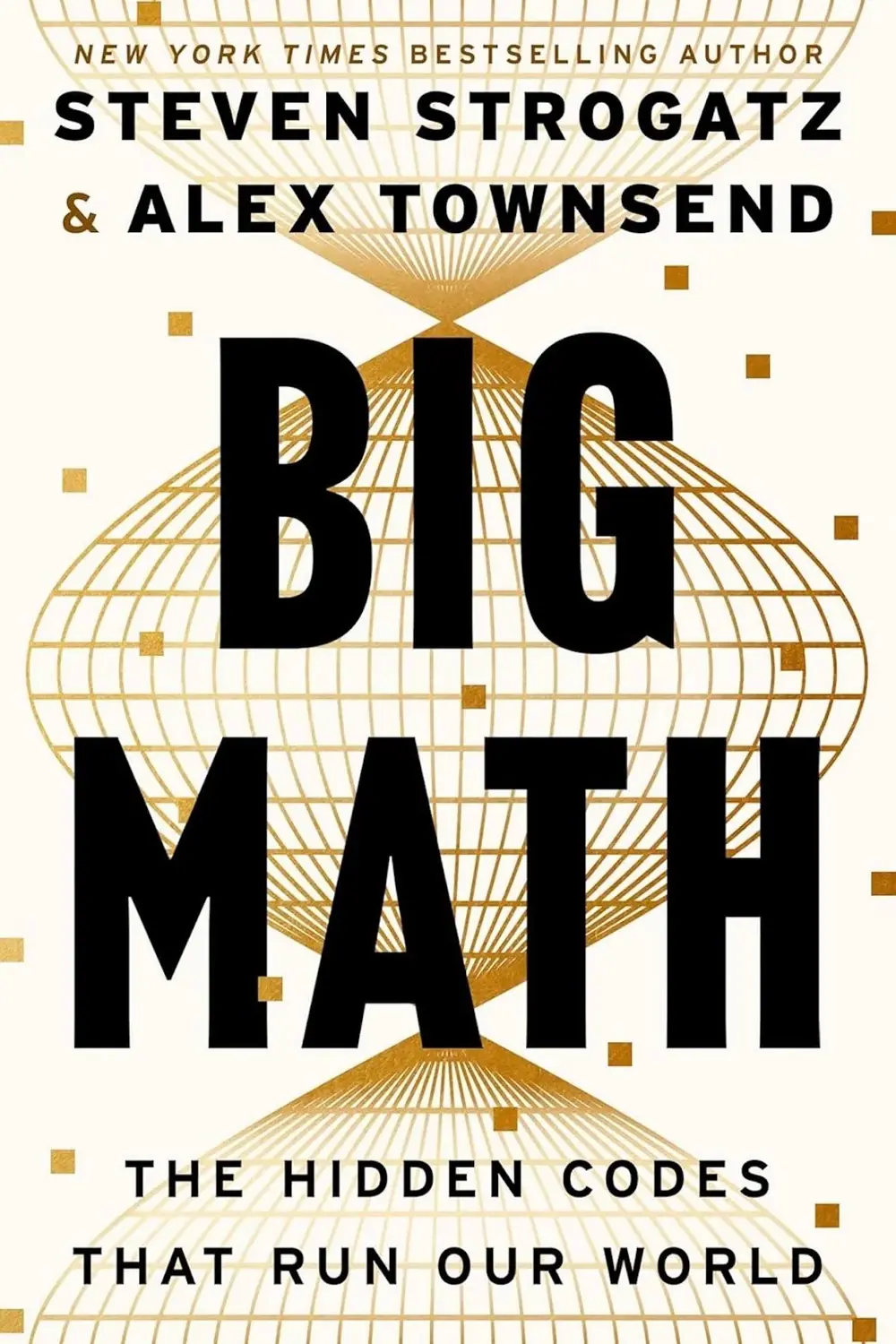
Nowadays, trillions of parameters are typical in the biggest of the large language models. But infinity is not big from this point. Infinity, which you would think of would be the biggest of big math, is not because calculus fits perfectly nicely in a human head. Infinity turns out to be very tractable in a way that a billion is not.
Little, Brown & Co. Little, Brown & Co. Leah Strogatz Leah Strogatz Little, Brown & Co. Leah StrogatzArs Technica: One of your real-world examples of big math is particularly relevant at the moment: mathematics as it relates to the gerrymandering issue.
Steven Strogatz: It’s an interesting question of, what’s a fair map and what’s a reasonable redistricting? The legal system gives us certain criteria, but they are vague. The districts should not be too snakey-looking, not look like salamanders, for instance. The term in the law is ‘compact.’ They should be reasonably compact. But what does that mean mathematically? The districts are also supposed to be contiguous; you don’t want to have separate islands and call that one district. It’s supposed to respect natural boundaries like rivers or other landscape features. Also, each district is supposed to have roughly the same population.
So how to make maps that respect all of the criteria? It turns out there are a lot of ways to make them. Using past voting information, you can stack the deck. That’s what gerrymandering is all about, trying to redistrict in favor of whatever party is in power. There has been a big debate about whether certain maps violate people’s rights. The principle should be one person, one vote. If you do things that dilute somebody’s power so that their votes are wasted, so to speak, that’s traditionally thought to be unfair or maybe even illegal.
The Supreme Court has heard all kinds of cases, but the court is very resistant to the use of math. I quoted [Chief Justice] John Roberts talking about the efficiency gap as one measure of gerrymandering. He referred to it by its Greek letters and said something like, “The average person on the street is just going to think this is gobbledygook, that this is not a criterion that the law should pay any attention to.”
Nevertheless, Moon Duchin and her colleagues showed this very down-to-earth way of generating a big ensemble of reasonable maps that satisfy all the legal criteria so that you have a baseline, you could do the control experiment. What the math does is give you a principled way of generating maps at random that respect the criteria that the law requires, but otherwise are just a random sample of reasonable maps. How often would a map produce the result that the gerrymander intended? If you can show that it’s an extreme outlier, that’s a measure of something. Does it prove malicious intent? Not really. It does prove it’s not typical.