
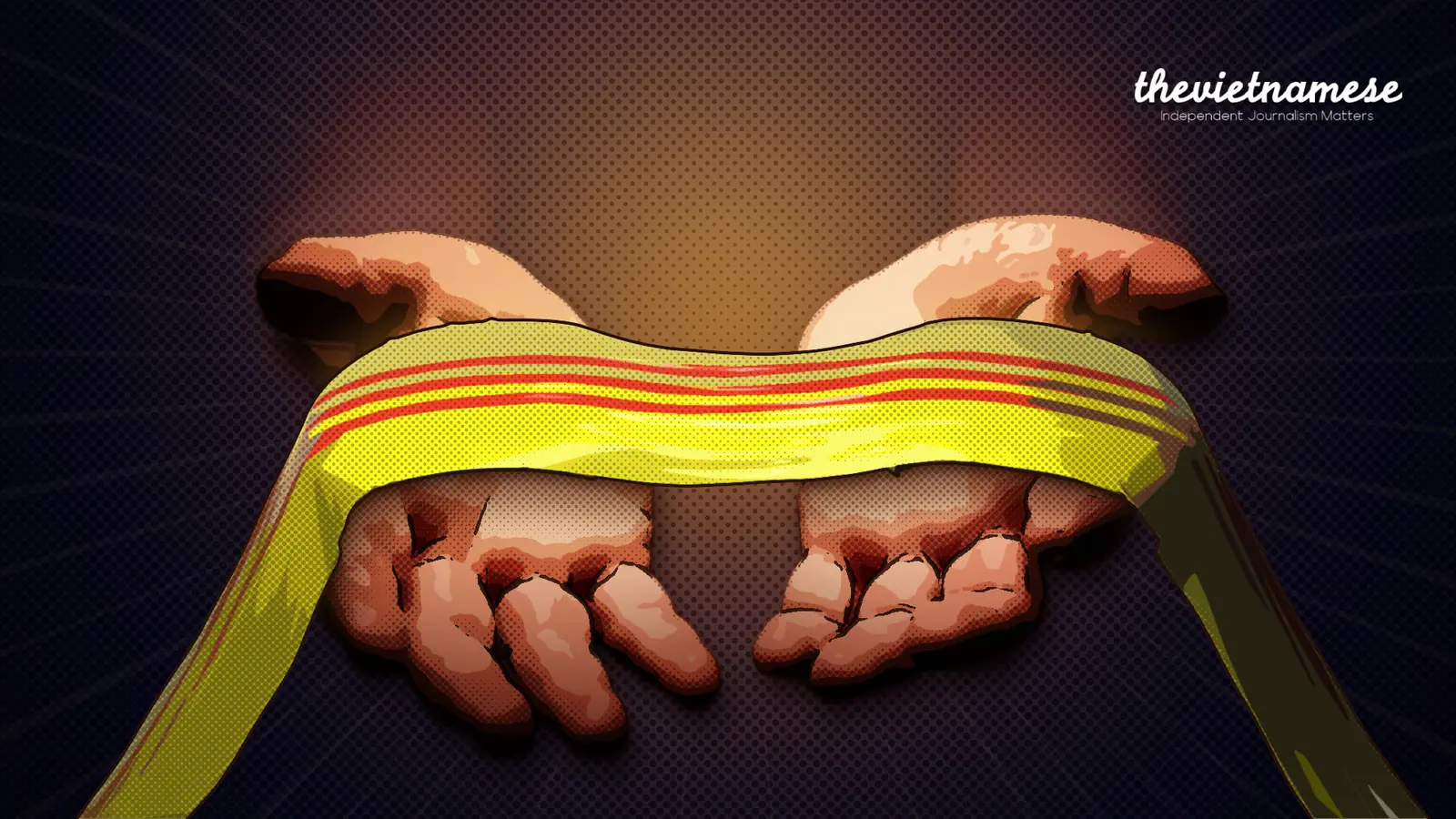
Before rushing to write a rebuttal, defend a political position, or declare someone right or wrong, we should ask ourselves a fundamental question: Have we taken the time to understand the issue from more than one perspective, or are we simply defending what we have already been taught to believe?
There is a difference between conviction and blind allegiance. Conviction can withstand questions, evidence, and scrutiny. Blind allegiance fears them.
Every person has a homeland. Loving one’s country, cherishing its culture, and taking pride in one’s heritage are natural human sentiments. But patriotism must not be confused with political obedience. A nation and the political party governing it are not interchangeable. A party may exercise political power, but it does not own the nation, monopolize its history, or speak for all its people.
Việt Nam is more than the Communist Party, and the Vietnamese people are more than any government. Vietnamese history is more than the version being told by those in power.
Consider a statement made in defense of a young Vietnamese woman’s perspective:
“Those who display this flag do not represent the entire Vietnamese-American community. Many Vietnamese Americans agree with the young woman’s views. She is courageous and has spoken out about what she believes to be the truth. These are her personal opinions, and freedom of speech in the United States does not prevent her from expressing them.”
At first, the statement appears to support diversity and freedom of expression. Yet, beneath its reassuring language lie questions that deserve much closer examination.
Who are the “many” people being invoked to validate her views? What evidence establishes that her interpretation is true? Why should the right to express a political opinion be treated as if it places that opinion beyond historical scrutiny?
A Lesson I Have Never Forgotten
More than 30 years ago, shortly after arriving in the United States, I enrolled in an English as a Second Language (ESL) class. During the first few days, our professor asked each student to introduce themselves and share their country of origin. What began as a simple classroom exercise soon escalated into a heated political debate.
When we introduced ourselves as Vietnamese and spoke about our homeland, the discussion turned to the Paracel and Spratly Islands. As soon as we stated that these islands belonged to Việt Nam, several Chinese students reacted strongly. They verbally insisted that the islands belonged to China. Some even claimed that Việt Nam was a province of China.
That experience has stayed within me for decades. I witnessed firsthand how deeply national narratives can influence people’s understanding of history and how quickly a conversation can become a confrontation when people are unwilling to question what they have been taught.
The situation reminds me of statements that some Vietnamese people are now making about their country’s history. The circumstances are different, but the underlying concern is similar: What happens when a person becomes so convinced of one narrative that competing historical perspectives are dismissed before they are even examined?
The sovereignty of the Paracel and Spratly Islands remains disputed, with overlapping claims in the South China Sea. Việt Nam continues to assert sovereignty over both island groups and maintains that historical evidence and legal grounds support its claims. Any responsible discussion must distinguish Việt Nam’s position from the broader international dispute and examine the historical and legal evidence. [1]
If we expect others to examine their historical narratives, we must also be prepared to examine our own. We must also be willing to provide evidence for our claims, just as we demand it from those who disagree with us.
Otherwise, we are not defending critical thinking. We are simply asking people to replace one unquestioned narrative with another.
The Yellow Flag and the History It Carries
Let us return to the claim that those who display the yellow flag with three red stripes do not represent the entire Vietnamese-American community and the Vietnamese diaspora in general.
This statement is true in one sense: no single flag represents every Vietnamese American or the Vietnamese diaspora. But it raises a more important question: Why must a symbol represent everyone before it is allowed to represent anyone?
According to the U.S. National Archives, the federal government established an interagency task force in April 1975 to coordinate the resettlement of Indochinese refugees, primarily Vietnamese.
President Gerald Ford signed the Indochina Migration and Refugee Assistance Act on May 23, 1975, helping approximately 130,000 Vietnamese, Cambodian, and Laotian refugees resettle in the United States during the initial period. [2]
National Archives materials also document the broader exodus of approximately 1.6 million Vietnamese who left the country in the years that followed between 1975 and the late 1990s. [3]
Behind these numbers were human lives: parents who feared for their children’s futures, families separated across borders, people who abandoned homes and possessions, and refugees who arrived in foreign countries with little more than their determination to survive.
For many of these refugees and their descendants, the yellow flag with three red stripes, the flag of the former Republic of Vietnam, is not simply a remnant of a former government. It carries memories of a homeland left behind, the pain of displacement, the struggle to rebuild, and the values and political convictions they continue to hold.
In 2023, House Resolution 560 was introduced in the U.S. House of Representatives. It described the flag of the Republic of Vietnam as a symbol of freedom, and the Vietnamese-American community acknowledged its recognition by numerous state and local governments. The resolution was introduced legislation, not an enacted federal law. [4]
Consider what happens when someone tells a refugee that the symbol through which they remember their homeland does not represent the entire community. The statement may be technically correct, but does it acknowledge the history behind that symbol? Does it use community diversity to diminish the experiences of those who fled?
There is a difference between saying, “This flag does not represent everyone,” and implying, “Because it does not represent everyone, its significance should be questioned or dismissed.”
The first recognizes diversity. The second risks erasing history.
A flag does not need unanimous support to carry the memory of its people. A history does not become irrelevant because a later generation sees it differently. And a community retains its right to remember, even if others choose not to share those memories.
Who Deserves Credit for Việt Nam’s Development?
In February 1994, President Bill Clinton lifted the U.S. trade embargo against Việt Nam. On July 11, 1995, Clinton announced the normalization of diplomatic relations between the two countries. By August 1995, the United States and Việt Nam had opened embassies in Washington, D.C., and Hà Nội. [5]
But consider a question that deserves more than a slogan in response: What might Việt Nam’s economic and political circumstances look like today if the United States had continued its embargo and the two countries had not normalized relations?
Việt Nam could have faced a significantly more difficult path, potentially resembling the international isolation experienced by North Korea. This is a counterfactual judgment, not an established historical fact; numerous domestic and international factors have shaped Việt Nam’s actual development.
Nevertheless, the broader point remains: we must understand Việt Nam’s development within an international context. It cannot be explained solely through the decisions of one political party or the leadership of one government.
Việt Nam connected to the global internet on November 19, 1997, following government regulations issued that year concerning the establishment and use of the internet. The World Bank also records Việt Nam’s connection to the global internet in November 1997. [6]
This raises another question: When people today enjoy opportunities to access information and communicate across borders, do they ever consider the historical circumstances that made those opportunities possible, or do they attribute every achievement exclusively to the government they have been taught to praise?
Some individuals continue to repeat the familiar slogan, “Thanks to Hồ Chí Minh and the Communist Party,” as though the country’s achievements must necessarily be credited to its political leadership.
But what does national progress mean to a family that still struggles to feed itself? Vietnamese families have endured periods of severe hardship in which survival meant eating whatever was available, including sweet potatoes, sorghum, banana roots, and even dried cassava slices. These memories are part of the lived experience of many people and should not be dismissed simply because they complicate a triumphant account of national development.
Economic progress deserves recognition where it has occurred. But recognition is not the same as unquestioning praise. Acknowledging a country’s achievements does not require denying its people’s suffering, overlooking the contributions of others, or treating criticism as disloyalty.
How Many People Actually Agree?
Let us return to the statement: “Many Vietnamese Americans agree with the young woman’s views. She is courageous and has spoken out about what she believes to be the truth.”
The word “many” sounds persuasive. It creates an impression of widespread support, as though the size of the supposed majority should settle the argument before it begins. But how many people, exactly?
Do we know the backgrounds and perspectives of those being counted, or are we simply assuming that a visible group represents a much larger community? Without reliable evidence, “many” is not a measurement. It is an assertion.
The second claim, that the young woman has spoken “the truth,” deserves the same scrutiny. Where does this truth come from? Is it supported by credible historical records and independent sources? Does it account for the experiences of Vietnamese refugees and their descendants? Has the information been examined from multiple perspectives, or does it reproduce a single political narrative without adequately considering what that narrative excludes?
These questions should not be interpreted as an attempt to deny the young woman her right to speak. They are questions about the accuracy and credibility of what she says.
Every person is entitled to hold an opinion. No person, however, is entitled to demand that an opinion be accepted as historical truth merely because they sincerely believe it.
Freedom of Speech Is Not Freedom From Criticism
Let us return to the statement made in defense of the young Vietnamese woman’s perspective. It is unsurprising that some individuals, particularly those who have never personally experienced life under Communist rule or witnessed the suffering, displacement, and profound human tragedies surrounding the fall of South Vietnam in 1975, share similar views.
For them, these events may exist primarily in history books, political narratives, or stories passed down through generations. For countless Vietnamese refugees and their families, however, they are not merely chapters of history. They are memories of lost freedom, separated families, abandoned homelands, and sacrifices that continue to shape their lives and identities.
Yet historical distance should never become an excuse for historical indifference. One can understand persecution’s consequences without personally enduring it, just as one can recognize freedom’s value without experiencing its loss.
Nevertheless, when individuals speak publicly about events that have profoundly affected millions of lives, they bear an intellectual and moral responsibility to examine the historical record, consider the testimony of those who lived through those events, and distinguish personal conviction from documented fact.
This responsibility becomes especially important when freedom of speech is invoked to defend controversial political opinions. In the statement supporting the young woman, her defenders argue: “These are her personal opinions, and freedom of speech in the United States does not prevent her from expressing them.”
That assertion is correct as a matter of principle, but it addresses only one side of the issue. The right to express an opinion does not establish the historical accuracy of that opinion, nor does it exempt the speaker from public scrutiny.
The same freedom that allows the young woman to express her convictions also allows Vietnamese refugees, their descendants, and others to question her assertions, challenge her interpretations, and defend historical experiences they believe must not be forgotten.
There is, however, an essential distinction between legitimate criticism and intimidation. Peaceful disagreement, reasoned rebuttal, and rigorous examination of historical claims are indispensable to democratic debate. Threats, violence, harassment that crosses legal boundaries, and unlawful attempts to silence others are fundamentally different matters. Defending the right to criticize must never become a justification for denying another person’s right to speak.
My concern arises when the First Amendment is invoked as though it settles not only whether someone may express a controversial opinion, but also whether that opinion deserves to be challenged. Constitutional protection establishes the right to speak; it does not establish the truth of what is spoken.
For Vietnamese refugees and their descendants, this debate carries significance beyond ordinary political disagreement. Their memories of displacement, persecution, separation, and the loss of their homeland are not merely ideological positions to be dismissed because another generation interprets history differently. These experiences form part of the historical record and deserve serious consideration alongside other credible evidence.
A genuinely free society must therefore make room for both the original statement and the rebuttal. It must protect the young woman’s right to express her beliefs while also recognizing the equally legitimate right of Vietnamese refugees, their descendants, and the broader public to challenge those beliefs openly and peacefully.
The United States, Việt Nam, and the Meaning of Freedom
The First Amendment to the U.S. Constitution protects freedom of speech and the press, as well as the rights to assemble peacefully and petition the government. These protections are fundamental to political participation and the ability to question those in positions of power. [7]
This raises a direct question: Can people in Việt Nam criticize the country’s highest political leaders as openly as Americans can generally criticize their president without risking imprisonment?
According to Human Rights Watch’s World Report 2026, which examines events in 2025, the Vietnamese government severely restricts freedom of expression, association, and peaceful assembly. The report describes the detention of more than 160 political prisoners and the arrest of at least 40 additional people for criticizing the government. It also discusses the use of Articles 117 and 331 of Việt Nam’s Penal Code against activists and people expressing views online. [8]
Việt Nam is also a party to the International Covenant on Civil and Political Rights (ICCPR). Article 19 recognizes the right to hold opinions without interference and the right to freedom of expression, including the freedom to seek, receive, and impart information and ideas. United Nations human rights experts have also reiterated Việt Nam’s obligations under these standards. [9]
These commitments raise an essential question: What value does a recognized right have if people cannot exercise it freely and meaningfully in practice?
We truly defend freedom only when we defend it regardless of whether the speaker agrees with us. We defend our own comfort.
Diplomatic Relations Do Not Require Historical Amnesia
The establishment of official diplomatic relations between two governments does not mean that refugees, political exiles, or diaspora communities must remain silent about the governments of their countries of origin.
Three distinctions are essential.
- First, diplomacy is not a surrender of individual rights.
The United States may maintain official relations with Việt Nam while Vietnamese Americans continue to criticize the Vietnamese government. Diplomatic engagement does not, by itself, eliminate their constitutional right to peaceful political expression.
- Second, a historical symbol does not lose its meaning because political circumstances change.
For many Vietnamese refugees and their descendants, the flag of the Republic of Vietnam with three red stripes remains a symbol of their identity, history, and heritage. Others may hold different views, and those differences should be acknowledged. But disagreement over a symbol’s meaning does not erase the experiences that gave rise to its significance.
- Third, a nation is not the same as the government that rules it.
Criticism of the Vietnamese Communist Party is not automatically hostility toward Việt Nam. Questioning government policy does not mean rejecting Vietnamese culture. Advocating human rights does not mean wishing harm upon the Vietnamese people.
Loving Việt Nam does not require unconditional loyalty to the Communist Party. Nor should Vietnamese Americans be expected to abandon their historical memories simply because the governments of the United States and Việt Nam have chosen to normalize relations.
Reconciliation should create room for honest dialogue, not demand silence from those whose memories make that dialogue uncomfortable.
What Does It Mean to Love Your Homeland?
We should ask ourselves whether we are examining history honestly or simply repeating what we have been taught. We should question unsupported claims about what an entire community believes. We should distinguish personal conviction from historical evidence and recognize that political disagreement does not automatically constitute hostility toward a nation.
Above all, we should consider whether our commitment to freedom of expression is genuine. Do we defend the right to speak only when we agree with the speaker? Do we respect historical memory only when it aligns with our own? Do we recognize the diversity of a community only when it supports our argument?
A nation’s history does not belong exclusively to those in power, and the people who leave their homeland do not lose their right to remember it.
For Vietnamese Americans, the question is not whether everyone must embrace the same flag, share the same political beliefs, or interpret every historical event identically. The question is whether people can preserve their history, express their identity, and participate in public debate without having their experiences dismissed simply because they challenge an official narrative.
We can acknowledge Việt Nam’s achievements without ignoring its hardships. We can support diplomatic relations without surrendering historical memory. We can respect someone’s right to speak without accepting every claim that person makes. And we can love our homeland without granting any government unconditional ownership of our conscience.
Diplomatic relations may change. Governments may rise and fall. Political narratives may be revised. But the right of people to remember their history, preserve their identity, question those in power, and express their convictions must never depend on the relationship between governments.
Because if reconciliation requires silence, it is not reconciliation. If patriotism requires blind allegiance, it is not freedom. And if we are unwilling to question the stories we have inherited, how can we ever be certain that we truly understand our own history?