
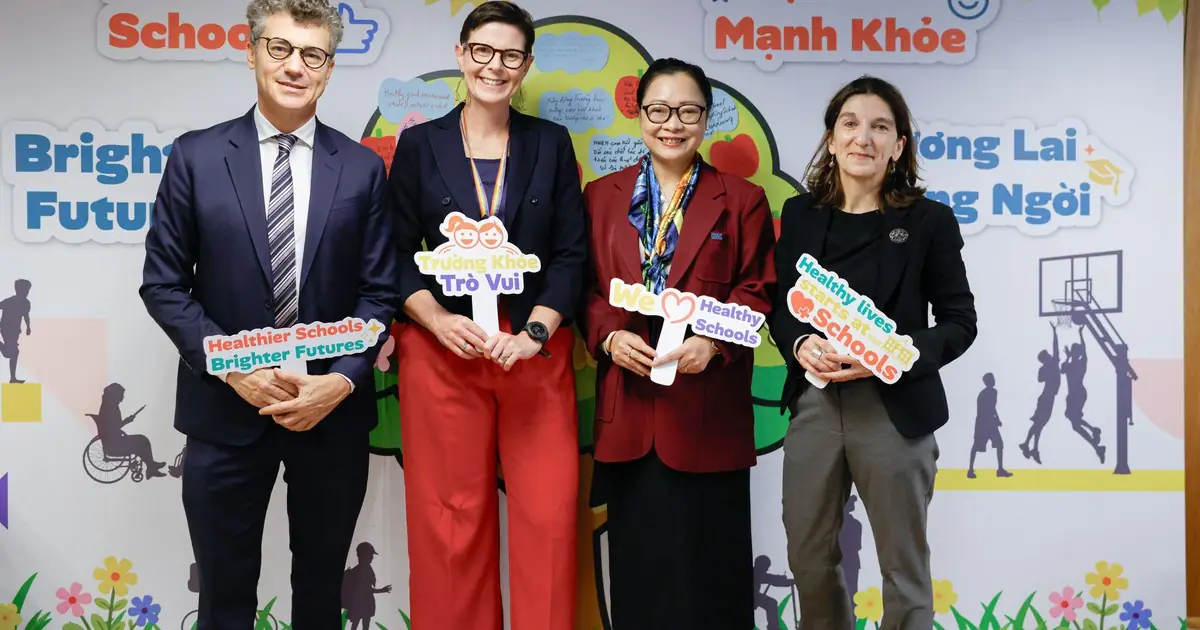
The Ministry of Education and Training (MOET), the World Health Organization (WHO) and the United Nations Children's Fund (UNICEF) in Viet Nam released a comprehensive national picture to date of health, and water, sanitation and hygiene (WASH) in 8,159 schools, providing a new evidence base to guide action under the Government's Program on School Health 2026–2035.
The survey consists of two complementary assessments jointly implemented by: on school health policies and practices in 959 schools, and on access to WASH services in more than 8000 schools nationwide, including consultations with 284 girls and boys in six regions across Viet Nam.
Schools play a vital role in children's health, protection, well-being and learning. With school-age learners making up more than one quarter of Viet Nam's population, schools are among the most important places to promote healthy behaviors, prevent disease and injury, and support children's mental and physical well-being. They can also provide safe, inclusive and enabling learning environments where health concerns can be identified early, and children can be connected with the support they need.
The findings show progress as well as opportunities for improvement.
For example, 93.7 percent of surveyed schools reported providing periodic health examinations for students, while 86 percent have access to basic WASH services. However, the survey also identified challenges that require urgent action, including better support for students with chronic health conditions and more accessible, safe and adequate services, especially for children with disabilities and girls.
Out-of-school rates decrease by 80% in Viet Nam: UNESCO
Viet Nam to exempt tuition for all public school pupils from 2025-2026 academic year
MOET Vice Minister Dr Nguyen Thi Quyen Thanh said, "The survey provides an important benchmark for tracking progress under the Program on School Health 2026–2035. It will help guide the Government's priorities and investments to better support students' health and comprehensive development. We look forward to working with partners across sectors to turn these findings into practical action for children across Viet Nam."
WHO Representative in Viet Nam Angela Pratt said, "This survey provides a clear picture of school health in Viet Nam today. It gives policymakers, educators and health professionals the evidence they need to identify priorities, target resources and measure progress over time. Most importantly, it helps ensure that decisions about school health are guided by data and focused on the areas where they can make the greatest difference.
"Healthy schools are essential for healthy, thriving societies. When children are well-nourished, protected from health risks, supported in their mental well-being and able to access the services they need, they are better able to learn, develop and reach their full potential. The findings from this survey provide an important foundation for strengthening school health policies and programs across the country."
UNICEF Representative in Viet Nam Ms Silvia Danailov said, "This survey gives us a clear picture not only of the progress made, but of the children and schools that need greater support. Closing the gaps in accessibility, menstrual health and hygiene, and maintenance of facilities, particularly in rural and disadvantaged areas, will require sustained investment, effective monitoring and action across sectors. Success will ultimately be measured by the girl who no longer misses school during her period, the child with a disability who can use a school toilet safely, appropriately and privately, and every girl and boy who goes to a healthy, safe school environment and ready to learn and grow comprehensively."
Participants emphasized that effective school health extends beyond health services to include nutrition, physical activity, mental health and protection and, importantly, access to quality WASH services. Achieving these outcomes requires coordinated action across the education and health sectors, together with local authorities, schools, families, communities and development partners.
The workshop follows the recent establishment of the School Health Technical Working Group, which brings together government ministries, UN agencies and partners to strengthen coordination and support implementation of the National Program on School Health 2026–2035. Building on the survey findings, the workshop identified a clear roadmap for translating policy into action and improving the health, well-being, protection and learning outcomes of children and adolescents across Viet Nam./.