
US secretary of state’s comments come as vulnerability in programming language Java highlighted
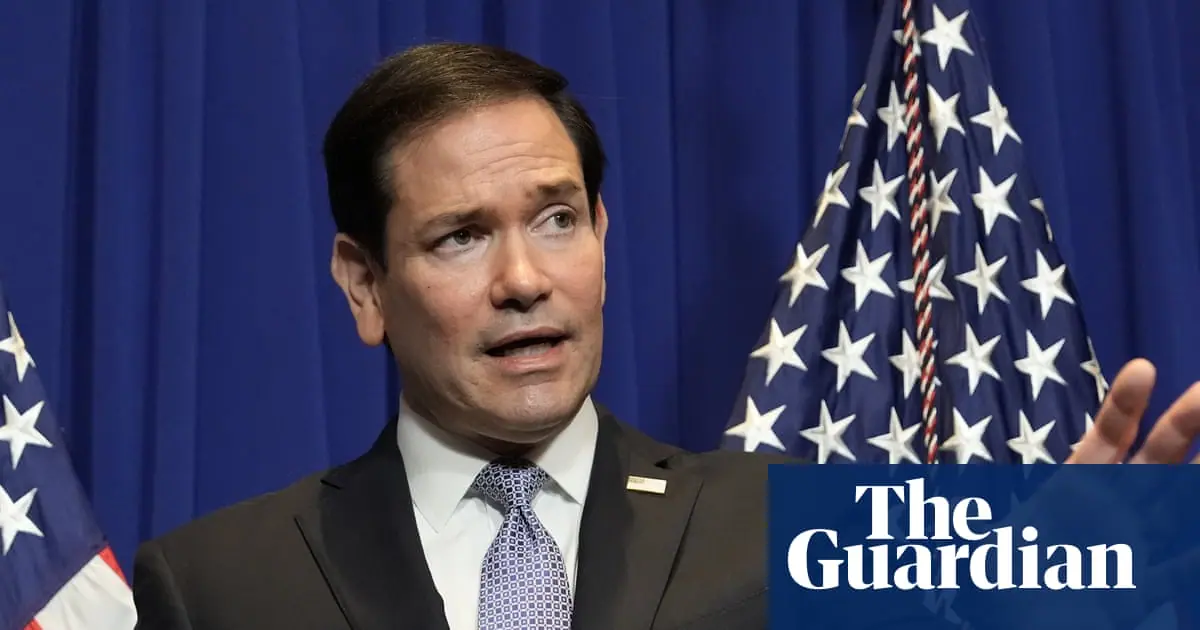
There is “zero evidence” that a wave of IT outages – which have grounded flights, cut off work access, limited bank access, affected Apple and disrupted classified communications – are related to each other or are the work of malign actors, according to the US secretary of state.
Marco Rubio said the US was “not under systemic attack” and a cascade of network problems was “not inter-related”.
In recent days, Microsoft, major US banks, Apple, American air traffic control systems and the National Security Agency have all been affected by technical failures and outages.
“We have zero evidence or any reason to believe that any of these isolated or individual instances have anything to do with nefarious actors, with cyber-hackers, with criminals, with another nation state, with a malign actor of any kind,” Rubio said.
Rubio’s comments came as cybersecurity researchers flagged a vulnerability in Java, a programming language used by 90% of companies in the Fortune 500, a ranking of the largest companies in the US. The researchers at US-based Calif used AI to discover the flaw and recently unearthed glitches in PHP, another computer language.
Calif said the Java flaw could allow hackers to remotely execute code, allowing them to place malicious software on a target’s systems.
The US director of national intelligence, Jay Clayton, said the incidents were caused by security upgrades – such as plugging the flaws in PHP – that took longer than planned or encountered unexpected hiccups.
“Everybody recognises it’s time to upgrade their systems, and as they upgrade them, they’re not coming back as expected in all cases, and in some cases, systems have to hand off to other systems, and those handoffs are not coming back as expected,” he told the Fox Business news channel.
Tal Be’ery, a cybersecurity expert, said he did not believe the incidents were linked directly but had a common underlying theme: AI. IT systems were buckling under the pressure of adding AI or tackling flaws uncovered by AI, he said.
“Our IT infrastructure is brittle, and when AI puts massive extra pressure on it, whether through upgrades to accommodate AI or through the rapid patching that AI-driven vulnerability discovery demands,” Be’ery said.
Since April, when the AI startup Anthropic released its Mythos model, which had a startling ability to flag IT flaws, the amount of vulnerabilities found by leading tech companies has soared eightfold – while OpenAI has also released models capable of finding previously unseen flaws. Researchers at Calif used OpenAI technology to discover the Java flaw.
“[Java] is the beating heart of the modern economy,” Calif wrote in a blogpost. “Banking, aviation, telecommunications, nearly every critical sector runs on Java, including national security systems.”
However, Steven Murdoch, a professor of security engineering at University College London, said the flaw did not apply to every Java user and was specific to a library of code – Base64 – that comes bundled with a version of Java.
“It’s significant but it’s not every Java program that is affected,” he said.
In the UK the National Cyber Security Centre urged organisations to keep their systems up to date, while the US and South Korean authorities also urged Java users to install security updates.
Rubio made the comments as he travelled with Donald Trump for key meetings in the Philippines on Wednesday, before flying to the tech hub of Shenzhen in China for the Asia-Pacific Economic Cooperation (Apec) summit.
Trump was dismissive when asked whether he was concerned about the outages on Tuesday. “It’s life. When you’re big and powerful and you have all the money, things like that happen. It’s fine,” Trump said in Manila.
The series of outages began on Thursday last week, when Microsoft’s email and other tools went down, affecting millions of workers who rely on them. Microsoft traced the problem to “an earlier network capacity upgrade”.
Flights across the US were grounded the next day in the longest “ground stop” since the September 11 attacks. The US Federal Aviation Administration blamed a router upgrade.
By Monday, banks were in the spotlight, as customers reported difficulty accessing online accounts at several major financial institutions and the money transfer service Zelle after a technical problem at JPMorgan Chase caused ripple effects throughout the financial system. Chase said it was caused by “a software bug” and was “not cyber-related”.
The same day, United Airlines said it had resolved an internal system outage that delayed departing flights.
Then on Tuesday, an internal network that the National Security Agency uses to communicate classified information was offline after what the agency described as “routine maintenance”. Apple also confirmed problems with its iPhone apps, such as Apple Pay and iCloud, on Tuesday but said it had resolved them.
The Democrat Mark Warner, the vice-chair of the Senate intelligence committee, supported the assessment that the outages were not caused by a “coordinated effort” but by attempts to shore up systems.
“The evidence so far points toward legitimate efforts to secure our systems, not malicious activity.”
Explore more on these topics- Technology sector
- Marco Rubio
- AI (artificial intelligence)
- Trump administration
- Data and computer security
- news