
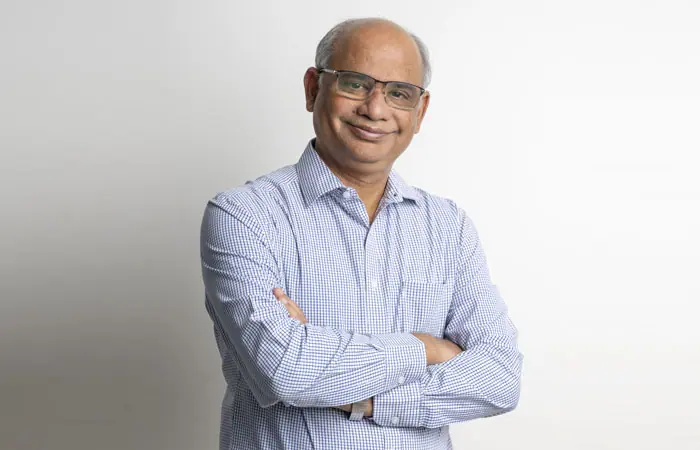
As the textile industry faces mounting pressure to reduce its environmental footprint, recycled polyester is emerging as a necessity rather than an alternative. With sustainability commitments gaining momentum and demand for circular materials rising, the shift towards recycled fibres is becoming increasingly important. Makarand Kulkarni, Whole-time Director & CEO, Revalyu Recycling (India), in a dialogue with Divya Shetty, shares his perspectives on the evolving landscape of polyester recycling.
How is Revalyu serving India’s textile industry through recycled polyester, and which textile segments are driving the strongest demand?
At Revalyu, we have two products for the textile industry. The first is filament yarn, which includes DTY as well as FDY for making fabrics. We supply these to various textile mills, which make fabrics and supply them to their customers.
Secondly, we also produce recycled polyester chips, which are supplied to various spinners who can supply yarns to other segments. For example, we supply to a carpet manufacturer who uses recycled chips to make BCF yarns and recycled polyester-based carpets. That segment is also quite a big segment. We also supply these chips to other players for making filament yarns.
We are increasingly focusing on recycling activities and trying to reach more customers and increase our volumes because scale is going to be important.
How is demand for recycled polyester evolving in India? Is adoption driven primarily by the domestic market, or are international brands and export markets driving demand?
In textiles, it started primarily with overseas brands, particularly European brands. Initially, when we started around 2012, demand was mainly confined to the sportswear segment, which has always supported recycled products very well. Brands like Adidas, Decathlon and Puma have always supported recycled products.
Slowly, fashion brands came in, including Inditex, H&M, C&A and Bestseller. Then, home textiles also started adopting recycled products. Today, Target is one of our largest customers in home textiles. IKEA and some other brands are also there.
I think today it is supported by all types of customers and across all segments wherever polyester can be used, including automotive applications. Demand is rising everywhere.
Demand is good. People are becoming more aware and understanding the value of using recycled products. Retail customers are also giving preference to products made from recycled materials. That is a good development.
How does chemically recycled polyester differ from virgin polyester in terms of quality, performance and cost? What challenges do textile manufacturers face while adopting chemically recycled polyester?
The beauty of chemically recycled polyester is that it performs on par with virgin polyester or conventional polyester. From a performance point of view, there is no challenge.
Of course, some adjustments are required because the dyeing behaviour is slightly different. For example, with our chemically recycled product, dyeing in darker shades happens faster. So, some minor changes are required in dyeing recipes or dyeing temperatures. However, these are very minor adjustments, and once customers adopt them, they do not face day-to-day problems.
From an adoption point of view, it is not a challenge nowadays. New customers also start using it without many questions. When we started initially, customers used to have a lot of queries and challenges. We needed to provide technical service, which is natural for any new product.
Today, customers are well informed and have become familiar with recycled products. They are using them with the same ease as conventional polyester.
In terms of cost, there will be some difference, depending on oil prices. When oil prices were almost $120 per barrel, PTA and MEG prices subsequently went up, and virgin polyester prices increased. At that time, we were cheaper than conventional polyester.
When oil prices were around $70 per barrel, we were slightly costlier than conventional polyester. So, the difference could be plus or minus, depending on oil prices.
What are the biggest barriers to scaling recycled polyester in the Indian market, particularly in terms of raw material availability, collection infrastructure, pricing and market acceptance?
There are two aspects to this. Today, when we talk about recycled polyester, we primarily speak about bottle-to-textile products, where plastic bottles are used as raw material.
When we look at that product, the availability of raw material is certainly a challenge. In India, there is a mandate requiring 40 per cent recycled content in certain categories of plastic packaging. Because of that, there is a lot of demand for bottles.
Bottle prices have gone up, creating pressure on recyclers’ margins. This has also created pressure on prices, and because of that, there will be limitations.
The second development is textile recycling because there is now demand for recycling textile waste. These technologies are developing, but they are yet to reach a level where people can easily use the recycled products.
There will be challenges in terms of cost and quality consistency in these products. However, I think these technologies will evolve over the next two to five years.
How do you source plastic bottles? Are there specific clusters across India from which you source them?
We source plastic bottles from within a radius of about 300–400 km from our plant. Since transportation of these lightweight materials is costly, we prefer to source them from nearby areas.
Our plant is based in Nashik. Within a radius of around 400 km, we have cities such as Mumbai, Pune, Surat, Indore, Nagpur and Aurangabad. We carry out our collection activities in this region, which is sufficient for a plant like ours.
How are global requirements for traceability and lower carbon footprints influencing Indian textile manufacturers, and what opportunities do these present for Revalyu?
These definitely provide opportunities because everybody wants to demonstrate a lower carbon impact on the environment.
We have conducted life cycle assessment (LCA) studies for our products and provide copies of these studies to our customers. Using these scientifically conducted studies, customers can make claims about the environmental impact of products manufactured using our recycled materials.
Globally, companies use these techniques and submit the information to their customers or brands. Brands themselves also use these techniques and make declarations in their annual reports or in whatever they have to submit to the European Commission and other authorities.
This is definitely helping. Using recycled products helps customers not only from a compliance point of view but also in positioning themselves in the market. So, customers are benefiting from both aspects.
How will Revalyu’s expansion in India strengthen its textile offerings, and what opportunities exist for partnerships with yarn, fabric and apparel manufacturers?
We started our operations with a capacity of about 40 tonnes a day. Today, we are producing about 240 tonnes a day. There is ample material availability.
Of course, because of the mandate, we are also supplying to the packaging sector. However, for textiles, we still supply about 100–120 tonnes a day out of these 240 tonnes.
There is availability of material and the capability to supply it to customers at a very fast pace if they have specific requirements.
Revalyu is globally accepted as a product known for its quality and is recognised by brands. We have acceptance from more than 30 textile brands globally, and that acceptance helps customers.
Whoever wishes to enter into a tie-up or collaboration, we work with them. We already have multiple partnerships with different types of customers in India, both at the yarn stage and at the chip stage.
If any new customer or supplier is interested in collaborating with us, we are more than happy to do that.
What policy support and industry collaborations are needed to make recycled polyester more competitive in the global market? How do you see India’s textile recycling industry evolving over the next five years?
From a policy point of view, one very important area where we require government support is the provision of separate HS codes for recycled materials.
What is happening in global trade is that certain duties, including anti-dumping duties, are being imposed on conventional polyester. These duties are increasing. For example, India faces anti-dumping duties in certain South American countries, Turkey and Vietnam.
These duties are intended for conventional polyester, but recycled polyester also has to bear the brunt because it falls under the same HS code.
Many countries in Europe, as well as countries such as the USA, Canada and Japan, provide considerable support for products made from recycled polyester.
However, identifying these products is very challenging because our recycled polyester also goes to Europe, the USA and other markets under the same HS code. How do we identify it and prove that it is recycled polyester? That is very challenging.
This is one of the biggest challenges for the industry.
Today, raw material availability is also becoming a challenge for bottle-to-textile recycling. In India, it is a very good development that we have implemented a mandate for using recycled polyester in packaging.
At the same time, we have a huge recycled fibre industry that has been taking care of plastic waste for years. Today, that industry is facing a shortage of raw material.
As a result, manufacturers have to use alternative raw materials that may not be of the same quality. In the process, they are losing out on quality and price.
If the government allows the fibre industry to import PET flakes, it will be a very big help because we are certainly facing a shortage of raw materials.