
‘INDISPENSABLE’: A change in Taiwan’s status would alter the military balance in the western Pacific and threaten critical technology supply chains, the report said
- By Fion Khan / Staff writer
The next 24 months could shape cross-strait relations for years, as China is to assess Taiwan’s Nov. 28 local and 2028 presidential elections to gauge whether coercion and political pressure could move the nation toward unification, an annual report to the US Congress released yesterday by the US-China Economic and Security Review showed.
China’s coercion strategy hinges on having a “conciliatory government” in Taipei, but Taiwanese “overwhelmingly” support maintaining the “status quo,” the report said.
If China believes its political strategy is failing, Beijing could resort to more “aggressive coercive actions” against Taiwan, including imposing a blockade or quarantine, it said.
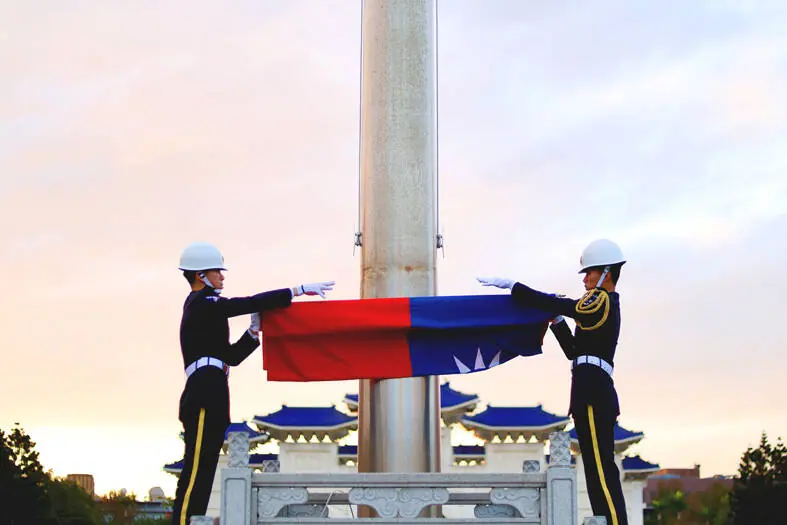
Honor guards fold the national flag during a flag-lowering ceremony in Taipei’s Liberty Square on Jan. 16.Photo: Ritchie B. Tongo, EPA-EFE
“Coercion and military buildup are mutually reinforcing components of Beijing’s dual-track strategy rather than alternative paths to unification,” it said.
China aims to weaken Taiwan’s resistance “through military and coast guard activity, cyber and information operations, economic leverage, lawfare and political influence while building capabilities to blockade or invade” the nation, it said.
China is also “intensifying its efforts to intimidate and coerce supporters of Taiwan’s autonomy, moving beyond symbolic legal threats toward more concrete efforts to punish opposition to Chinese malign influence and to deter support for Taiwan,” it said.
“Over the past year, Beijing introduced new legal authorities, launched criminal investigations and took public enforcement actions to intimidate a broader range of Taiwan officials, civil society leaders and public figures,” the report said.
While the report acknowledged Taiwan’s increased defense spending, military reforms, investments in resilience and enhanced cooperation with the US, it said that “significant vulnerabilities” remain.
Political divisions within Taiwan have slowed investments in defense, and nearly US$30 billion in approved US weapons had yet to be delivered as of August, it said.
Taiwan also depends heavily on imported energy, leaving it “particularly vulnerable” to a quarantine or blockade, scenarios that China is increasingly rehearsing, it added.
The near-term challenge for Taipei is not only to deter an invasion, but to better prepare itself for coercion that is designed to change the “status quo” without inciting war, the report said.
Taiwan is “indispensable” to the balance of power in the Indo-Pacific region, as well as to the US’ economic security and technological leadership, it said.
Taiwan’s central location in the First Island Chain and proximity to important maritime routes restricts China’s options, while enhancing the US’ access, capabilities and operational freedom in the Indo-Pacific, it added.
“A change in Taiwan’s status would alter the military balance in the western Pacific, test confidence in US alliances, and threaten critical technology supply chains,” it said.