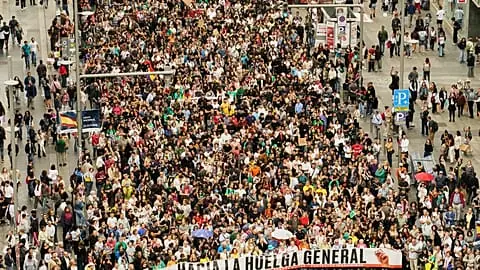
Public administration workers are holding a national strike this Friday, demanding better pay and working conditions. Health, education and justice are among the hardest hit sectors, with many public services likely to face disruption.
Public administration workers are staging a nationwide strike this Friday.
ADVERTISEMENTADVERTISEMENTIn Lisbon, the coordinator of the Frente Comum said this morning that the protest has been seeing strong participation since overnight and that the first effects can already be felt in areas such as health, education and rubbish collection.
In some of these services, such as hospitals, only minimum services are being provided. On the figures for education, Sebastião Santana said, quoted by the Lusa news agency, that "data are still being collected" but "many schools are closed across the country".
Also in the morning, the secretary general of FENPROF, José Feliciano Costa, said there was a "significant number of schools on strike", particularly in Greater Lisbon. "Today teachers will join the public sector strike also because they see their careers being devalued," the union leader told Lusa.
In health, more specifically in hospitals, Joana Bordalo e Sá, vice president of the National Federation of Doctors (FNAM), said that "minimum services are being rigorously complied with", with the greatest constraints affecting consultations and scheduled surgeries.
"This is a strike for patients and for the National Health Service. Ana Paula Martins [health minister] knows the chaos that is going on in healthcare and does nothing to solve it," she told reporters this morning.
The protest was called by the Frente Comum, affiliated to the CGTP, to demand better wages to keep up with inflation and cope with the cost of living. The union front is calling for a pay rise of no less than 15%, with a minimum increase of 150 euros for everyone, and is also advocating raising the basic pay in the public administration to 1,150 euros, with effect from 1 January.
Unions want to influence budget debate
In an interview with RTP, the coordinator of the Frente Comum accused the government of having no real will to negotiate.
"We are at the fourth round of negotiations and the government insists on not moving from its starting point," said Sebastião Santana, who cited the executive's proposal to increase the meal allowance as an example.
"The government proposed an increase of 15 cents compared with the first proposal it presented for the meal allowance, which is ridiculous." The union organisation is demanding a 13 euro increase in this area, stressing that the government's proposal would raise the current amount to 6.45%, falling far short of workers' demands who, according to Sebastião Santa, have some of the lowest wages in Europe and have been losing purchasing power "for more than a decade and a half".
The union leader also explained that the choice of date for the protest is intended to influence the budget debate.
"The strike is on the 20th and not on the 25th in order to influence the discussion of the State Budget," he said.
Go to accessibility shortcuts