
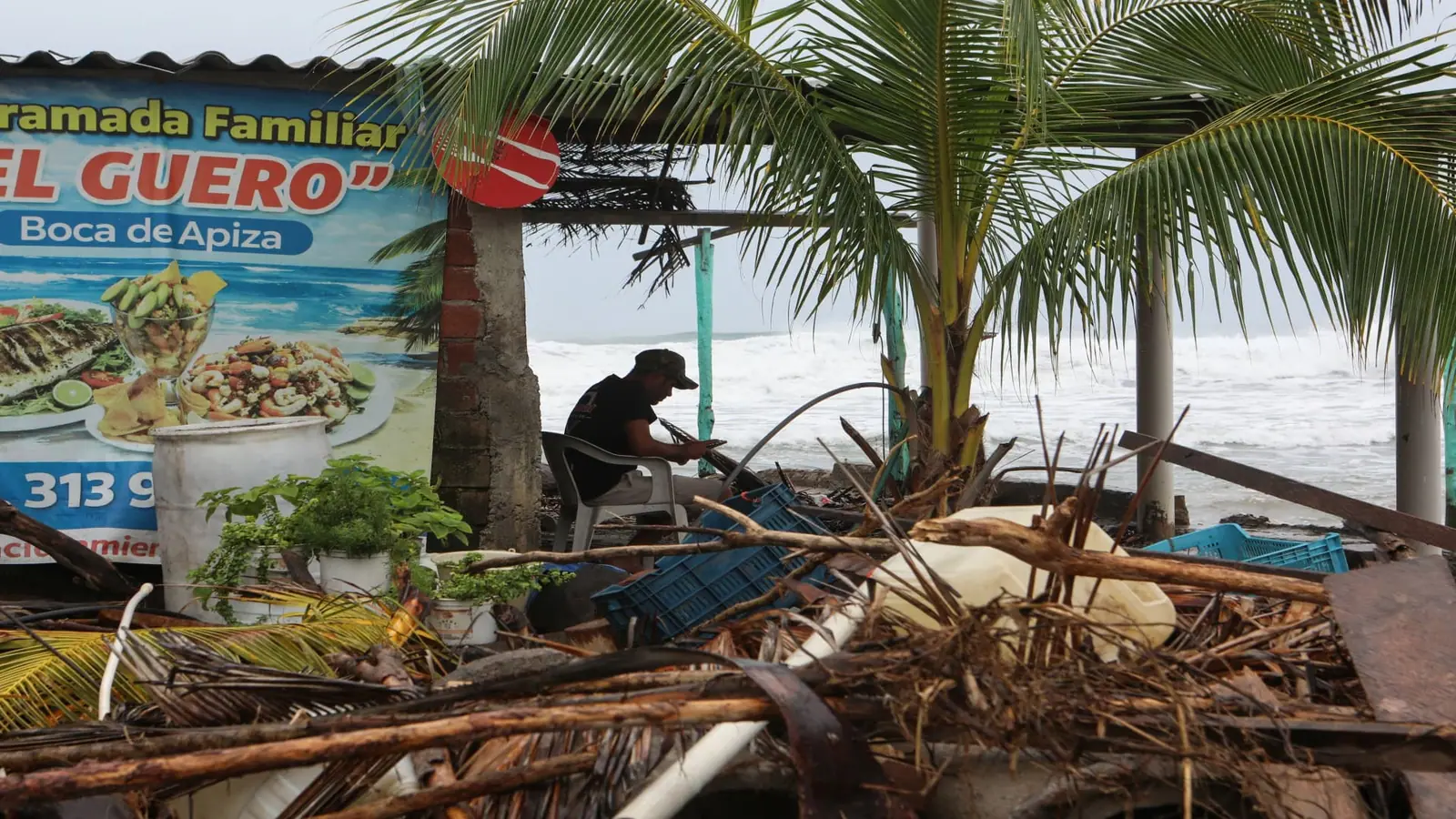
Hurricane Trudy lashed parts of Mexico's Pacific coast with heavy rain and strong winds Sunday as the U.S. National Hurricane Center warned of potentially life-threatening flooding and mudslides.
A hurricane warning remained in effect from Manzanillo, Colima, to Cabo Corrientes, Jalisco. The latest NHC data showed the Category 2 hurricane with maximum sustained winds of 105 mph (165 kph) moving northwest off Mexico's Pacific coast at 10 mph (17 kph).
Meanwhile, Typhoon Champi was moving away from Guam as a Category 4 super typhoon.
Trudy's center was expected to remain near the Mexican coast through Sunday evening before moving south of the Baja California Peninsula on Monday and Tuesday. A tropical storm warning remained in effect for Las Islas Marias. The warning for the coast east of Punta San Telmo to Lazaro Cardenas was discontinued.
The Mexican Navy urged mariners and coastal residents to exercise extreme caution because of high waves, heavy rain, and the risk of rising rivers, flooding, and landslides in vulnerable areas.
Colima authorities said risks remained low but warned that heavy rainfall could cause damage because successive storms had already saturated the ground along the Pacific coast.
Trudy was expected to bring 4-8 inches (10-20 centimeters) of rain through the weekend, with isolated totals of around 12 inches (30 centimeters) along and near the coast in Michoacan, Colima and Jalisco. The hurricane center warned of potentially life-threatening flooding and mudslides, especially in areas with steep terrain.
Also in the Pacific, Champi moved away from Guam on Sunday after passing near the island's southern tip, with sustained winds of 150 mph (240 kph). Late Sunday afternoon, it was 200 miles (320 kilometers) west of Guam, moving west at 14 mph (23 kph), according to the U.S. National Weather Service.
The storm was forecast to weaken through Monday but remain a major typhoon. All tropical cyclone watches and warnings for Guam, Rota, Tinian and Saipan had been canceled.
The governors of Guam and the Northern Mariana Islands requested emergency disaster declarations on Friday.
On Saturday, U.S. President Donald Trump approved an emergency declaration for Guam authorizing the Federal Emergency Management Agency to coordinate all federal disaster relief efforts. FEMA announced that federal disaster assistance was available for the territory of Guam to supplement local response efforts following Typhoon Champi.
Airports, harbors and some health facilities in the territories were closed. FEMA said resources were unlikely to reach the islands for three to five days, according to Saturday updates.
The territories are still recovering from super typhoons Sinlaku and Bavi, which struck in April and July, respectively.
Choose CNBC as your preferred source on Google and never miss a moment from the most trusted name in business news.