
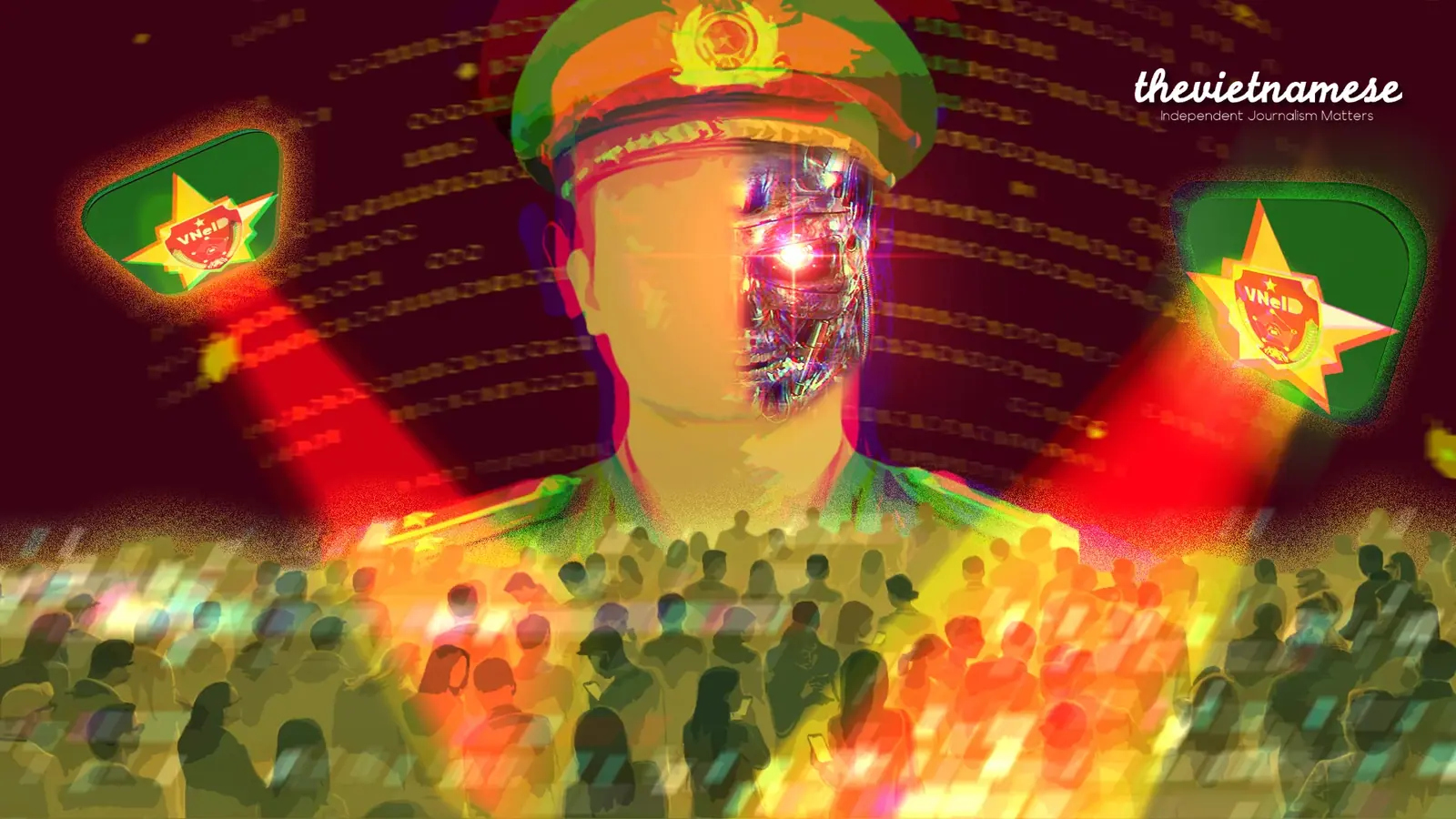
When a young man known as N.T.Đ. posted a satirical AI-generated image of a driver fainting at a petrol station to mock fluctuating fuel prices, the Hà Nội Police Cybersecurity Division reacted with swift, uncompromising urgency. Authorities immediately penalized him for spreading what they deemed false information.
On a much more sinister scale, state prosecutors sentenced dissidents Lê Trung Khoa and Nguyễn Văn Đài in absentia to 17 years in prison, accusing them of using AI deepfakes and voice synthesis to caricature ruling party leaders.
These are not isolated incidents of the government’s overreach. Reuters claims that an internal draft document from the Vietnamese Communist Party’s propaganda committee reveals preparations for a massive, coordinated digital offensive. By 2030, the state plans to assemble 1,000 social media influencers and 5,000 AI specialists to enforce “ideological immunity.”
The government’s goal is to use proprietary AI tools to remove at least 90% of non-compliant content within 24 hours, allowing the state to proactively “lead social discussion.” It is blatantly obvious that the Vietnamese state is not hesitating, debating, or wringing its hands over the ethics of artificial intelligence. Instead, it is actively weaponizing AI to guarantee regime survival.
Việt Nam’s digital governance has pivoted toward total control under party chief and President Tô Lâm, the former minister of public security who engineered an unprecedented expansion of the internal security apparatus. The 2025 Law on Artificial Intelligence, the amended Cybersecurity Law, the Personal Data Protection Law, and Penal Code Articles 117 and 331 collectively grant the authorities sweeping powers to penalize digital expression that critiques the single-party regime.
Simultaneously, Prime Ministerial Decision No. 940/QĐ-TTg mandates the expansion of the “VNeID” digital identity app—already covering over 67 million citizens—into an AI-powered surveillance super-app. According to a report from The Future of Free Speech—an independent, nonpartisan think tank—by linking biometrics, health records, banking history, private messaging, and public CCTV feeds to AI models, Việt Nam intends to establish real-time behavioral monitoring of their citizenry.
Legal scholars point out that many of these statutory provisions remain vague and that the state’s official AI strategies lack detailed technical frameworks or human rights safeguards. Yet, mistaking bureaucratic vagueness for operational weakness is a fatal error. As demonstrated by Tô Lâm’s relentless track record, where political will exists in Hà Nội, draconian enforcement inevitably follows.
In contrast to Việt Nam’s state-driven technological deployment, a global “AI resistance” movement has gained momentum across Western democracies and civil society organizations.
As detailed in a cover story by TIME, a broad cross-section of the American public—uniting Democratic socialists, conservative populists, environmentalists, and indigenous groups—has mobilized to halt the rapid expansion of artificial intelligence.
Local activists, state lawmakers like Wisconsin’s Francesca Hong, and indigenous leaders from the Muscogee Nation have successfully stalled over $98 billion in construction projects for data centers, citing soaring residential electricity rates, massive water consumption, noise pollution, and corporate greed. Meanwhile, creative worker unions stage 148-day strikes against job displacement, while digital artists deploy “data poisoning” techniques to deliberately sabotage machine learning models.
However, Vietnamese activists who engage in these moral debates over carbon footprints or the philosophical sanctity of human labor are indulging in a luxury they do not possess. The Politburo in Hà Nội does not hold public town halls, accept environmental impact lawsuits, or pause infrastructure projects for disgruntled citizens.
Data centers will be built, and state-backed surveillance models will be trained regardless of environmental degradation or moral philosophy. When a totalitarian regime commits to building a high-tech panopticon, refusing to adopt modern AI technology due to perceived moral superiority or a strict ethical code is suicide.
Pro-democracy advocates in Việt Nam must utilize AI to have any chance of success. As the Human Rights Foundation guide—AI for Activists: A Guide to Supercharging Your Movement with Artificial Intelligence—documents, AI drastically alters the power asymmetry between dictators and dissidents.
Furthermore, political scientist Erica Chenoweth demonstrated that nonviolent revolutions succeed when approximately 3.5% of a population is mobilized. AI tools drastically reduce the financial, technical, and logistical barriers to reaching this threshold.
Activists without formal engineering backgrounds can leverage “vibe coding“—a concept coined by Andrej Karpathy—to build custom digital tools through plain-text descriptions. This approach is already transforming global activism. Togolese activist Farida Nabourema used plain-language AI web builders to construct a digital museum for assassinated president Sylvanus Olympio. Venezuelan opposition leader Leopoldo López co-developed Ágora, a Bitcoin fundraising platform for global dissidents. Rwandan activist Anaïse Kanimba created Zuka, an open-source app allowing dissidents to publish securely under pseudonymous AI avatars.
To evade pervasive state surveillance, activists can run local AI models like Ollama or LM Studio entirely offline, ensuring that no data leaves their devices. Alternatively, they can also employ encrypted interfaces like Maple or Tinfoil, or use privacy proxies like PayPerQ and Routstr with censorship-resistant Bitcoin micro-payments.
Furthermore, personal AI agents, such as OpenClaw or Hermes, can assist with research, monitor state media, manage communications, or alert trusted networks if an activist is detained. This mirrors how Serbian democracy leader Srdja Popović trained his personal agent, “Molly,” on nonviolent strategic frameworks.
Artificial intelligence is not a fleeting trend, nor is it a novelty that civil society can politely ignore. Whether individual dissidents choose to learn and integrate these tools is ultimately a personal decision. However, maintaining an anti-AI stance is a fatal mistake when activists are confronted by an unyielding police state that has no qualms about abusing advanced technology to track, dox, fine, and imprison its critics.
Vietnamese activists must carefully consider the formidable adversary they face in cyberspace. If those fighting for freedom refuse to even touch the defining technology of the modern era, the state will happily use this very technology to ensure they never speak again.
References:
- Andrew R. Chow, “The AI Industry Faces a Bipartisan Grassroots Fight,” Time, Feb. 19, 2026,https://time.com/7377579/ai-data-centers-people-movement-cover/
- Can Şimşek, AI resistance: Who says no to AI and why?, Digital Society Blog, Aug. 18, 2025, https://www.hiig.de/en/ai-resistance/
- David Robson, “The ‘3.5% rule’: How a small minority can change the world,” BBC, May 14, 2019,https://www.bbc.com/future/article/20190513-it-only-takes-35-of-people-to-change-the-world
- Mai Phương, The 2026 AI Summit in India: Implications for Southeast Asia, The Vietnamese Magazine, March 20, 2026. https://thevietnamese.org/2026/03/the-2026-ai-summit-in-india-implications-for-southeast-asia/
- Phuong Nguyen and Francesco Guarascio, “Communist-run Vietnam eyes influencers, AI to spruce up propaganda, documents show,” Reuters, May 8, 2026, https://www.reuters.com/sustainability/society-equity/communist-run-vietnam-eyes-influencers-ai-spruce-up-propaganda-documents-show-2026-05-08/
- Thạch Hãn. “Hà Nội Police ‘Take Action’ Against Man for AI Image of Fainting at Gas Station, The Vietnamese Magazine, April 10, 2026, https://thevietnamese.org/2026/04/ha-noi-police-take-action-against-man-for-ai-image-of-fainting-at-gas-station/
- Trịnh Hữu Long. “Artificial Intelligence & Freedom of Expression in Vietnam.” That Violates My Policies: AI Laws, Chatbots, and The Future of Expression, Oct. 7, 2026. https://futurefreespeech.org/wp-content/uploads/2026/10/AI-Report-Chapter-Vietnam-CTF.pdf