By the time it’s 5pm on a Friday, the headache and dry eyes have well and truly settled in. Maybe it’s a long day in front of your four screens while funnelling white noise through a large pair of headphones to cancel out the calls of your co-workers. Or maybe it’s the almost chemical wash of white fluorescent lights that shine from the low ceiling in your open-plan office, or the feeling of enclosure as you look out the window on to the reflective walls of other towers.
To lift your spirits, you decide to treat yourself to a weekend at a beachside Airbnb.
But the town is not how you remember it as a kid. The farmland has been turned into identical housing estates broken up by highway-hugging shopping centres with the same Guzman, Woolies, Chemist Warehouse, Dan Murphy’s and Priceline as all the other shopping centres.
They’re not the only things that are samey. The cars in the car park are mostly white or grey, and stepping out of them, people are in near-identical athleisure or shorts and T-shirts.
The Airbnb is how it was depicted in the pictures (minimalist, fancy handwash in the bathroom, Anko soft furnishings) but there is something dispiriting about it. Just like the cars, the interior is grey and white, and it smells of surface cleaner. It’s a house devoid of colour, personality and character.
The beach itself is still beautiful, but coming out of the ocean you can’t remember where you left your towel. Every inch of sand is taken up with the same stripy Cool Cabana tents, rendering the visual landscape hectic and disorientating, as if you’d hit your head and were seeing double.
At the cafe (minimalist, blond wood, pot plants, $7 flat whites) you run into some people from school who you haven’t seen for ages. You can’t quite put your finger on it but they look different, weird almost. There’s something uncanny about their faces, with their foreheads smooth as a screen, their lips and cheeks plumped.
Looking around – with everyone wearing the same athleisure, staring into the same screens, drinking the same coffee, pouring it into the same-looking plastic faces – you wonder when did all this happen? Where did all the beauty go?
It’s difficult to believe we are lucky enough to be born on a blue, watery planet that is covered in flowers. And that on this planet everyone is a completely unique individual, all 8.3 billion of us, with our own specific way of expressing ourselves, our unique faces and bodies, our idiosyncrasies, desires, aversions and tastes.
Because right now we are stuck in a sea of sameness. Whether it’s the design of our offices, the interior of our houses (major paint brands like Dulux and Sherwin-Williams say grey is a top-searched and frequently used colour, with the Financial Times reporting that grey is chosen because it may result in better resale value) or the cars we drive. Modern life is becoming drabber, uglier, more uniform and a lot less pleasing to look at.
But there are signs of a resistance – with one of the most fascinating being discussions around the need for beauty.
The left are reawakening to the fact that fighting for better material conditions for all people extends to what was previously thought of as a frivolous or optional extra. But beauty – and the elevation of beauty – is central to the project of flourishing.
This is an ancient ideal, and its suppression by the powerful is equally old.
The Greeks had a concept that bound beauty, goodness and truth together as kalos kagathos, literally “beautiful and good”. In The Symposium, Socrates describes beauty as the thing that draws the soul upward towards truth, justice and the divine. Ugliness, in this framework, was not merely unpleasant, it was a form of moral disorder.
Throughout history, there have been times when beauty has been elevated (the Renaissance) and suppressed (the factory districts in the Industrial Revolution). And in times of suppression, movements have emerged such as the Arts and Crafts movement in the 1860s, aimed at restoring dignity to working people through the elevation of beautiful objects in their homes such as wallpaper, textiles and furniture.
We are living in a time where originality and beauty have been suppressed, where everything has become so frictionless and optimised (such as the grey homes optimised for resale, not for living in) that concerted efforts must be made to turn back towards beauty and individuality, even if it has no explicit market value.
The tipping point for me is the very devaluation of the role of human-made art, writing, music and design by the rise of machine-made art in the form of AI slop.
I can live (I guess … ) with the grey houses and the bland homewares, but not with removing humans from the creation of writing, art and beauty in favour of AI.
Suffragists, unionists and workers have long fought under the banner of bread and roses – that is, having basic biological needs met while also having access to the things that elevate the spirit and please the eye.
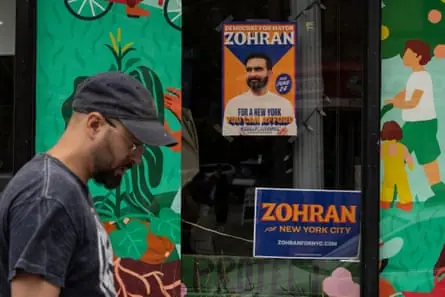
Now the project has some new energy. You see it in Zohran Mamdani’s New York (he used the campaign slogan of “Roti and Roses”) where there was bread in the form of a promise of freezing rents, but roses too.
Everything from the way his campaign posters, font and videos were designed – with an eye for pleasing human-made (in contrast with the Truth Social slop, such as Trump as Jesus ) – to policy decisions such as releasing 70,000 free Metropolitan Opera tickets, has at its core the importance of flourishing on all levels.
Beauty can be something we vote for, but it is also something that right now we must fight for – whether we advocate for the natural world, or better-planned communities and housing.
It is also something we co-create with the world. Beauty is not slavishly following trends but working out what you like, what makes you happy – and going with that.
It could mean a maximalist apartment where the walls are pink. Or it could be wearing colour when everyone else is in black. Or it could be nurturing pot plants in your office or helping with a community garden. Or maybe it’s creating your own art, or employing an artist or writer, rather than using AI.
Beauty made by humans (and in the case of nature, protected and nurtured by humans) is not just pleasing to the eye and the spirit, but it is a form of protest. A pushback against dehumanisation of our current age.