Key Takeaways
- Reliability layers sorted answers by trustworthiness but corrected almost none; yield, right answers over all records, exposes what accuracy hides.
- Deterministic code can prove an answer wrong, never right: it catches nonexistent codes and spans missing from the post, but plausible answers still need a model or a person.
- Recognition beats generation: recalling SNOMED codes from memory, the model invented 13 to 18 percent that don’t exist; picking from a menu, it scored ten times higher.
- Determinism held: four of five model families reproduced their output exactly at temperature zero; the fifth agreed on 70 percent of mentions across three runs.
- Detection sets a hard ceiling: no layer recovers a mention the extractor missed, so the largest gains came from matching the corpus’s annotation conventions, not domain-adapted models.
The theory: More layers should mean more accuracy
Clinical notes, incident reports, support tickets, and forum posts are prose, and a language model can read them. What it produces is not dependable. Ours was right about one answer in three on the task below and reported full confidence on two-thirds of its answers; wherever a wrong answer costs something, that is unusable.
We tested six layers, checks wrapped around the model, that each evaluate the model's output and flag what is wrong so that it can be put right: check each answer against something deterministic, send provable failures back to the model [1], sample it several times and vote [2], have a second model judge it [3], withhold what cannot be corroborated, and send the rest to a person. The theory we set out to test is that these layers are additive: each one catches errors the layers below it missed, so accuracy rises with every layer added. That assumption is what justifies stacking them at all. We ran all six on the same records, each priced, with the free check entered as a competitor. The theory did not hold. The layers sorted the answers by how far to trust them and corrected almost none.
Testing it needs a graded task, so we chose an annotated corpus: CADEC, the CSIRO Adverse Drug Event Corpus [4], 1,250 forum posts about two drugs, every adverse reaction marked as a span, the writer's exact words such as "rectal bleed", and given a SNOMED CT code. A gold answer for every mention lets us score each layer's verdicts instead of trusting them — and that assumes gold is the only right answer, which is not always true. Running one development document through the pipeline, the span "extremely sick" is gold-coded 213257006 |Generally unwell|; the model answered 39104002 |Illness| — an equally active, equally general reading that shares no wording with the span or with gold's own name. Naming either is a real answer; only one is scored correct. We did not build a CADEC system or tune for it: the aim was to evaluate open-weight models and measure how much each layer raises their accuracy, and CADEC is the instrument.
A supervised system does far better. CONORM [5], fine-tuned on 875 of CADEC's 1,250 files, reaches an end-to-end F1 of 0.72 under lenient span matching. Our zero-shot extractor, everything it returns, reaches 0.47 to 0.50 under the same matching on our development split, 0.39 to 0.43 span-exact. We are not competing with it: it needs those 875 annotated files, and still cannot say which of its answers to trust. Our held-out split was spent once: 60 documents, one run; every other number is development-side and says so. Two things would move the absolute numbers: the judge is small, and CADEC, public since 2015, is almost certainly in its training data. The comparisons between layers should hold.
The system under test: the model reads, the vocabulary knows
The model is never asked for a code, and everything above it depends on that choice.
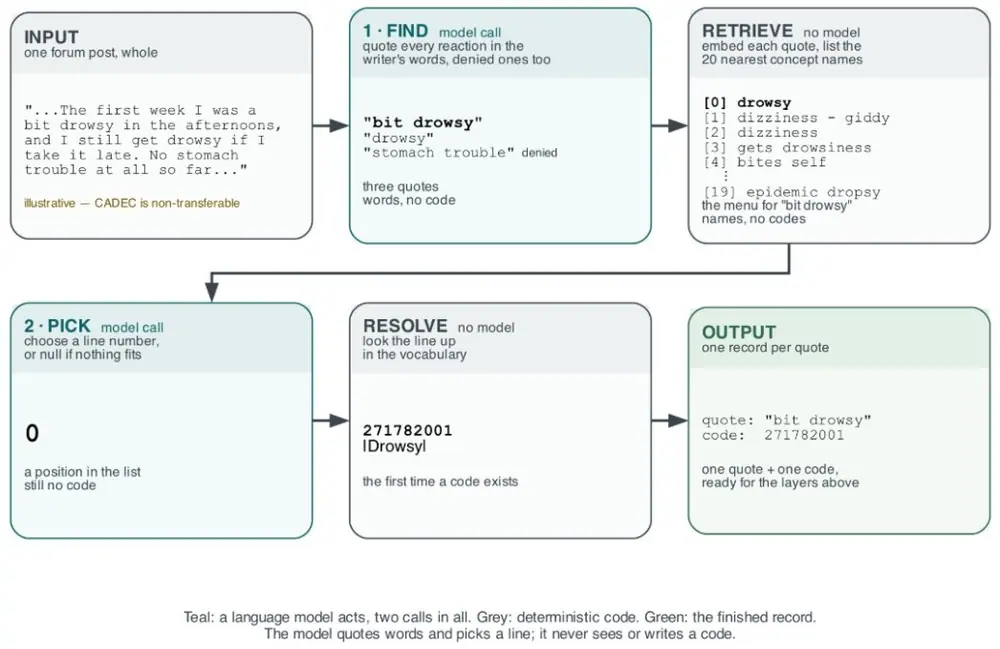
Figure 1: The pipeline, left to right, on one illustrative post (CADEC is non-transferable). Teal: a model call; grey: deterministic code. Each card shows what that step produces for the example; code appears for the first time in the last one. Image: the authors.
The model quotes each reaction; a retriever with no language model in it searches 227,554 keyword-to-code rows — every description in the SNOMED CT Australian edition of 31 July 2026 — embedding each quote with granite-embedding:30m, 384 dimensions, run locally, and showing the model a menu of the 20 nearest concepts to pick from. Codes are written as 271782001 |Drowsy|, SNOMED's bar notation, throughout.
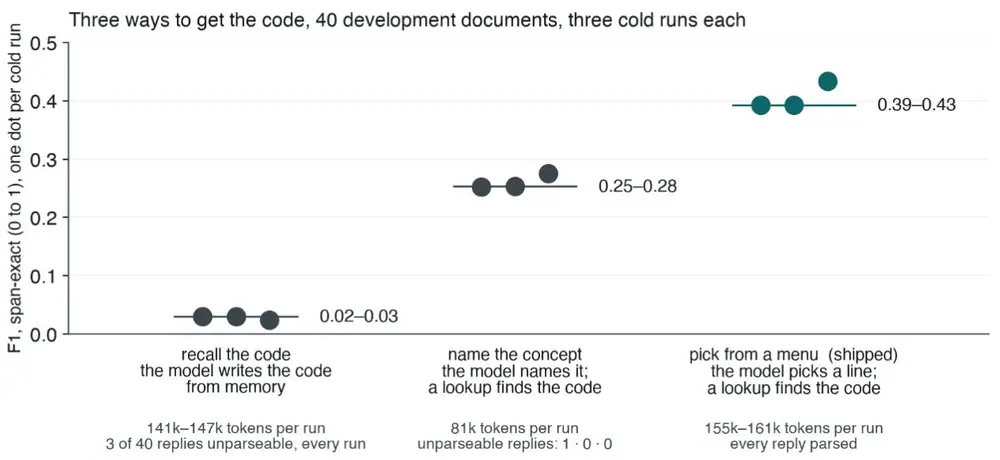
We chose this shape by measuring the alternatives on 40 development documents, three cold runs each: recall the code from memory, name the concept and look it up, or pick from the menu.
Figure 2: F1 of the extractor alone under three ways of getting the code, one dot per cold run, with tokens per run and unparseable replies beneath. Image: the authors.
Recalling the code is not weak but broken: eight to twelve times worse than naming the concept. It answered null on up to 38 percent of records, and of the codes it committed to, 13 to 18 percent exist in no SNOMED release.
F1 is span-exact throughout: a wrong boundary is both a false positive and a false negative.
That is the extractor the six layers sit on. Before measuring what a layer adds, we had to know how much its output moves between runs of the same inputs.
The noise floor: three runs of the same system
Three identical runs of the unchanged extractor differed by four points of F1, at temperature zero.
We ran the extraction step three times, cold, on the same 40 documents. Two runs were byte-identical. The third diverged and finished with 98 correct mentions against the pair's 87. Grouped by mention, the runs give 233 mentions:
| across the three runs | mentions |
| all three agree on span and code | 164 (70%) |
| same span, different code | 22 |
| same code, different span | 1 |
| span and code both differ | 10 |
| found by only two runs | 15 |
| found by only one run | 21 |
Where all three found the same span, they agreed on the code 84 percent of the time, so what moves between runs is mostly the reading, not the coding. We did not ask why those 22 were coded differently, and we should have.
The variation is a property of this model: four other families run three times each, llama3.1:8b, mistral:7b-instruct, qwen3:8b, and granite4:micro-h, returned byte-identical output every time. Our extractor, gpt-oss:20b, is the only mixture-of-experts model of the five and the only one that varied. Why, we could not settle: the diverging request, sent alone eight times, returns one reply; it moves only inside a full run. We kept it for its 6.5 extra points of F1 over llama3.1:8b.
From then on, every change was measured on three runs and reported as the range across them.
What each layer bought, and what it charged
The two free layers did their jobs: the vocabulary check sorted the answers, and refusal withheld the doubtful ones, and neither changed an answer. Of the three paid layers, self-correction almost never fired, voting did not help, and the judge worked, but nothing read its verdict.
Development split, three runs of 40 documents; figures below are ranges across the runs:
- Vocabulary check, 0 tokens. Did its job. It changes no answer; It gives each answer one of three verdicts. REJECT: the code does not exist, or the span is not in the post. 2714004, claimed as |Pale skin|, is in no SNOMED release. ACCEPT: the span's words match one of the vocabulary's own names. "chronic pain" matches |Chronic pain|. BAND: the span's words match none of the vocabulary's names, so the check has no evidence either way. "bit drowsy" against |Drowsy| happens to be right; "truck hit" against |Injury due to motor vehicle accident| is a fabricated finding — the check cannot tell the two apart.
- Self-correction, about 1,500 tokens. Barely exercised. It fires only on REJECT, restating the failure to the model as a fact ("code 999999 does not exist"). It fired two or three times per run and corrected nothing: unmeasured, not refuted.
- Voting, 411,000–432,000 tokens. Did not help. Three samples of the extractor, the majority wins. It changed about 27 codes a run, as many right-to-wrong as wrong-to-right: net −1 to +1, destroying 2 to 5 right answers. The voter is the answerer, so a vote carries no information that the answer lacked.
- Second-model judge, 84,000–88,000 tokens. Work once shown the menu; nothing read its verdict. A second, smaller model, 3.2B parameters against the extractor's 20B, is asked whether each answer is right. Shown only the span and a nine-digit code, it barely told right from wrong. Shown the menu the extractor chose from, it separates 3.4 to 4.2×, more sharply than the free check, and can say the right answer is not on this menu. No later layer reads its verdict.
- Refusal, 0 tokens. A guard, and it held. It passes answers that meet a chosen verdict and holds the rest for a person. On ACCEPT, our measured setting, 21 to 23 percent of records pass at 0.74 to 0.82 accuracy. A confidence threshold was tried and retired: the extractor's confidence is 1.0 on two-thirds of answers, right or wrong.
- A person. Not measured. What refusal holds back goes to a reviewer, whose decisions are corrections that a later model can be trained on.
Then we removed the three paid layers and replayed refusal: what it passed differed by one record on the first run and by none on the other two.
Voting and the judge's verdicts are good for diagnosis, not repair: a split vote marks an answer the model cannot reproduce, and a judge answering not on this menu marks a failed menu, not a failed pick. We did not use them that way, and should have.
Layers withhold; they don't add
One dial, not a staircase.
Every verdict carries information. None makes the system produce more right answers, and they do not stack.
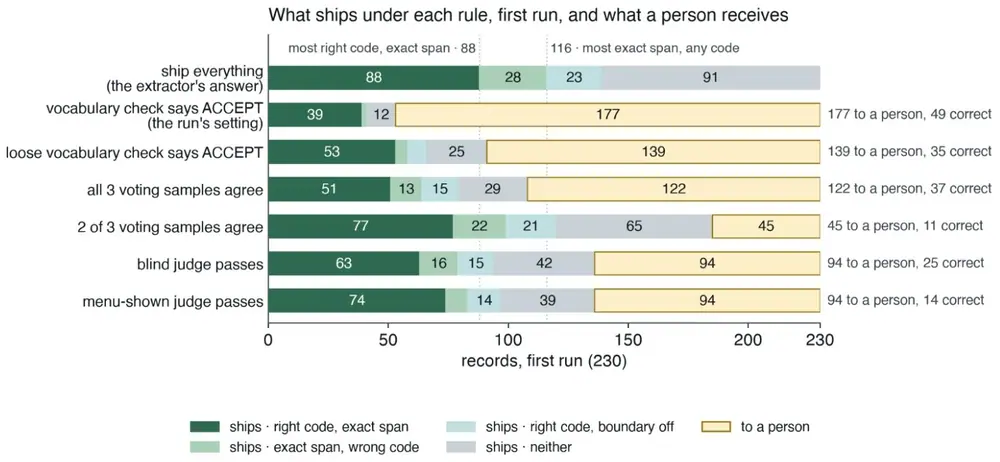
Figure 3: The first run's 230 records under each shipping rule. Dark green: right code on the exact span; light green: exact span, wrong code; light teal: right code, boundary off; grey: neither; amber: to a person. Dotted lines: the most the extractor found. Image: the authors.
Figure 3 reads each verdict as a shipping rule over the same 230 records. Three things hold.
First, any verdict raises the accuracy of what passes, because withholding is a layer's only lever. No rule ships more than the 88 right answers the extractor found, so every gain in accuracy is paid for in right answers held back. Accuracy alone flatters any withholding layer. Yield, right answers as a share of all records, cannot be flattered, so we report both.
Second, the price differs by verdict. ACCEPT is the most precise rule and the most expensive: moving to it removes 128 errors at the cost of 49 right answers and 177 records for a person, because the check can endorse only 32 percent of mentions whose wording matches the vocabulary. The menu-shown judge's verdict is informed rather than lexical, and it is the one rule whose F1 beats shipping everything, 0.420 against 0.397.
Third, the verdicts nest rather than add. Nearly everything the free check endorses, the judge endorses too, so a second verdict mostly confirms the first and can only remove records, never recover one the first held back; that is why removing the paid layers changed one record. Where every verdict agrees, the answers are almost all right; where only a vote does, almost all wrong. Each verdict is a different trade between errors, lost answers, and reviews; we recommend none.
The held-out split, run once, tells the same story. Before any check, one answer in three was right. Of those, the vocabulary check marked ACCEPT, five in six were right; of the rest, one in five. The check changed no answer; it only sorted them.
Where the model loses
The domain knowledge was never missing. The model loses at reading, and nothing above it can see what it did not read.
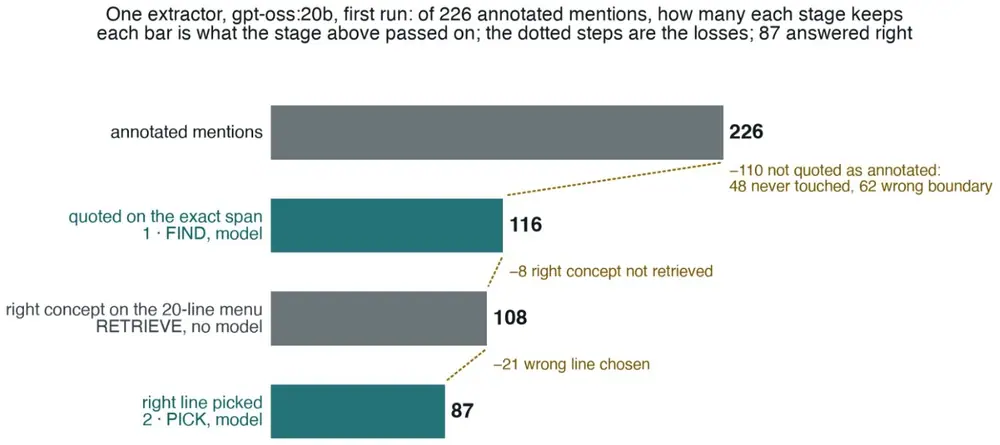
Figure 4: Where the development split's 226 annotated mentions go through the shipped extractor, gpt-oss:20b, first run. Each bar is what the stage above kept; the dotted steps are what each stage lost. Teal: a model call; grey: deterministic code. Image: the authors.
Once a mention is found, the pipeline is reliable: the right concept reaches the menu for 93 percent of found spans and the model picks it 81 percent of the time. The loss is at finding. Nearly half the annotated mentions are never quoted as the annotators marked them, and none of the reasons are medical: single words go untouched where the annotator marked them, boundaries stretch — an extra adjective swept into a span the annotator left bare — and figures of speech are read literally, an idiom for exasperation coded as a nocturnal behaviour. Two domain-adapted models did not help: BioMistral-7B could not reliably return a parseable reply, and SapBERT as the retriever's encoder improved the menu and worsened the answer. A worked example and a denied-reactions rule did.
No layer can add a mention. Every layer above the extractor checks, re-asks, votes on, judges, or withholds an answer the extractor already gave; none can find a mention it missed. So the most any stack can ever get right is what the extractor found in the first place: on the held-out split, just over half the annotated mentions, a detection F1 of 0.521. The one way past that ceiling is a second reader: a different model family shown the post and the first model's spans, asked what was missed. We did not build it. Its additions would be proposals, needing the same measurement as the extractor's.
Does it hold beyond CADEC?
Four of the five lessons were held on other data. What changed is where the model loses, and where the free check can be trusted.
Seven further corpora [6–10], five model families; for each lesson, does the data agree?
- Layers sort; they do not fix. I agree. On PsyTAR, the paid layers changed nothing in any run.
- Start with the free check. Holds where the vocabulary's names are evidence and reverses where they are not. Clinical vocabularies behave as SNOMED did — the endorsed lane is right 76 to 100 percent of the time across five model families. Gazetteers do not: a place name matches the vocabulary and is still the wrong place, and the same lane is right 7 to 26 percent. On financial tag names, it never fires.
- Ask the model to read, never to remember. Not re-tested; every corpus used the menu.
- Make repeat runs a validation step. I agree. Every other family repeated itself exactly; our extractor's one instability elsewhere was refusing a document on one run of three.
- Study the data before adding layers. Agreed, with a change: where the model loses is not the same everywhere. On CADEC, it loses at reading; on the financial corpus, it reads well and coded badly, and its worst error was a habit, picking the menu's first line, not a gap in domain knowledge.
Two more findings met the same test:
- Self-correction barely fires. Sharpened. On PsyTAR, the check wrongly rejects some right codes in the answer key, so self-correction had work; it fired zero times, because the check never rejects what the model actually writes.
- A fact recorded once will be wrong silently. Repeated. Seventeen matrix cells ran with the wrong prompt or the wrong model, caught only because each run also saved the configuration it received.
The judge, the nesting of verdicts, and the diagnostic use of split votes were measured on CADEC only.
Defects between the layers, and inside the metric
Every layer passed its own tests. The two defects that mattered sat between the layers and inside the metric.
The first was the unread verdicts. The second was the metric: voting overwrote codes without re-running the vocabulary check, so records shipped marked verified for a code they no longer held. Fixing that moved the held-out F1 from 0.204 to 0.204, because precision and recall cannot tell an unwarranted answer from a wrong one. We built six layers to decide which answers to trust, then scored them with a metric that cannot see the difference.
Both defects share a shape: a load-bearing fact recorded once, so nothing could disagree with it. Three checks built from that lesson, gatecheck, crosscheck and stagecheck, are reached from the repository below; stagecheck is a standalone package with no dependencies.
Six practices that transfer
What transfers is not the layers but six practices, each earned above.
- Read the data before you add a layer. Our two largest gains were a worked example in the corpus's conventions and a rule for denied reactions; no layer and no domain model were supplied either.
- Never ask the model for an identifier. Have it quote and pick; let a lookup produce the code. Asked to recall codes, it invented them 13 to 18 percent of the time and scored ten times worse.
- Anchor confidence in something that does not resample: a vocabulary, a schema, a compiler. Test it on the answer key, where every rejection is false by construction, and on your own vocabulary, where it may reverse.
- Measure your floor before any improvement. Three runs minimum, reported as a range, and decide in advance what difference you will accept.
- Treat disagreement as a to-do list. A split vote, a judge's not on this menu, a mention coded differently on a repeat run: each marks where the task is underspecified. Read them offline; do not pay for them online.
- Find the reader of every field a layer writes, and check your metric can see the defect you prevent. A forty-line search found three verdicts nothing read; yield beside accuracy shows what a withholding layer hides.
We set out believing that stacking reliability layers buys reliability. Measured end to end, they sorted the answers by how far to trust them and fixed almost none: worth a great deal, and not what we bought them for. The model reads. Almost everything else belongs to code, and one choice to you.
Code, ledger, decision records, and every figure's source. CADEC is non-transferable; we ship document IDs, never text.
References
- Madaan et al., Self-Refine: Iterative Refinement with Self-Feedback, 2023.
- Wang et al., Self-Consistency Improves Chain of Thought Reasoning in Language Models, 2022.
- Zheng et al., Judging LLM-as-a-Judge with MT-Bench and Chatbot Arena, 2023.
- Karimi, Metke-Jimenez, Kemp and Wang, Cadec: A corpus of adverse drug event annotations, Journal of Biomedical Informatics 55, 2015.
- Yazdani, Rouhizadeh, Bornet, and Teodoro, Context-Aware Entity Normalization for Adverse Drug Event Detection (CONORM), medRxiv 2023.
- Gritta, Pilehvar and Collier, A Pragmatic Guide to Geoparsing Evaluation, Language Resources and Evaluation, 2020. — GeoWebNews, LGL and TR-News all ship here.
- Loukas et al., FiNER: Financial Numeric Entity Recognition for XBRL Tagging, ACL 2022.