
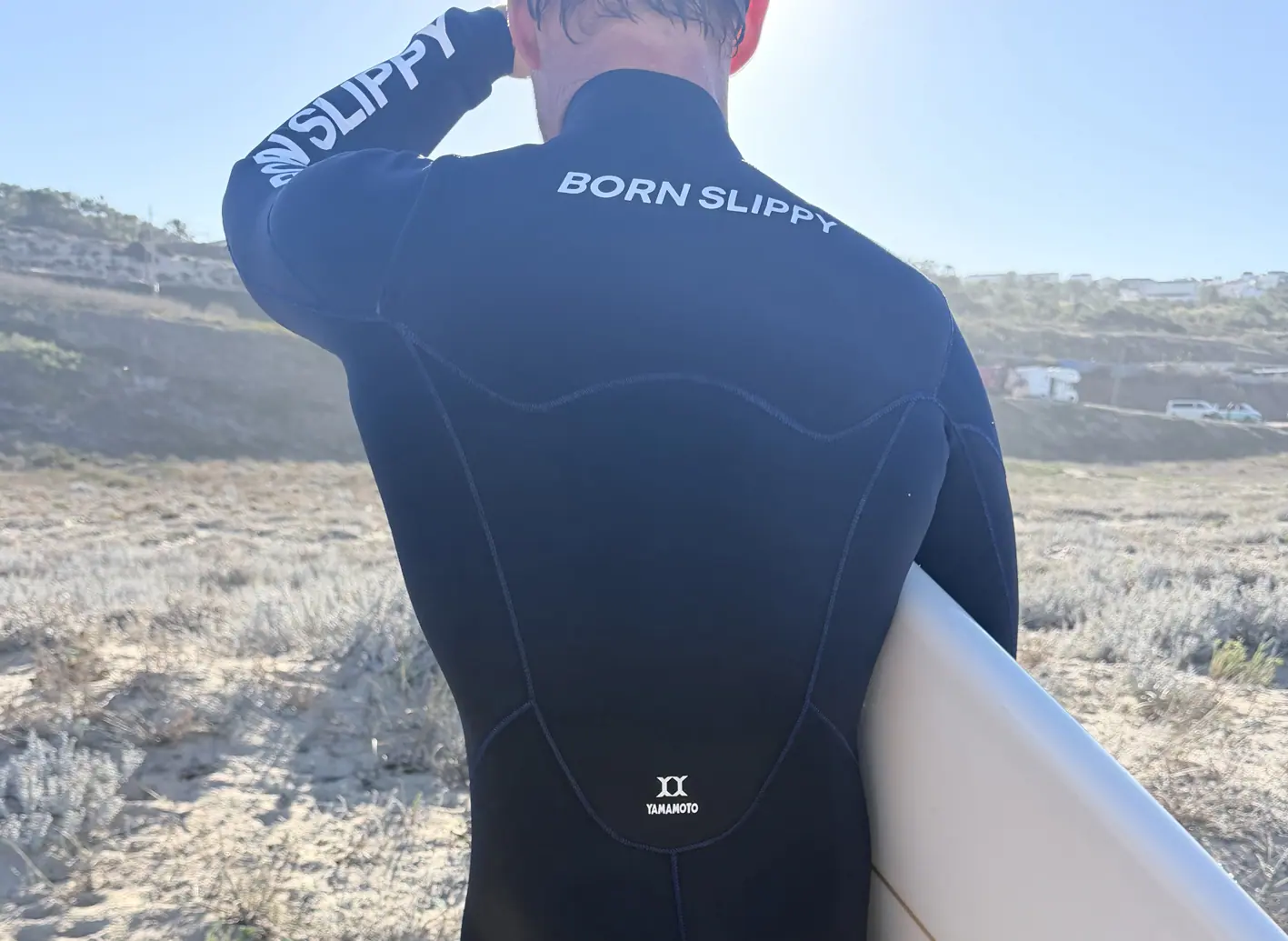
Production will be restricted to 1,000 individually numbered suits worldwide, each manufactured to order.
11th November 2026
Innovation in Textiles
| Valencia, Spain
A new made-to-measure wetsuit developed with British big-wave surfer Andrew Cotton uses micro-chamber insulation technology in place of conventional fleece linings, in an attempt to improve thermal performance without adding bulk.
The Aptus 1.0 wetsuit has been developed by Born Slippy, a new technical watersports brand founded by British entrepreneur Charles Gadsdon, who is based in Valencia, Spain.
Combining Japanese Yamamoto neoprene with an engineered micro-chamber insulation structure incorporated into the torso panels, the suit has been designed to address the competing requirements of warmth, flexibility and fit in cold-water surfing.
Conventional wetsuits rely on the insulating properties of neoprene, with additional thermal linings increasingly used to improve warmth. These extra layers, however, can add bulk and potentially restrict freedom of movement.
Born Slippy’s alternative approach employs a micro-chamber structure designed to retain warmth around the chest and back without requiring a conventional fleece lining.
The company has combined this construction with Yamamoto limestone-based neoprene, selected for its flexibility and thermal properties.
The wetsuit also incorporates glued, blindstitched and triple-taped seams to limit water ingress and improve durability under demanding surfing conditions.
Individual fit
A second distinguishing feature is the use of individual body measurements rather than conventional standard sizing.
Each Aptus 1.0 wetsuit is manufactured to order using 26 measurements to create a personalised pattern, with the objective of minimising gaps between the suit and the wearer’s body.
Fit is particularly important to wetsuit thermal performance because excess space can allow cold water to circulate between the neoprene and the skin, reducing the effectiveness of the insulation.
Andrew Cotton, who is a founding athlete and partner in the business, tested prototypes at Croyde Bay in North Devon and subsequently at Nazaré in Portugal, one of the world’s most demanding big-wave surfing locations.
He has extensive experience of extreme surfing conditions, having ridden a wave estimated at 80 feet at Nazaré in 2014 and suffered a serious back injury there in 2017.
His feedback on thermal performance, flexibility, fit and construction has been incorporated into the development of the wetsuit.
“The warmth provided by the new construction around the chest and back is particularly noticeable compared with conventional fleece-lined wetsuits,” he says. “The custom fit is incredible and the Yamamoto neoprene feels like cashmere against your skin.”
Limited production
Born Slippy is positioning Aptus 1.0 at the premium end of the technical wetsuit market, with a retail price of €1,295.
Production will be restricted to 1,000 individually numbered suits worldwide, each manufactured to order, after which the company says the model will be permanently discontinued.
The company describes this approach as a commitment to quality and controlled production rather than volume manufacturing.
Each wetsuit will also carry a serial number and security code linked to an individual Digital Product Passport containing details of its materials, specifications, care requirements, warranty and authenticity.