
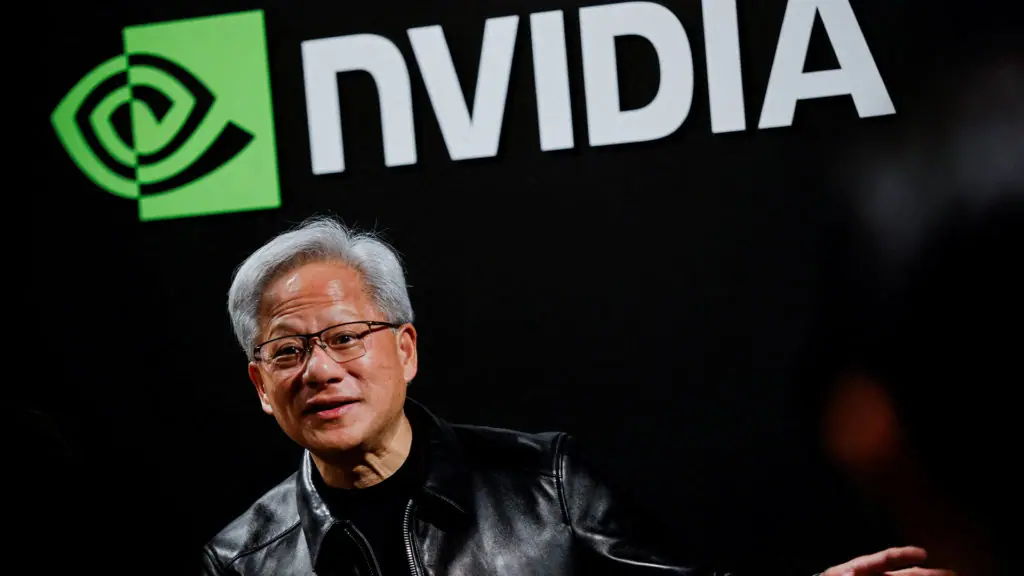
Nvidia CEO Jensen Huang announced his resignation after it was reported that he had an affair with a businesswoman accused of being a Chinese spy and an extramarital relationship with an Nvidia executive. Huang's departure has sparked questions about the future of Nvidia, the AI industry and U.S. national security. Amna Nawaz discussed the latest with Dmitri Alperovitch and Stephen Witt.
Notice: Transcripts are machine and human generated and lightly edited for accuracy. They may contain errors.
Geoff Bennett:
Welcome to the NewsHour. We begin tonight with the shakeup at the center of the artificial intelligence industry. Nvidia CEO Jensen Huang announced his resignation after it was reported that he had an affair with a businesswoman accused of being a Chinese spy and also had an extramarital relationship with an Nvidia executive.
Amna Nawaz:
Lawmakers are now calling for investigations into the company and into Huang's relationship with President Trump. Huang's departure has sparked a number of questions about the future of Nvidia, the AI industry, and U.S. national security when it comes to restricting China's access to the most powerful chips.
For more on this, we're joined now by Dmitri Alperovitch. He co-founded and was Chief Technology Officer of the cybersecurity firm CrowdStrike. He's now co-founder and chairman of Silverado Policy Accelerator. That's a Washington DC think tank.
We're also joined by Stephen Witt. He's an investigative journalist and author of the book "The Thinking Machine, Jensen Huang, Nvidia, and the World's Most Coveted Microchip". Welcome to you both.
Dmitri, I'll start with you. After the flurry of revelations and headlines of the last few days, is there any circumstance under which Jensen Huang could have or should have stayed on at Nvidia?
Dmitri Alperovitch:
I don't think so. And look, Amna, the board had to act here immediately because of the revelations with these affairs, particularly the affair with a person that was in the direct chain of command for Jensen Huang. As a public board, you cannot have a situation when an executive is having these types of situations. We've seen this before at Intel. We've seen it at McDonald's where the executives that had these these circumstances had to resign.
But the broader issue here is not about what Jensen Huang is doing in his bedroom. The broader issue is the potential illegality that has occurred here with the smuggling of these chips to China, perhaps one of the most valuable resources, the critical thing that keeps China behind U.S. frontier models in the most important technology of the day, which is AI.
Amna Nawaz:
I want to get to the national security issues around that as well. But Steven, let's get your take on this. Is it immediately clear who might step up Nvidia and and what's the broader impact that we could see here given what a huge player this one company is in the entire AI industry?
Stephen Witt:
Yeah, it's not clear at all. I mean the video's corporate org structure had Jensen at the top and then no second layer of command and then like 60 people below him. You know whoever manages Nvidia for the long term and this is the challenge they have to be a world class computer scientist which is what Jensen was. They can't just be a classic business person with an MBA.
They have to understand computers from the level of the transistor scaling up all the way to the data center. They have to understand every part of that. You know Jensen could do that. He could also scream at his suppliers in Taiwan when they were late and he could sign these mega deals that were difficult for other CEOs to get.
You know Jensen has great handwriting and he could take his equipment and draw by hand an exploded diagram of what it looked like when you took every part apart and you know how much every part cost and you know how every part was coming from where it could be improved. It's going to be hard to find someone with that kind of level of mental acuity and and drive again. So Nvidia is facing a real problem here. That is great though for its competitors who all went up in the stock market today.
Broadcom one of the makers of of alternative chips to Nvidia went up. AMD maybe their chief rival over the last 20 years went up. I's good for Google who's manufacturing and selling another kind of Nvidia alternative. It's possible that the ecosystem of how we build AI will change now. In fact that seems likely to me.
Nvidia for a long time sort of had the absolute throne. They were the king. Now that that that empire is shattered and all of these people are going to rush in and try and take that spot.
Amna Nawaz:
So Dimitri let's get to some of those other concerns that you raised also the questions right now unanswered. As we pointed out one of Huang's affairs is with an alleged Chinese spy, a woman named Alice Huang. She also led the Singapore based company MegaSpeed. MegaSpeed faced allegations last year it was buying Nvidia chips and then illicitly shipping them into China. What are the bigger concerns here about what we don't yet know?
Dmitri Alperovitch:
Well, we have export control regulations and laws on the books that are designed to prevent this cutting edge compute from going to China. Akin to what we did with the Soviet Union, we were not selling supercomputers to the Soviet Union for the same reasons. And the fact that it is now very clear the Chinese have been able to acquire billions of dollars of compute from Mega Speed, but also from these other shell companies. Some of them Alice had been involved in, but also other Chinese nationals that have stood them up. And it was very clear to everyone, by the way, that these were shell companies that had no business. They popped up out of nowhere and placing orders for billions of dollars, setting up data centers in Malaysia, talking about the fact that they had customers like Alibaba in China. And in fact, New York Times last year did an investigation into megaspeed specifically. So the only people that didn't seem to know that Mega Speed is an illicit actor here were Jensen Huang and Nvidia and the Commerce Department.
Amna Nawaz:
To follow up on that, talk about this new reporting that was out today that the Commerce Secretary Howard Lutnick allegedly resisted cracking down on Megaspeed. Is there a sense that there were red flags missed here or ignored?
Dmitri Alperovitch:
I think that this is going to be a key part of the investigation going forward, particularly in Congress as the Democrats take over. What did Howard Lutnick and others in the Commerce Department know and when did they know it? Because there's a lot of allegations here. On Monday, there was a report from Bloomberg and New York Times that Nvidia was calling officials at the Commerce Department trying to stop an investigation to megaspeed. Highly inappropriate, maybe even illegal. So a lot of murky activities here.
Amna Nawaz:
Steven, weigh in on this and what Dimitri just had to say about the concerns about those sales or the chips making their way into China and what lawmakers need to ask now.
Stephen Witt:
Yeah, I mean, this this was not a secret as he says. You know, this went back to 2024 to 2023. It was very obvious, honestly, and almost an open secret that these Malaysian entities are really being used as cutouts to get the chips either to Chinese developers remotely, or, as it turns out, just kind of shipping them in the front door, repackaging, and shipping them out the back into China which seems to be what's happening. So there was just this is smuggling, right? There was a lot of smuggling going on. And and when that happens often the CEO will be a little insulated from kind of the the rule breaking down down down the line. In this case, the CEO Jensen was having an affair with the chief smuggler and almost quite openly too. So there was this sense I think that when they came to Asia, the rules didn't apply for them. The US rules didn't apply that it was kind of a wild west and they could do what they wanted and and nobody cared. I don't I don't think that that is going to hold now. The Singaporean authorities are upset. They actually held Ms. Wong's passport for some time. They were looking into us and they say they didn't get cooperation from the US government. Commerce was looking at this under Biden, but then when when Trump came in it seems like kind of that that investigation died down. So there's there's kind of looks like there's a little influence peddling as well. It's all very bad for for for Jensen. This could this could really blow up in his face.
Amna Nawaz:
Dmitri, I'll give you the last word here in a minute or so we have left based on the way the information has come out day after day. Do you get a sense that there could be more to come?
Dmitri Alperovitch:
I'm certain there is more and I think that what can come out is the extent of his relationships with the Chinese. Look, he's made some very troubling statements about the fact that China is not an enemy. By the way, this is a country that is building a military to kill American forces and and and fight us in the Pacific, has been stealing our intellectual property, decimating industrial base. Very strange statement to make, certainly not one that most people in this town would agree with on the Democratic side or Republican side. He's been fighting all these regulations that prevented him from exporting chips to China. I think that he's going to be in the hot seat for one time and let's see there could be even potentially criminal allegations here that he's going to have to face.
Amna Nawaz:
A lot we don't yet know, but thank you so much to both of you for your insights, Dmitri Alperovitch and Stephen Witt. Thank you.