
WORRYING RESULTS: The results of the study reveal that there are limits to animals’ ability to adjust in response to environmental changes, such as with climate change
- By Rachel Lin and Jonathan Chin / Staff reporter, with staff writer
Instead of digging deeper to shield their offspring from rising temperatures, burying beetles exposed to heat bury food for their larvae closer to the surface, a National Taiwan University (NTU) study has found.
The counterintuitive behavior suggests that some species might struggle to adapt to climate change because protective measures carry a high physical cost, the university said.
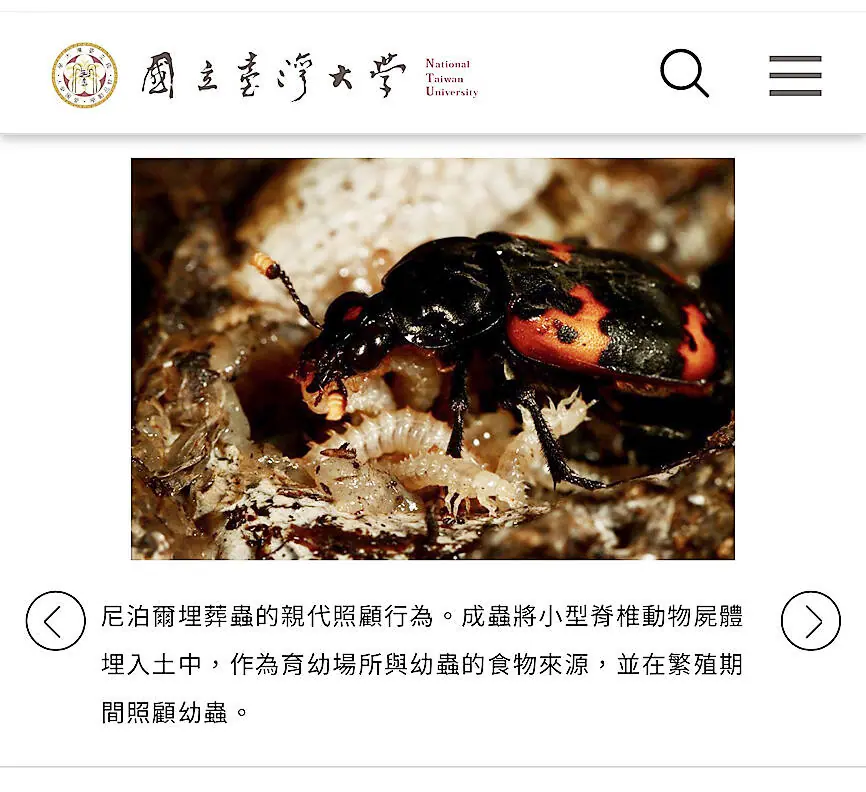
A team led by NTU associate professor Sun Syuan-jyun (孫烜駿) studied Nicrophorus nepalensis, which buries small vertebrate carcasses underground to feed its larvae. The beetles show a degree of parental care rare among insects.
A burying beetle featured in an NTU study is pictured in an undated photo.Photo: Screen grab from National Taiwan University’s Web site
Previous research showed that a 4°C temperature rise could impair reproduction and sometimes kill entire broods. The team examined whether the beetles would respond by digging deeper, where soil remains cooler.
In laboratory experiments using heat lamps to simulate sunlight, heat-exposed beetles buried carcasses an average of 4.3cm closer to the surface than beetles under cooler conditions.
Females that dug deeper in the heated experiments produced larger broods with heavier larvae than those that buried carcasses at shallower depths. However, they also lost more body mass, suggesting greater energy expenditure.
Although the researchers could not conclusively explain the shallower burials, they suggested that the energy needed to dig deeper might outweigh the reproductive benefits.
The results highlight limits to behavioral plasticity — animals’ ability to adjust their behavior in response to environmental changes — as a means of coping with climate change, the university said.
Published on Oct. 26 in Biodiversity, the study was funded by the National Science and Technology Council, the Ministry of Education and NTU. The Ministry of Agriculture’s Forestry and Nature Conservation Agency and Fushan Botanical Garden provided permits to collect beetles.