Tussle for influence as trade, tech and regional security to take centre stage in China, Philippines and Cambodia meetings
The global political centre of gravity will be firmly in Asia this week as world leaders fly in for back-to-back high-level summits against the backdrop of the tussle for influence between the superpowers China and the US.
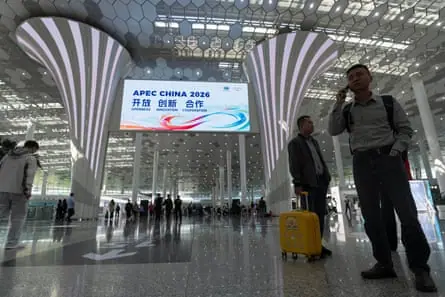
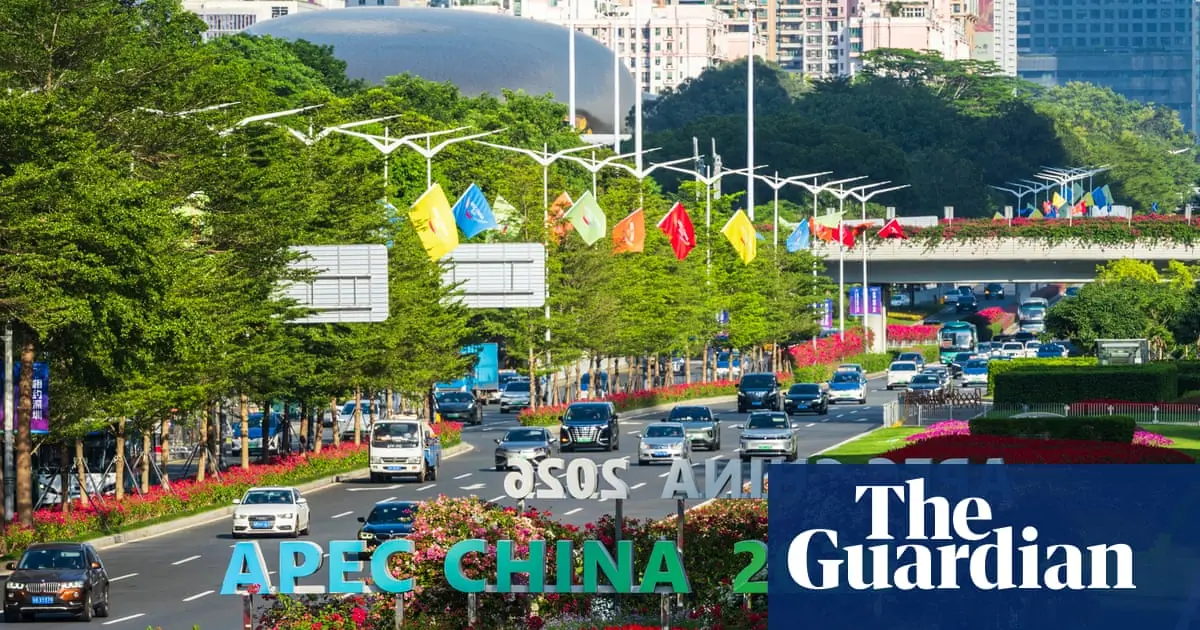
Beijing will have the home advantage when it welcomes Donald Trump to its southern technology hub of Shenzhen for the Asia-Pacific Economic Cooperation (Apec) leaders’ meeting. It starts two weeks after the US leader lost midterm elections.
The summit also comes after an awkward-at-best revelation that the head of Nvidia, the US chipmaker that for a long time was the world’s most valuable company, was having an affair with a woman US intelligence suspects was a Chinese spy.
Apec represents more than 60% of global GDP and has primarily promoted free trade and multilateralism. This year’s meeting could be defined, however, by theconfirmed trilateral meeting between Trump, the Chinese president, Xi Jinping, and Vladimir Putin of Russia.
The three-way meeting has been likened to a modern-day Yalta, when in 1945 then US president, Franklin D Roosevelt, Britain’s Winston Churchill and the Soviet leader Joseph Stalin met in Crimea to carve up Europe after the second world war. However, analysts say a “Yalta 2.0” that issues edicts on Ukraine and Taiwan without their involvement is unlikely.
Xiaoyu Pu, an associate professor at the University of Nevada’s department of political science, said a three-way meeting “might be more symbolic than substantive, although symbolism itself matters in great-power diplomacy.
“Trump appears interested in nuclear arms control and denuclearisation. Xi’s priority is likely to maintain a stable relationship with Washington while preserving China’s strategic partnership with Russia. Putin, meanwhile, wants to maintain his bargaining leverage over Ukraine.”
Apec begins on Wednesday and follows a flurry of other diplomatic gatherings, chief among them the Association of Southeast Asian Nations (Asean) meeting in the Philippines, starting on Sunday, which Trump will attend.
While he is in Manila, US officials will hold a sidelines meeting of the so-called Quad – Australia, India, Japan and the US. In addition, a Francophone summit, which includes the Canadian prime minister, Mark Carney, and the French president, Emmanuel Macron, is happening concurrently in Cambodia.
Critical global issues at all these summits will include AI supply chains and governance, tariff reductions and the green energy transition. Trump’s focus has been on denuclearisation. A key regional focus will be on the South China Sea, where Beijing has built massive military outposts in disputed waters, as well as the gigantic Indonesian forest fire haze blanketing the region.
The humanitarian and security crisis in Myanmar has become a perennial issue, as is status of Taiwan, which China does not recognise. The self-ruled island is sending the founder of the tech hardware company Acer as its envoy to Apec.
Global pivots towards Asia
For well over a decade, Washington’s engagement in the region has been coloured by concern over the rise of China, with the then president Barack Obama telling Australia’s parliament in 2011 that the US was “a Pacific power, and we are here to stay” – a policy known as the “pivot to Asia”.
The strategy of intense diplomacy and trade deals was adopted by Joe Biden, who hoped to gather allies on the continent who wanted to balance their relationships with both superpowers.
Some analysts see Trump’s transactional style in Asia as a continuation of the pivot policy. Still, the president’s volatility and unpredictability have spooked smaller nations, who regard China as a more predictable partner.
Jayant Menon, an economist at Singapore’s Iseas-Yusof Ishak Institute, said that countries in south-east Asia had been “laying the groundwork for a future with reduced dependence on the United States” by seeking deals elsewhere, including with each other and the EU.
“Amid persistent uncertainty and an administration determined to levy tariffs by any legal means, south-east Asia’s ability to ride out another round of tariffs depends on deeper regional integration and diversification beyond the US market,” he wrote this month in the East Asia Forum.
Beijing’s more predictable policies do not necessarily make it any more palatable for its regional neighbours, however, and the Chinese premier, Li Qiang, could have tough talks when he goes to Manila for the Asean summit, especially on the South China Sea.
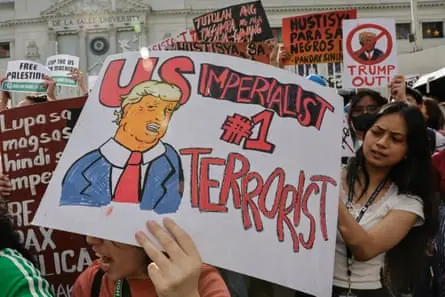
China’s top diplomat, Wang Yi, recently urged Manila to rein in Filipino politicians who he said had repeatedly “smeared” Beijing, after public outcries in the country over the disputed waters.
Brunei, China, Malaysia, the Philippines, Taiwan and Vietnam have been locked in decades-long territorial standoffs in the busy waterway, which could sit on deposits of oil and gas. Washington has sent military ships on “freedom of navigation operations”, despite Chinese outcries, although US-linked crises in Iran, Ukraine, Venezuela, and Palestine and Israel have sucked up Washington’s focus under Trump’s second term.
A decades-long attempt to sign a South China Sea pact is not expected to happen at this year’s Asean summit, as previously hoped. Despite monthly meetings, negotiations will have to continue next year, when Asean’s leadership rotates to Singapore.
Diplomats at the Asean summit will also be focusing on Myanmar, which is seeking reintegration. Each country in the group is assessing how to deal with their isolated neighbour. The timing of summits this week coincides with a judgment in the international court of justice on Thursday that could find Myanmar responsible for genocide. The coup leader, Min Aung Hlaing, remains barred from Asean but is allowed to send a representative.
Asia’s week of diplomacy will be followed next month by the G20 summit in Miami, Florida, which Xi is expected to attend if US and Chinese relations continue to hold steady.
Additional research by Yu-chen Li
Explore more on these topics- Apec summit
- Asean (Association of Southeast Asian Nations)
- China
- Philippines
- Cambodia
- Donald Trump
- Xi Jinping
- news