
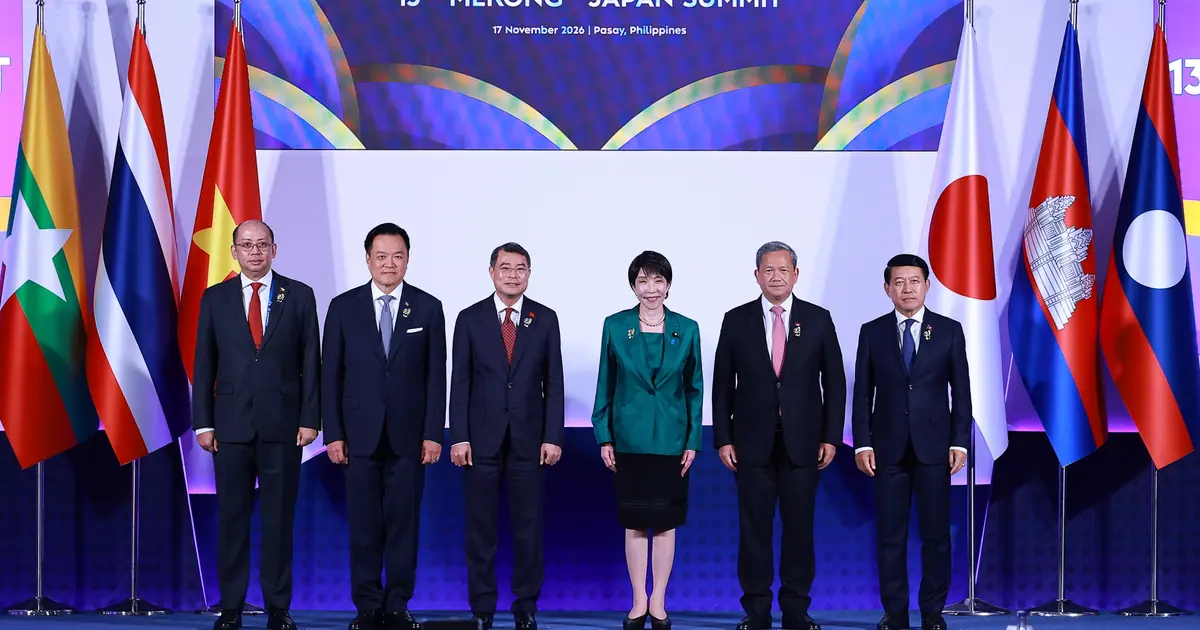
The summit was also attended by Cambodian Prime Minister Hun Manet, Lao Prime Minister Saleumxay Kommasith, Thai Prime Minister Anutin Charnvirakul, and the representative of Myanmar.
Mekong–Japan Cooperation was established in 2008 with the participation of the five Mekong countries, namely Cambodia, Laos, Myanmar, Thailand and Viet Nam, and Japan.
This year's summit, resumed after a six-year hiatus, was held under the theme "Innovating Together, Adapting Resiliently," proposed by Viet Nam.
The leaders highly valued the achievements made over nearly two decades of Mekong–Japan cooperation, particularly in quality infrastructure development, enhanced connectivity, human resource development, digital transformation, environmental protection, and addressing cross-border challenges.
The Mekong countries thanked Japan for its significant contributions to the sustainable development of the sub-region, while appreciating Viet Nam's co-chairmanship during the 2025–2026 period, which helped promote cooperation, resume high-level meetings, and steer Mekong–Japan cooperation through challenges.
The leaders proposed further promoting Mekong–Japan cooperation in the spirit of co-creation, jointly identifying priorities, and mobilizing resources to implement practical programs and projects.
The leaders emphasized priorities in economic connectivity, enhancing production capacity and supply chain resilience, digital transformation, clean energy transition, sustainable water resource management, human resource development, and combating transnational crime.
The leaders also called for leveraging the role of the business community and strengthening the linkage and complementarity between Mekong–Japan cooperation and ASEAN–Japan cooperation.
Addressing the summit, Vietnamese Prime Minister Le Minh Hung emphasized that the resumption of this summit reflects the determination to elevate the Mekong–Japan partnership, contributing to building a strong and self-reliant ASEAN Community.
Le proposed that Mekong countries and Japan strengthen connectivity in infrastructure, logistics, production networks, and supply chains, while enhancing production capacity and fostering innovation.
He proposed the Mekong–Japan Smart Supply Chain Initiative to consolidate regional supply chains through digital connectivity and the application of artificial intelligence (AI).
He called on both sides to strengthen cooperation in responding to non-traditional security challenges, giving priority to sustainable water resource management, disaster mitigation, energy transition, and combating cybercrime.
The Vietnamese Prime Minister suggested that Japan expand cooperation with the Mekong River Commission, support the application of AI and high technology in disaster forecasting and response, and expressed support for Japan's initiative to establish a dialogue channel on combating transnational crime.
The Summit adopted the Co-Chairs' Statement of the 13th Mekong–Japan Summit, affirming the determination to deepen the partnership in the spirit of co-creation toward sustainable, inclusive development and shared prosperity for the sub-region.
At the conclusion of the Summit, Prime Minister Le Minh Hung thanked Japan and the Mekong countries for their close coordination in helping Viet Nam fulfill its role as Co-Chair of Mekong–Japan Cooperation for the 2025–2026 term.
He affirmed that Viet Nam will continue working with member countries to build a trusted, resilient, and innovative Mekong–Japan partnership, contributing to deepening the ASEAN–Japan Comprehensive Strategic Partnership.
Prime Minister Le Minh Hung respectfully handed over the Co-Chairmanship of Mekong–Japan Cooperation for 2027 to Cambodia, expressing confidence that Cambodia will successfully fulfill this role and continue to promote increasingly substantive and effective cooperation.