
Popular American investor Michael Burry is known for his bearish bets, from the housing market in 2008 to AI frenzy in 2026. However, the 'Big Short' investor is bullish on some beaten-down companies that are faraway from the wild swings of the artificial intelligence trade.
In a post on Substack, Burry highlighted five stocks he has now bought as "full positions" in his portfolio. These include roofing distributor QXO, the grocery store Sprouts Farmers Market, the custom stuffed animal store Build-A-Bear, the footwear brand Birkenstock and the eCommerce site Mercado-Libre. The market veteran believes all these stocks have “corrected tremendously" and now offer extremely "attractive" valuations.
QXO shares have tumbled around 37% in 2026 so far, while those of Sprouts Farmers Market are down over 22%. Build-A-Bear shares recorded the sharpest decline among the stocks, crashing nearly 58% this year. Birkenstock shares have fallen 20% while those of Mercado-Libre are down 11%.
Also Read |Michael Burry revives AI warnings, Big Short investor says 'You could have heard it first
Michael Burry remains bearish on AI frenzy
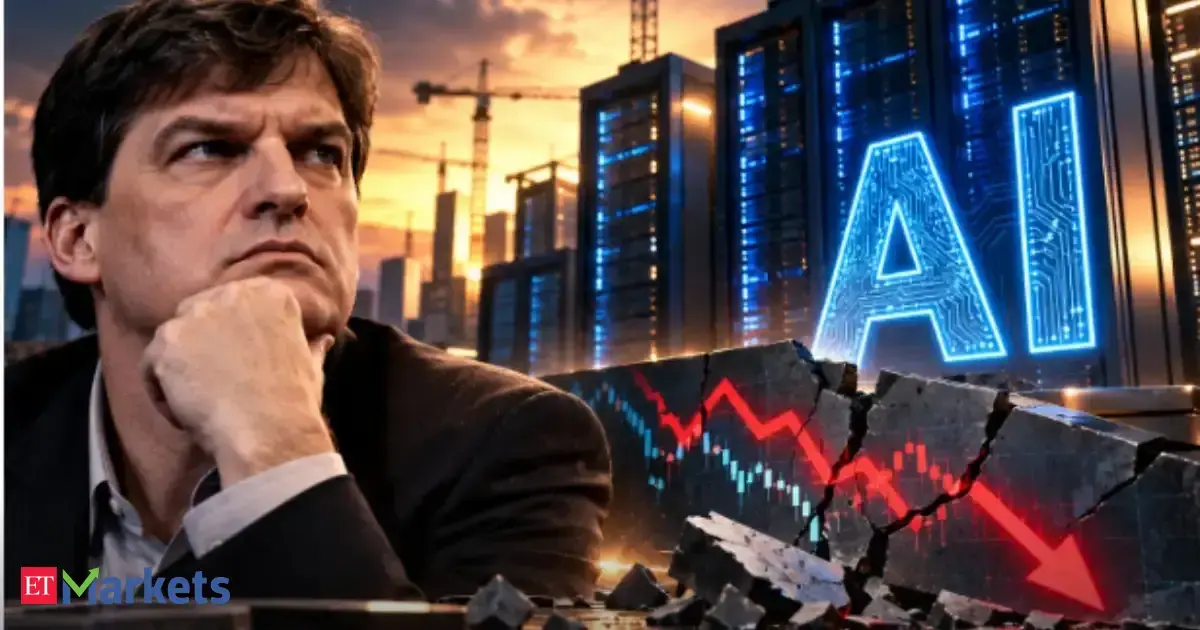
Meanwhile, Burry continues to remain bearish on the excessive optimism over AI. Last month, he revived his AI warnings and shared with analysts that found nine technology giants had amassed around $3 trillion in off-balance-sheet commitments related to the nascent technology.
“Well, you could have heard it first, months ago, 2025 even,” Burry, best known for correctly predicting the 2008 housing crisis, wrote on X. Recently, the American investor said he continues to believe that the market is close to a major top, warning of a similar crash to that of 1987 when Dow Jones recorded a historic 23% plunge which led to the introduction of regulatory circuit breakers. However, the market investor noted that the S&P 500 making new highs likely will bring new money into the market.
Earlier this year, Burry wrote on a Substack post that he sees many indicators, both technical and fundamental, lining up for the same conclusion as the Dotcom crash. "1999 went where no market had gone before, and I would say so can this one...It is already there on a number of indicators," he said, arguing that massive venture capital flows, rising AI debt issuance, and extreme market optimism are creating conditions where valuations may detach from economic reality.
Also Read | Michael Burry revives AI warnings, Big Short investor says 'You could have heard it first'
Michael Burry's 2008 prediction
Just before the 2008 financial collapse, people believed that the US housing market was secure and booming, and that home prices would not fall. Banks increasingly issued subprime loans; riskier mortgages were given to borrowers with weaker credit, under the assumption that rising prices would shield them from losses. Despite misplaced optimism, Burry warned that the market was on the brink of collapse, which most people did not believe.
After tirelessly studying mortgage securities, he concluded that subprime loans would collapse by 2007, taking down the broader economy with them. In 2005 and 2006, he warned his clients in letters that the meltdown was coming, but almost no one believed him. Against all odds, Burry bought credit default swaps against subprime mortgage securities, effectively betting that the market would crash. As premiums mounted, investors grew furious and demanded withdrawals, forcing Burry to restrict fund redemptions to hold the positions.
The backlash was so intense that it nearly destroyed his firm, until the market finally collapsed exactly as he predicted. Burry made around $100 million personally and $725 million for investors when the housing market finally collapsed.
Burry’s popular bet against the housing market was depicted in the 2015 movie titled 'The Big Short', which starred Christian Bale, Ryan Gosling, Steve Carell and others.
Disclaimer: This article has been written by Debaroti Adhikary, who is not a SEBI-registered Research Analyst or an Investment Adviser. Debaroti Adhikary and his/her ‘relative(s)’ (as defined under Section 2(77) of the Companies Act, 2013) do not hold any financial interest in the companies mentioned in this article as of the date of publication. The views/recommendations mentioned in this article, wherever applicable, are those of the respective SEBI-registered Research Analyst/brokerage and have been reproduced/reported with due attribution. They should not be construed as the views or recommendations of The Economic Times Digital or the journalist. Readers are advised to consider the original research report and make their investment decisions based on their own assessment. Brokerage disclaimers here.
Add as a Reliable and Trusted News Source Add Now!
(You can now subscribe to our ETMarkets WhatsApp channel)
'Big Short' investor Michael Burry hates the AI trade, but the bear is bullish on these stocks
Michael Burry has taken full positions in five beaten-down stocks: QXO, Sprouts Farmers Market, Build-A-Bear, Birkenstock and MercadoLibre, citing attractive valuations. The investor remains bearish on AI-driven market exuberance, warning about stretched valuations, rising AI debt and potential market risks, while drawing parallels with previous periods of excessive optimism.
- Written by
- Debaroti Adhikary
- Published by
- The Economic Times
- Published
- Length
- 736 words · 3 min
Where this came from
This story was reported by Debaroti Adhikary and first published by The Economic Times on 28 September 2026. HUE Legacy Ventures did not write it.
Carried in full with attribution and a link to the original. Rights remain with the publisher, who may request removal at any time.