Adrian Hamins-Puertolas and Maria D. Tito1
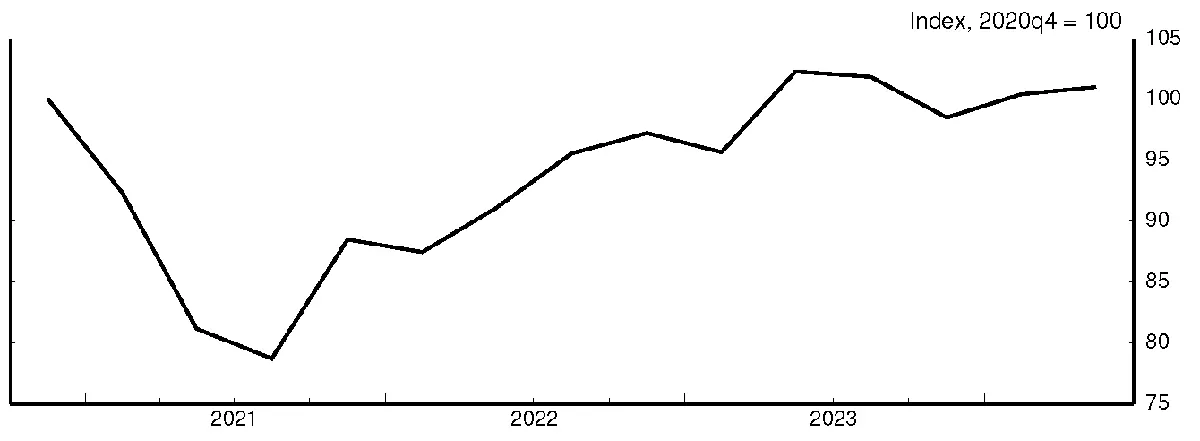
The motor vehicle industry suffered severe production disruptions during 2021 and 2022, as semiconductor shortages—triggered by pandemic-era plant closures and shifting demand patterns—brought some assembly lines to a standstill. Having recovered to nearly pre-pandemic levels by the fourth quarter of 2020, aggregate U.S. light vehicle production plunged in early 2021, ultimately falling 20 percent below 2020:Q4 levels by the third quarter (figure 1). Thereafter, recovery was slow: production did not return to pre-crisis levels until early 2023. Against a counterfactual baseline of 2020:Q4 output levels, the cumulative production shortfall exceeded 2 million vehicles over 2021-2022, with cascading effects on vehicle prices and the used car market. Yet these realized losses may partly understate the severity of the underlying supply shock. In this note, we characterize the 2021–2022 shortage episode and examine how automakers responded to minimize production losses.
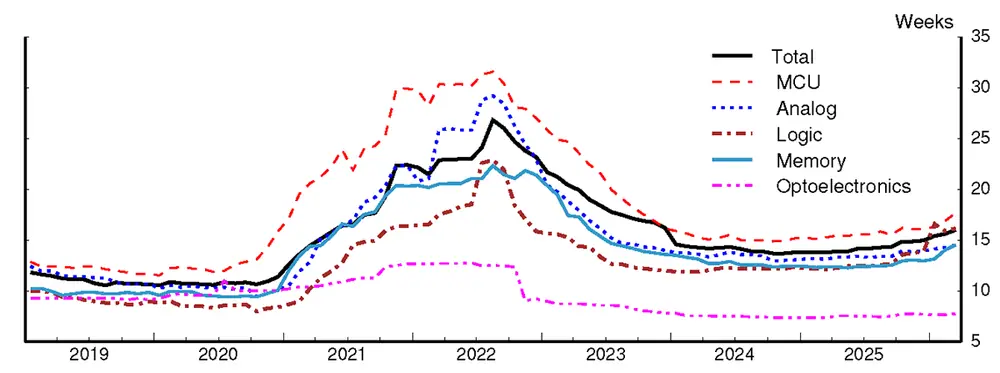
Figure 1. The Trajectory of Light Vehicle Production Through the Chip ShortageAn interesting feature of this episode was its heterogeneity: the impact of shortages varied markedly across chip types and vehicle equipment, as illustrated by figure 2. Lead times for microcontroller units, the dominant semiconductor category at 42 percent of the automotive chip market, roughly doubled from 15 weeks to 30 weeks, with sharp increases already emerging in the fourth quarter of 2020 and persisting through 2022.2 Analog, logic, and memory chips all saw elevated lead times, though to varying degrees. Optoelectronics, by contrast, remained largely unaffected. This heterogeneity meant different vehicle systems faced different constraints, forcing manufacturers into a continual optimization problem over which vehicles and features to prioritize for production.
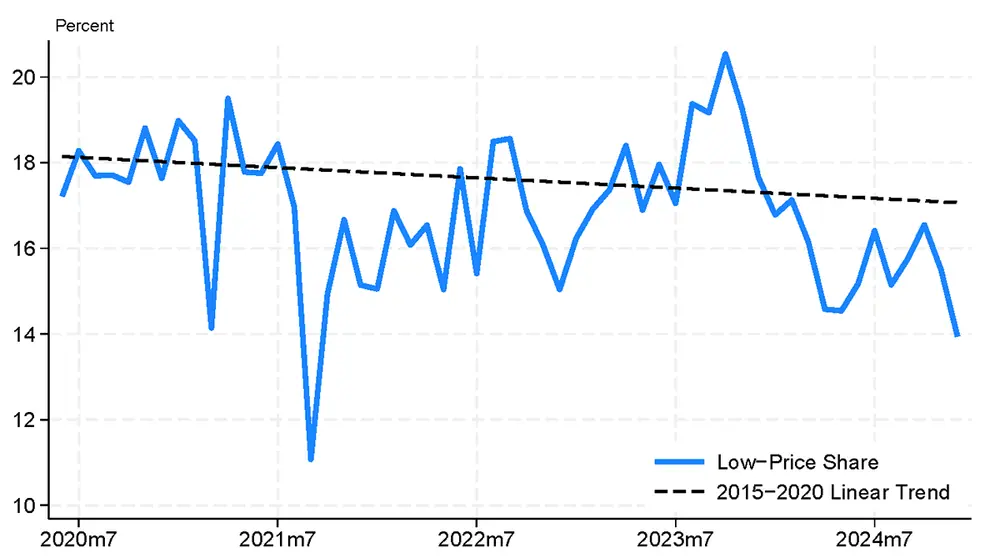
Figure 2. The Lengthening Wait: Semiconductor Lead Times Surrounding the ShortageFacing these constraints, automakers adopted two broad adjustment strategies. First, manufacturers reallocated scarce semiconductors toward higher-priced, higher-margin vehicles. This approach could not significantly affect total output, but it altered the composition of production in ways that protected revenue and preserved margins. Figure 3 provides evidence of this reallocation, tracking the share of production with manufacturers' suggested retail prices (MSRPs) below the 25th percentile of the price distribution (weighted by annual sales). From the second half of 2021 through mid-2023, this share ran consistently below its 2015-2020 trend line, indicating a systematic shift away from lower-priced models. The share moved above trend in the second half of 2023 as chip supplies improved, before declining again more recently.3
Figure 3. Shifting Mix: The Decline of Lower-Priced VehiclesThe second strategy involved the systematic elimination of chip-intensive features from vehicles already in or entering production. Automakers targeted less-vital features—ranging from heated seats to infotainment systems—that could be sacrificed with minimal impact on core functionality. Figure 4 tracks the share of vehicles equipped with select infotainment and convenience features across model years. To interpret these data, it is important to recognize that model-year designations follow an atypical production calendar: vehicles of a given model year are typically introduced in the summer of the preceding year, meaning model-year 2021 vehicles entered production in summer 2020 and became the primary offerings by early 2021, precisely when semiconductor shortages intensified. The vertical dashed line marking model-year 2021 reveals some breaks, with equipment adoption rates for several features falling below their more typical trends. HD radio equipment rates experienced a particularly sharp decline, with rates not recovering to pre-crisis levels until model year 2025. This pattern aligns with General Motors' decision to eliminate HD radio from its audio systems across multiple 2021 model year trims due to chip shortages.4 Similar feature deletions proliferated across the industry: GM and Mercedes-Benz limited wireless charging on certain models, Tesla removed USB-C ports from Model 3 and Model Y rear consoles, and Volkswagen dropped keyless entry and power rear gates.5
Figure 4. Strategic Compromises: Vehicle Equipment Rates Before and After the ShortagesAssessing how severely the presence of these features may have affected production requires linking chip types to specific equipment and output losses—a challenging task without a precise mapping between chip content and individual features. Infotainment systems offer a tractable starting point as they prompted widespread deletion efforts; we next describe a simple counterfactual exercise illustrating the effects of feature intensity on production losses.
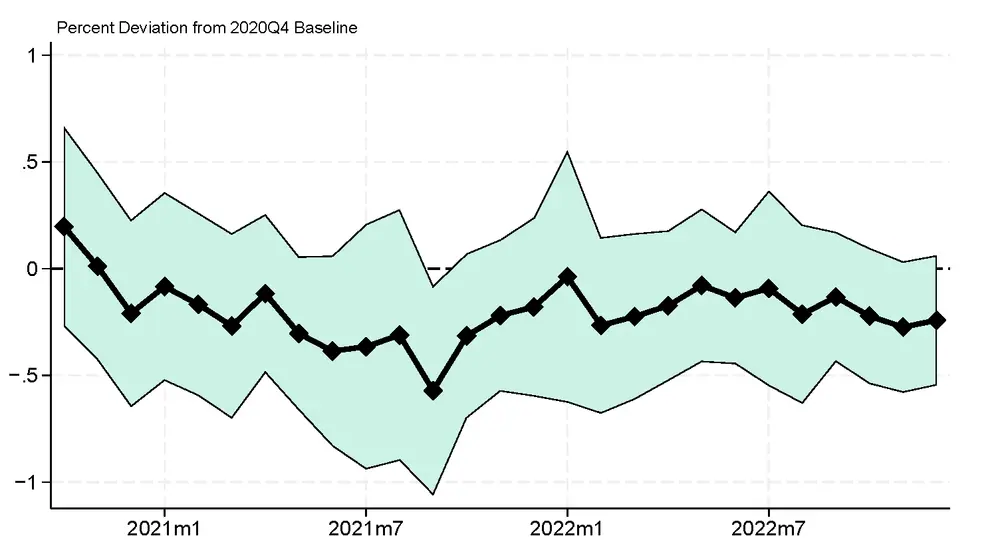
Our identification strategy exploits cross-vehicle variation in infotainment equipment rates for model-year 2021 vehicles, rates that were largely determined before semiconductor shortages intensified. Figure 5 compares production trajectories for vehicles with infotainment equipment rates above the 75th percentile—designated as "high-exposed" vehicles on the premise that higher infotainment content implied greater dependence on scarce semiconductors—against the remainder of the distribution. The coefficient estimates—the black diamonds in figure 5—denote the percent deviation of production rates for high-exposed vehicles compared to less exposed vehicles, relative to the fourth quarter of 2020; the green shaded areas represent the 95 percent confidence interval. High-exposed vehicles experienced systematically lower production rates, with significant losses in the second and third quarters of 2021. The differential effect remains negative throughout the sample period, although the estimates become statistically indistinguishable from zero in the later part of the sample as supply conditions gradually improved. Cumulatively over 2021-2022, the production rates of high-exposed vehicles were roughly 0.5 percent lower than their less exposed counterparts. This modest differential—small relative to the 20 percent aggregate decline—likely reflects imperfect identification of chip-to-component linkages and manufacturer adaptations: many offered monetary compensation or retrofit promises, enabling production of vehicles with temporarily omitted features.
Figure 5. Differential Production Rates by Infotainment Equipment ExposureDespite the modest magnitude of losses, the high-exposure classification still provides a useful basis for a simple back-of-the-envelope calculation to illustrate the magnitude of these mitigation efforts. Average adoption rates for infotainment features in model-year 2022 vehicles fell approximately 6 percentage points below pre-pandemic trends. Extending this analysis to convenience features suggests that absent selective deletion, roughly 10 percent of production—between 600,000 and 1,000,000 additional vehicles—would have fallen into the high-exposure category. Applying the observed 20 percent cumulative loss rate to this expanded exposure yields an additional 100,000 to 200,000 lost units beyond the more than 2 million that materialized.
The strategies adopted by the automakers—reallocating production toward higher-margin vehicles and systematically eliminating chip-intensive features—helped contain the production shortfall but had their own costs, with the shift toward premium models constraining access to affordable vehicles and with deleted features likely impacting vehicle quality.
Looking forward, the next semiconductor disruption facing the automotive industry may look very different from the last. Whereas the shortages of 2021 and 2022 were concentrated in microcontrollers, relatively mature-node automotive chips, the industry's transition toward software-defined vehicles is rapidly increasing demand for advanced logic and memory components.6
AI-enabled driver assistance systems, autonomous driving capabilities, and increasingly sophisticated in-vehicle computing platforms require substantially more semiconductor content per vehicle than conventional designs. As a result, automakers may increasingly find themselves competing directly with AI companies for access to some advanced chips and memory components.
The experience of the 2021–2022 shortage therefore offers not only a retrospective account of a unique disruption but also a warning about the supply-chain vulnerabilities that could accompany the next generation of automotive technologies.
References
Blanco, Sebastian. "Here Are Features Some New Cars Won't Get Because of the Chip Shortage." Car and Driver. November 13, 2021. https://www.caranddriver.com/news/g38179550/new-cars-tech-features-missing-chip-shortage/
Boigon, Molly. "The auto industry is competing with AI for memory chips — and losing" Automotive News, June 23, 2026. https://www.autonews.com/technology/mobility/an-dram-shortage-memory-0623/
Fortune Business Insights. Automotive Chip Market Size, Share & Industry Analysis, by Chip Type (Microcontroller & Microprocessor, Analog IC, Sensor, Memory, and Others), by Vehicle Type, by Application, and Regional Forecast, 2025–2032. Pune, India: Fortune Business Insights, 2025. Accessed July 9, 2026. Fortune Business Insights automotive chip market report, www.fortunebusinessinsights.com/automotive-chip-market-116795?utm_source=chatgpt.com.
McEachern, Sam. "These Chevy Models Will Get Limited Heated Steering Wheel Availability." GM Authority. November 2021. https://gmauthority.com/blog/2021/11/these-chevy-models-will-get-limited-heated-steering-wheel-availability/
Rogers, Cameron. "Volkswagen Drops Features Due to Chip Shortage." Edmunds. April 27, 2022. https://www.edmunds.com/car-news/volkswagen-drops-features-due-to-chip-shortage.html
Troester, Olivier, Malte Broxtermann, Xiaohang Yin, and Sven Zellner. "Navigating the Semiconductor-Auto Nexus in the Age of AI." AlixPartners. Accessed July 8, 2026. https://www.alixpartners.com/insights/102n5w9/navigating-the-semiconductor-auto-nexus-in-the-age-of-ai/
1. We wish to thank Tomaz Cajner and Ryan Decker for helpful comments and discussions. The views expressed in the article are those of the author and do not necessarily reflect those of the Federal Reserve Board, the Federal Reserve System, or its staff. Return to text
2. According to Fortune Business Insights (2025), microcontrollers and microprocessors function as the central computing units for engine control systems, infotainment platforms, ADAS modules, and autonomous driving systems. Return to text
3. Importantly, this shift toward higher-priced vehicles should not be interpreted as a shift toward vehicles with greater semiconductor requirements. Although higher-priced vehicles often contain more electronic content on average, semiconductor requirements depend on the vehicle's powertrain, specific electronic architecture, and installed features rather than MSRPs alone, allowing automakers to prioritize higher-margin models for given chip supply. Return to text
4. See Blanco (2021). Return to text
5. Blanco (2021), McEachern (2021), and Rogers (2022) details some of the feature-deletion strategies adopted by various manufacturers. Return to text
6. See Boigon (2026) and Troester et al. (2026). Return to text
Please cite this note as:Hamins-Puertolas, Adrian, and Maria D. Tito (2026). "When the Chips Went Down: Motor Vehicle Production and the 2021-2022 Semiconductor Shortages," FEDS Notes. Washington: Board of Governors of the Federal Reserve System, September 28, 2026, https://doi.org/10.17016/2380-7172.4155.
Disclaimer: FEDS Notes are articles in which Board staff offer their own views and present analysis on a range of topics in economics and finance. These articles are shorter and less technically oriented than FEDS Working Papers and IFDP papers.
Back to TopLast Update: September 28, 2026