
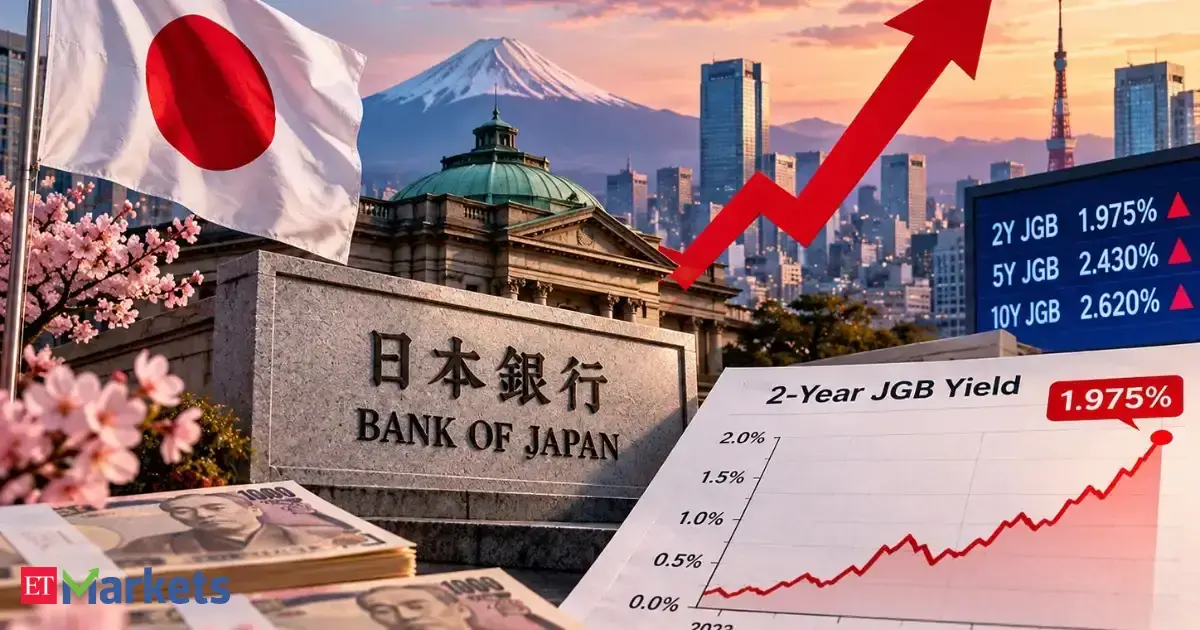
Japan's two-year government bond yield is approaching the 2% threshold for the first time in three decades, reflecting growing market expectations that persistent inflation could push the Bank of Japan into a more restrictive interest-rate policy.
The two-year JGB yield, which is particularly sensitive to expectations for the Bank of Japan's policy rate, rose as high as 1.975% on Monday, its highest level since March 1995. The yield has doubled over the past 12 months and is more than six times its level at the same point in 2024.
Read more: Global Market: Nikkei falls as oil surge, global bond selloff rattle markets
The move comes amid a broader global rise in bond yields as higher energy prices and investment in artificial intelligence infrastructure fuel inflation concerns. In Japan, however, the rise has been amplified by expectations that the BOJ could adopt a more hawkish stance to support the yen.
Markets price in further BOJ tightening
The BOJ raised its key policy rate to 1.25% earlier this month, the highest level in 31 years. Despite the increase, the yen has remained under pressure, adding to concerns that imported inflation could persist.
Reuters reported that the currency's weakness has prompted increased policy attention from both Tokyo and Washington. Joint yen-buying operations by Japan and the United States in July and August, along with calls from U.S. Treasury Secretary Scott Bessent for Japan to maintain higher interest rates, have reinforced expectations that monetary policy could tighten further.
Markets are increasingly pricing in the possibility of consecutive BOJ rate increases. Dai-ichi Life Research Institute chief economist Koichi Fujishiro said the combination of political and diplomatic pressure was making investors more alert to the prospect of further hikes.
Yen weakness adds to inflation concerns
The yen's persistent weakness has become a key concern for Japanese policymakers because it raises the cost of imported goods and energy.
Reuters reported that analysts increasingly expect the BOJ's policy focus to include limiting the inflationary impact of a weaker currency. The pressure comes despite the latest rate increase and recent warnings from Japanese and U.S. officials.
Japan's fiscal position is another factor complicating the outlook. Government debt remains more than twice the size of annual economic output, while rising borrowing costs are increasing debt-servicing expenses.
Read more: Global Market: RoboTechnik slides below IPO price in weak Hong Kong debut
Longer-term yields climb
The rise in Japanese bond yields has extended beyond the front end of the curve. Japan's five-year government bond yield touched a record 2.43% on Monday, while the one-month interest-rate swap rate starting in two years, viewed by market participants as an indicator of the potential endpoint of the BOJ's tightening cycle, climbed to a record 2.5%.
Money-market pricing points to a 36% probability of the BOJ raising its policy rate to 1.5% in October, according to Tokyo Tanshi. Traders have fully priced such a move for December.
Tankan report in focus
The timing of the next rate increase could depend on economic data, particularly the BOJ's Tankan survey of business sentiment among major manufacturers, due on Thursday.
A strong reading on capital investment could strengthen the case for an October rate increase, according to Resona Asset Management chief fund manager Takashi Fujiwara.
The sharp rise in short-term yields therefore signals that markets are reassessing how far Japan's rate cycle may ultimately extend, with inflation, yen weakness, corporate investment and fiscal pressures all shaping expectations for the BOJ's next moves.
(Disclaimer: Recommendations, suggestions, views and opinions given by the experts are their own. These do not represent the views of The Economic Times.)
Add as a Reliable and Trusted News Source Add Now!
(You can now subscribe to our ETMarkets WhatsApp channel)
Global Market: Japan 2-year bond yield nears 2% as BOJ rate hike bets rise
Japans two-year government bond yield neared 2%, its highest level since 1995, as persistent inflation, yen weakness and expectations of further Bank of Japan rate hikes pushed short-term borrowing costs higher.
- Written by
- Anupam Nagar
- Published by
- The Economic Times
- Published
- Length
- 607 words · 3 min
Where this came from
This story was reported by Anupam Nagar and first published by The Economic Times on 29 September 2026. HUE Legacy Ventures did not write it.
Carried in full with attribution and a link to the original. Rights remain with the publisher, who may request removal at any time.