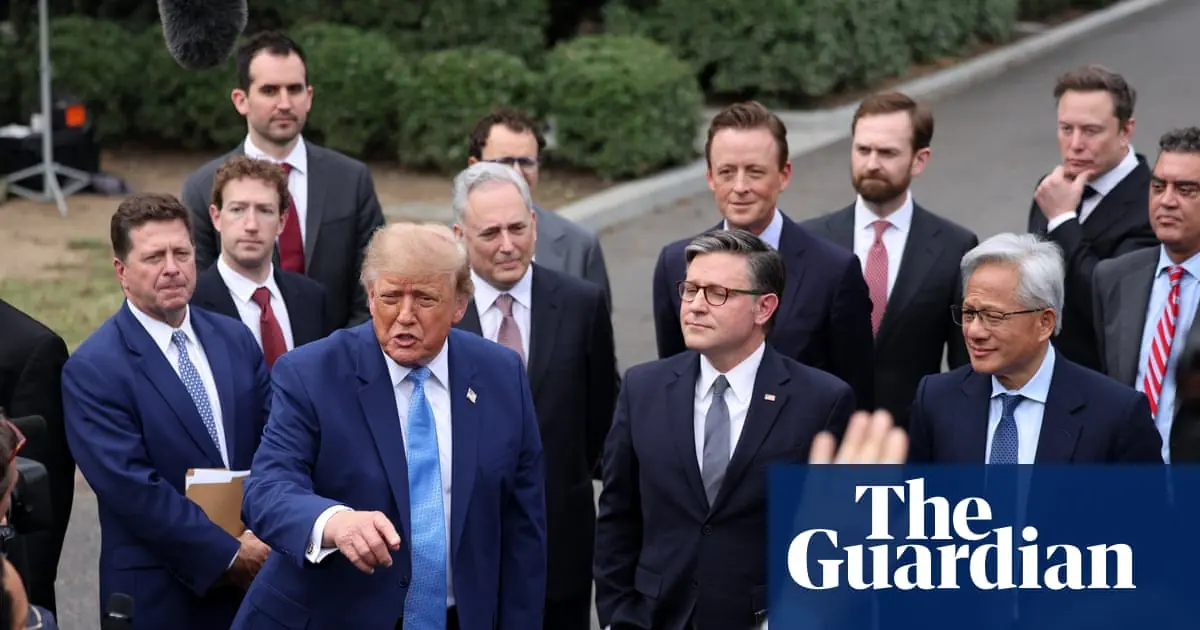
The US president announces vague ‘morally binding’ AI agreement among tech CEOs for ‘tremendous self-policing’
Donald Trump announced on Tuesday that the heads of the largest US tech and AI companies had signed a “morally binding” agreement to put controls on artificial intelligence. He announced the deal, called the Joint Commitment on Frontier Responsibilities, following a White House luncheon with top tech executives.
“It’s almost like a constitution in a way, and the biggest people in the world signed that, and I signed it as president, and it really is a form of protection,” Trump said.
Trump also signed an executive order renaming artificial intelligence as “superintelligence”, similar to a declaration he made at the United Nations last week.
“The Order directs all departments and agencies to use the terms ‘Super Intelligence’ and ‘SI’ in official correspondence, public communications, policy documents, and non-statutory documents within the executive branch and to no longer acknowledge the terms ‘Artificial Intelligence’ or ‘AI’,” the order declared.
The agreement, which Trump suggested would allow the companies to perform “tremendous self-policing” of their products and technologies, outlines a vague framework for how AI firms would establish safety standards as they test out new products. The tech industry has faced increased public scrutiny following a series of incidents in which major AI companies’ products hacked into outside organizations during safety tests.
While lawmakers, AI researchers and even some AI companies have called for more government oversight of artificial intelligence, Trump has broadly rejected calls for more regulation of the technology – citing competition with China and threats to economic growth.
The joint commitment that Trump posted to his Truth Social account on Tuesday appears to carry no enforcement mechanisms or legal implications and is instead a voluntary commitment.
The document outlines four “layers of controls and audits” for AI companies. The first involves implementing internal safety monitoring during training – something that already exists at major labs and has failed to prevent testing failures thus far. The second calls for empowering an internal team to make sure the first layer of monitoring is operating correctly, while the third agrees to give an external auditor the ability to independently assess safety controls. Finally, the agreement calls for companies to designate an independent board to review reports about those safety controls.
None of the controls listed in the agreement involve government regulators or include a commitment to publicly detail the findings of independent evaluations. The agreement also appears to allow companies to pick their own evaluators, appoint their own oversight boards and decide whether to publish their results.
Trump made the remarks after holding a luncheon with tech leaders including Elon Musk, the SpaceX CEO; Mark Zuckerberg, the Meta CEO; Jensen Huang, the CEO of Nvidia; Dario Amodei, the Anthropic CEO; and other top industry executives. The tech industry, which has largely aligned itself with the Trump administration, has lobbied against strict regulatory oversight, arguing that it would stifle the economy.
Zuckerberg, flanked by Trump and other tech moguls, told a press conference after the lunch that he was proud of the agreement and said that it was created to assure the American public that their technology was trustworthy.
“This is a start and an accord that the whole industry could come to,” Zuckerberg said. “It was sort of a historic conversation.”
Explore more on these topicsShareReuse this content