
- Published2 hours ago
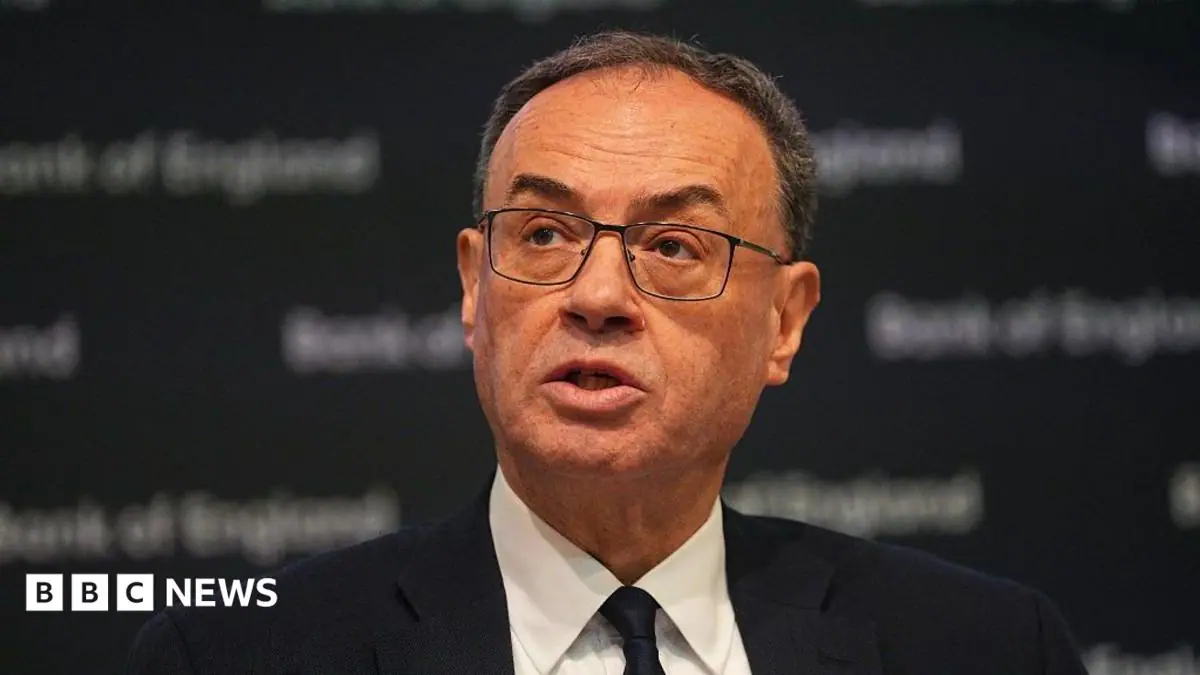
The Governor of the Bank of England has said regulating artificial intelligence (AI) "is not the right place to start" but instead called first for "rigorous" testing to find vulnerabilities and safeguards to contain risk.
Writing his first-ever article for Substack, Andrew Bailey said the risks around AI were "real and increasingly significant".
Bailey said the development of AI should not be halted or prohibited - "on the contrary, the benefits are immense" - but added there must be a system for intervention and to establish boundaries in which AI operates.
In recent weeks, the debate about the potential risks surrounding the rapid development of AI and what it means for humanity has intensified.
The bosses of leading AI firms such as Anthropic and OpenAI have called for development of the technology to slow down and for an internationally co-ordinated approach assessing risks and putting safeguards in place.
OpenAI recently announced that it would not release its latest AI model due to safety concerns.
The idea of a slowdown, however, has been rejected by the likes of President Donald Trump who has said the US is leading the AI race ahead of China, adding: "And, frankly, I want to keep it that way because whoever wins AI, wins."
But on Tuesday, after hosting a summit with the leading firms in AI such as OpenAI and Anthropic, Trump said executives had signed a "morally binding" document that would serve as a "form of protection" from AI's potential risks.
- Published13 hours ago
- Published1 day ago
Under the agreement, the companies are responsible for ensuring the safety of their own technology.
In the UK, Bailey said "important work" was underway in testing AI - the UK has set up the AI Security Institute - which, he said, should help form part of a set of standards.
"But the pace of progress must accelerate," the bank governor said, though he added: "We should proceed with a degree of humility."
He said, with testing, there will be failures and "models will behave unexpectedly".
But, he said: "That is not evidence that testing has failed, rather it is evidence of why testing is necessary."
Bailey said that testing should not be seen as an alternative to future regulation - over time a more formal regulatory framework might emerge. "But regulation is not, in my view, the right place to start."