
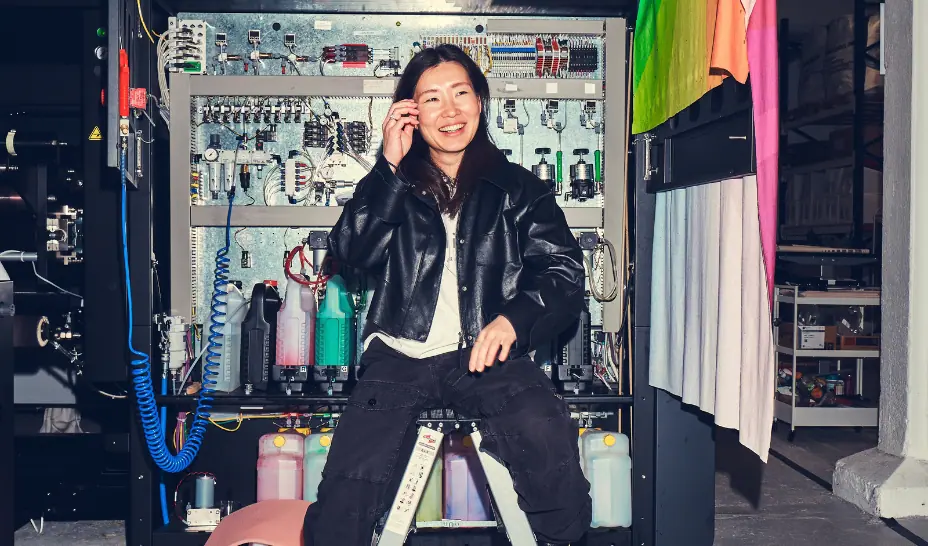
Danish FashionTech startup Rodinia Generation, a developer of clothing production technology, has raised €4 million to finance their industrial phase, including the establishment of a first commercial-scale facility in Portugal, planned for 2027.
The round was led by Vitamin°C, with continued backing from existing investors Climentum Capital and EIFO. This follows a €3 million raise in 2024, as reported by EU-Startups.
“Manufacturing closer to demand has never been more strategically valuable than it is right now,” says Trine Young, founder and CEO of Rodinia Generation. “The brands that produce with us have no need to predict what will sell months in advance. They also don’t need to produce at high volumes to reach better unit economics. They can react to demand in days instead of months, sell more at full price and manage inventory and cash much more efficiently – and on top of all this, they can do so with a much lower environmental footprint.”
Rodinia Generation’s financing comes amid continued European investment in technologies addressing the environmental and manufacturing footprint of textiles and apparel.
In 2026, EU-Startups has reported rounds including €5 million for fellow Copenhagen-based Octarine Bio to industrialise its sustainable pigment platform, €4.2 million for Cambridge-based Sparxell’s plant-based colour technology, €10.3 million for London-based Epoch Biodesign to commercialise textile and nylon recycling, €300k for Malmö-based Salt & Fiber’s seagrass-derived textile fibres, and €26.1 million for Paris-based Syntetica to build a commercial demonstration facility for nylon recycling.
Together with Bristol-based Ponda’s €1.6 million Seed extension, these comparable rounds amount to approximately €47.5 million, rising to around €51.5 million when Rodinia’s latest financing is included.
Lead investor Vitamin°C and existing backer Climentum Capital have also been active in 2026 after announcing first closes of €18 million and €60 million respectively for their climate-focused funds.
“Rodinia is tackling one of the largest industries in the world with a fundamentally different manufacturing model. What attracted us is not sustainability alone, but the potential to change the economics of apparel production by combining automation, flexi bility and local manufacturing at commercial scale,” adds Nathalie Moral, Founding Partner at Vitamin°C.
Founded in 2017, Rodinia Generation operates out of Copenhagen, Denmark and is a technology company founded by entrepreneur Trine Young.
In 2021 the pilot O-Factory opened in Copenhagen demonstrating a new garment production system built on three technology pillars: proprietary software, proprietary machinery, and the ability to selectively integrate external technologies and make them economically useful at industrial scale.
The Copenhagen facility has produced for fashion brands since 2021 and is currently producing the next collections for Henrik Vibskov and Klaus Samsøe.
“We have demonstrated in Copenhagen that a single O-factory line can produce 80% of clothing categories, including evening dresses, formal shirts, football tees, swimwear and childrenswear, just to mention a few of the categories that have already achieved competitive margins. The investment allows Rodinia to increase production capacity for existing and new brands with the opening of our industrial-scale O-factory in Portugal,” says Trine.
According to the company, fashion production is becoming increasingly difficult to automate because the industry no longer simply manufactures large quantities of identical products. Today brands need the flexibility to produce thousands of styles, allow for frequent product changes and achieve increasingly shorter production runs at competitive unit economics.
Rodinia’s O-factory is built for this complexity. The technology combines proprietary software and machinery with selected external production technologies, allowing production settings to adapt as the digital input of each garment changes.
Rodinia’s longer-term ambition is a global network of O-factories located closer to the major markets of fashion brands.
“By replicating flexible production capacity across different locations, we are creating the foundation for a new manufacturing infrastructure for the global apparel industry,” adds Trine.
The O-factory is designed to reduce CO₂e emissions by approximately 40% per average garment while eliminating water use from its production process.
Based on Rodinia’s current impact calculations, when O-factories are producing the equivalent of just half the annual garment volume of a large fast-fashion brand, approximately 100 billion litres of water and one million tonnes of CO₂e will be saved every year compared with conventional production.