
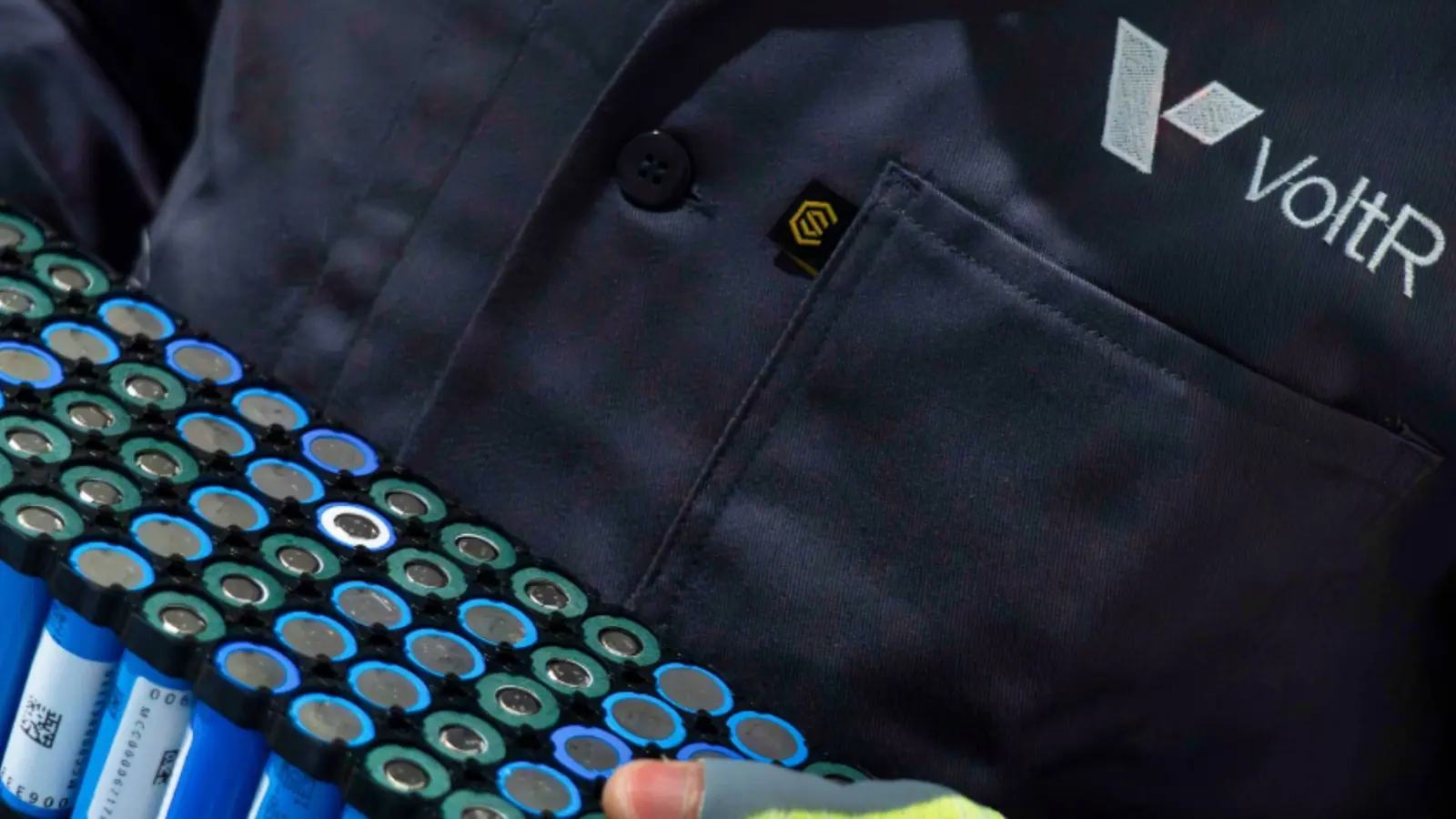
VoltR, a French manufacturer of eco-designed lithium batteries, has secured €22 million to accelerate its industrialisation.
This financing combines a €16 million equity investment and €6 million in grants secured through the “Première Usine” programme. The equity investment was raised from the SPI 2 Fund, managed on behalf of the French government by Bpifrance as part of the France 2030 initiative, and from Decathlon PULSE, Decathlon’s investment and innovation entity dedicated to creating new growth engines.
Maxime Bleskine, CEO of VoltR, said, “For the past four years, we have been working to demonstrate a fairly simple idea: a lithium cell that has reached the end of its first life cycle has not necessarily reached the end of its industrial life. We have validated the proof of concept with more than 20,000 batteries placed on the market, and this funding round now gives us the means to demonstrate this on a large scale.
“Within two years, we aim to increase our production capacity sixfold and double our workforce, creating about 40 jobs. The arrival of Bpifrance’s SPI Fund and Decathlon PULSE as partners is particularly significant: it brings together, around VoltR, expertise in industrialisation and very practical knowledge of applications and markets. Our course has remained the same since the beginning: to make remanufacturing a key player in the European battery value chain to strengthen its sovereignty and reduce its environmental impact. ”
Founded in 2022 by Alban Regnier, François Mallet, Thibaud Maufront, and Bleskine, VoltR recovers battery cells at the end of their first life cycle and repurposes them in new batteries tailored to their remaining performance. The company states that it can thus offer batteries made in France, eco-designed, and meeting the same performance and certification requirements as conventional batteries.
The French company aims to demonstrate at an industrial scale that a battery at the end of its first life cycle can become a new resource for manufacturing new batteries in France.
VoltR claims it has developed a unique, end-to-end integrated model, from collecting used batteries to cell diagnostics and producing new batteries. It manufactures batteries for a range of markets, including power tools, micromobility, home automation, smart cities and mobile energy storage.
According to the company, remanufacturing reduces the need for new cells and complements recycling with an additional stage of value recovery, helping strengthen the resilience of a strategic supply chain that remains heavily dependent on imports. VoltR further notes that it also addresses an environmental challenge by maximising the use of the resources and energy already invested in producing cells before they are ultimately recycled.
“With VoltR, the SPI Fund is reaffirming its commitment to building a sovereign battery industry. Having already supported both new battery production and recycling, we are now completing the value chain by giving batteries a second life. With its expertise and unique positioning, VoltR has established itself as a key player in this circular revolution, and we are proud to support the company through this new phase of industrialisation,” said Jean-Philippe Richard, Director of the SPI Fund, Bpifrance.
The company plans to use this capital to accelerate the industrial deployment of its remanufacturing model. The investment will support the expansion and scale-up of its industrial facilities, the industrialisation and automation of its production processes, the development of its cell diagnostics and repurposing technologies.
The funding will be used to double the size of its Verrières-en-Anjou (Maine-et-Loire) plant and increase its production capacity sixfold within two years, accelerating its expansion across Europe. In April 2024, the company announced a €4 million Seed round.
This scale-up will enable the company to handle growing volumes of batteries reaching the end of their first life and extend its expertise to new products and markets. VoltR currently employs around 40 people and aims to build a European circular economy value chain for lithium batteries.