
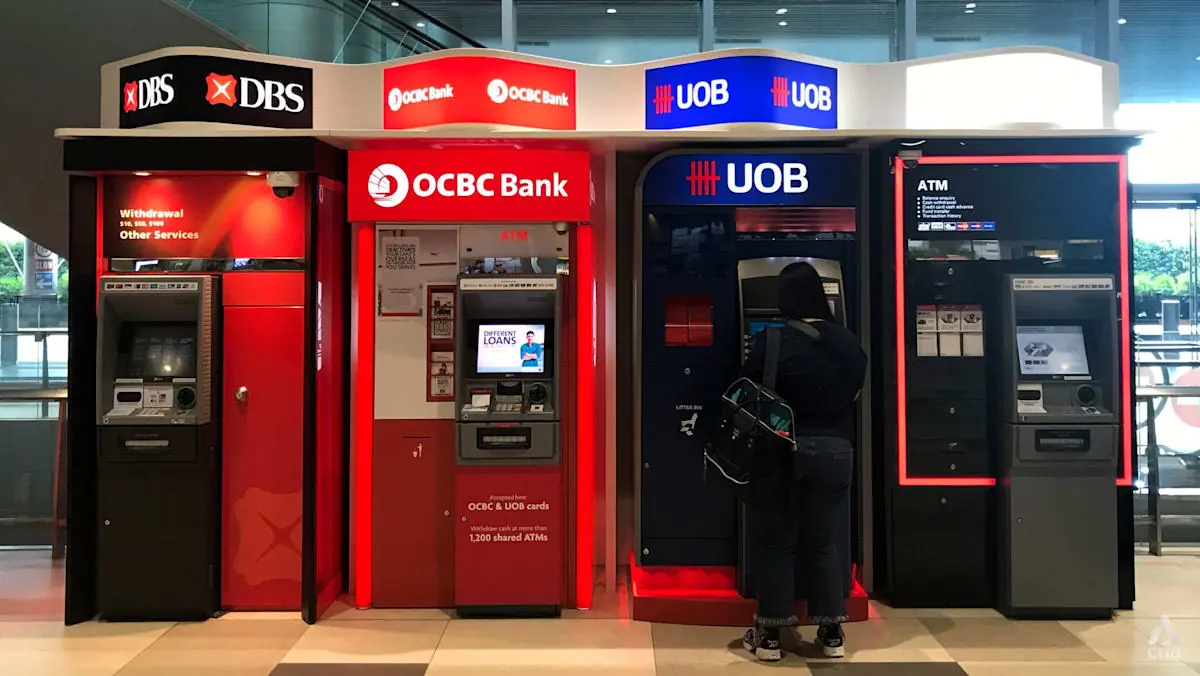
SINGAPORE: Singapore bank stocks tumbled for the second straight day on Thursday (Oct 8), extending a sell-off sparked by a Citi downgrade of OCBC.
The Citi report cut its rating on OCBC to “sell” from a “neutral”, saying it expected the bank's third-quarter earnings to be flat from a year earlier.
Shares of OCBC fell 4.29 per cent or S$1.30 to S$29 on Thursday. This followed a decline of more than 5 per cent the previous day, which wiped more than S$8 billion off the bank’s market capitalisation.
UOB also fell on Thursday, declining 5.16 per cent or S$2.19 to S$40.25. DBS slid 4.7 per cent or S$3.64 to S$73.85.
Guess WordCrack the word, one row at a timeBuzzwordCreate words using the given lettersMini SudokuTiny puzzle, mighty brain teaserMini CrosswordSmall grid, big challengeWord SearchSpot as many words as you can Show More Show LessThe declines come after the share prices of all three banks hit fresh record highs this year.
So why are investors turning cautious even after the banks’ record run, and what could determine how the sector performs going into next year?
Why are investors pulling back?
Analysts attributed this week’s pullback to a combination of profit-taking by investors after the sector’s strong performance, rising bond yields, as well as concerns about the potentially higher funding costs banks may face due to rising interest rates.
Investors may be selling bank stocks this week to rake in profits while they can after the banks’ fresh record prices this year, Macquarie Equity Research’s head of ASEAN equity research Jayden Vantarakis told CNA, noting that investors are becoming more risk averse.
Similarly, Jefferies’ ASEAN research analyst Joanna Cheah noted that Singapore banks had been trading at historically elevated valuations. OCBC in particular had an exceptionally strong second quarter this year, she pointed out.
Investors are now questioning whether that performance can be repeated, she told CNA.
With OCBC priced for good news after gaining about 60 per cent this year, there was little room for disappointment, said Glenn Thum, research manager at Phillip Securities Research.
Citi’s forecast that OCBC's third-quarter profit would be flat from a year earlier – after growing 22 per cent in the second quarter – challenged the growth story that had helped drive the stock higher.
Higher interest rates would typically be positive for banks, allowing them to earn more from lending. But analysts said the benefit could take time to materialise, while banks face higher funding costs in the near term.
As interest rates rise, banks may have to pay more to attract deposits, increasing the cost of funding their loans.
Mr Thum said banks are already competing for fixed deposits. Loans also take time to reprice at higher rates, meaning margins could remain under pressure for another quarter or two before improving.
In its report, Citi also said the market could be overestimating how much OCBC would benefit from higher interest rates and stronger loan growth.
CGS International research analyst Tay Wee Kuang similarly said higher funding costs could temper expectations for improvements in banks’ net interest margins.
Competition for quality loans could also limit how much banks can charge borrowers, making higher asset yields unlikely in the near term, he said.