
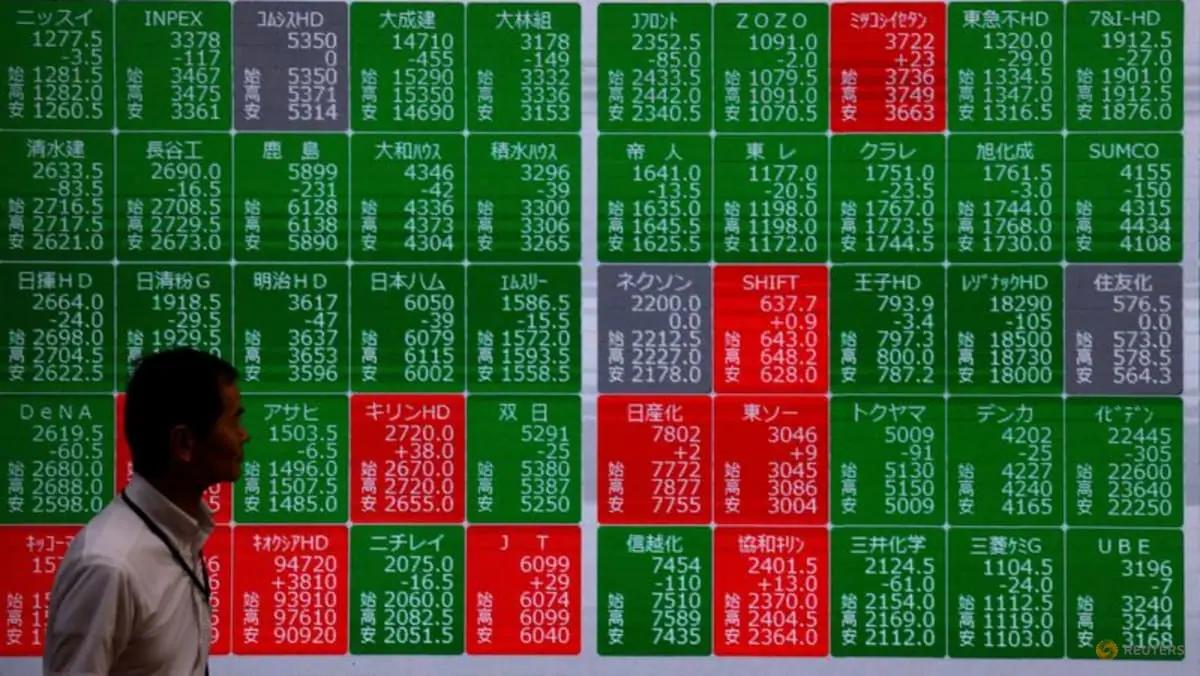
SYDNEY, Oct 12 : Stock markets got off to an erratic start on Monday as earnings season loomed, while oil slipped amid confusion over whether Russia would, or could, increase energy exports.
While the conflict in the Gulf continued with strikes on shipping and airports, President Donald Trump's announcement of an energy ceasefire between Ukraine and Russia muddied the waters on oil supply.
Trump's proposal for Russia to increase its exports of diesel added to the mix, though it also drew opposition from Republican and Democratic senators as potentially illegal.
Brent futures started higher but soon slipped 1.6 per cent to $103.01 a barrel, below a recent top of $109.97, while US crude futures lost 1.9 per cent to $90.11 a barrel.
Guess WordCrack the word, one row at a timeBuzzwordCreate words using the given lettersMini SudokuTiny puzzle, mighty brain teaserMini CrosswordSmall grid, big challengeWord SearchSpot as many words as you can Show More Show LessSouth Korean stocks fell 2.2 per cent and Taiwanese shares eased 0.5 per cent. MSCI's broadest index of Asia-Pacific shares excluding Japan dipped 0.3 per cent, while Chinese blue chips added 0.1 per cent.
On Wall Street, S&P 500 futures edged up 0.3 per cent, while Nasdaq futures firmed 0.4 per cent. In Europe, EUROSTOXX 50 futures firmed 0.5 per cent, DAX futures gained 0.6 per cent and FTSE futures added 0.4 per cent.
Trade was thin with Japanese markets shut and the US on a partial holiday ahead of earnings season, with major US banks kicking off on Tuesday.
TSMC, the world's largest manufacturer of advanced AI chips, will likely report a sixth consecutive quarter of record earnings on Thursday.
S&P 500 earnings are expected to jump by more than 30 per cent in the third quarter, according to LSEG IBES, though the bulk of that comes from the tech sector.
My Bui, an economist at AMP, said all the gains in the S&P 500 since mid-September had been in tech, while investors were demanding higher yields to fund the massive borrowing for AI.
The US investment-grade credit default swap index, which tracks the cost of insurance against default, had also risen sharply to its highest level since the US-Israeli war on Iran began.
"Overall, wider spreads suggest investors are questioning whether AI revenues can keep pace with rising borrowing costs," Bui said. "Corporate bond issuance to fund AI capex, combined with wider high-yield spreads, will raise refinancing costs as the current wave of debt matures over the next few years."
US CPI TO HEAT UP, BUT CORE COOLER
The flood of corporate debt has added to pressure in sovereign markets, driving Treasury yields to 24-year highs last week while lifting the discount applied to company earnings.
The market faces fresh challenges this week from US data on consumer and producer prices and retail sales. Rising energy costs are expected to lift CPI by a hefty 0.6 per cent to an annual 3.7 per cent, though the core is seen cooler at 0.2 per cent and 2.5 per cent.
"Oil prices remain higher than we had assumed as shipping costs have soared and product prices are even higher," said Bruce Kasman, head of global economics at JPMorgan.
"The signals on inflation point to a sharp rebound in headline inflation that will squeeze purchasing power and a firming in core inflation that will keep central banks focused on near-term hikes."
Markets imply only an 18 per cent chance of a rate rise from the Federal Reserve this month, rising to an 85 per cent chance of a hike in December. Investors are also wagering on hikes in the EU, Japan and Britain before the end of the year.
In currency markets, the euro remained on the defensive at $1.1201, having fallen for five weeks straight amid concerns about government deficits in Europe.
The dollar index held near 17-month highs at 102.25, but it has stalled on the yen at 158.19 as the threat of Japanese intervention deters speculators for now.
In commodity markets, non-interest-bearing gold rose 0.4 per cent to $4,212 an ounce, having managed to bounce more than 1 per cent last week.