
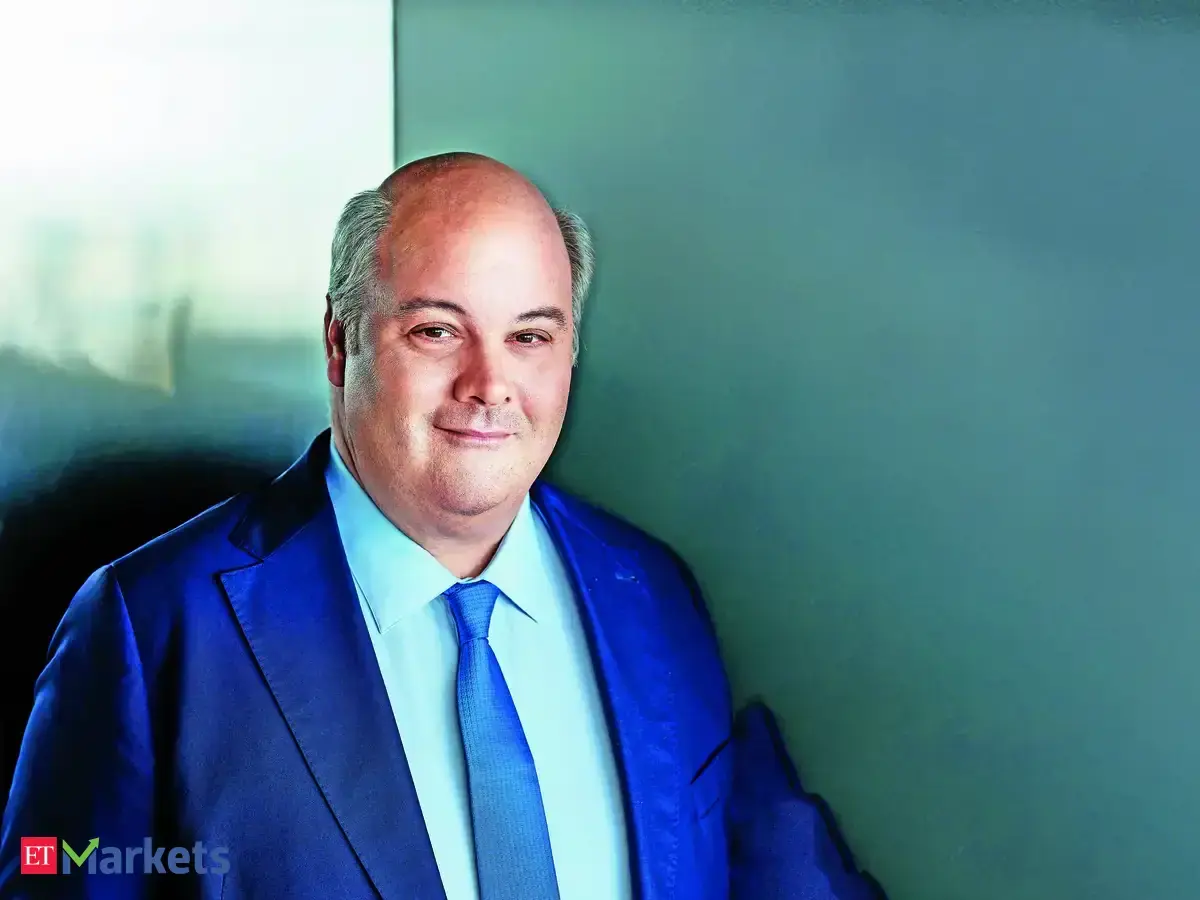
The two-year weakness in Indian equities is a temporary pause as valuations are back to decent levels, said Vincent Mortier, group chief investment officer of Amundi, Europe’s largest asset manager. In an interview with Nishanth Vasudevan during a recent visit to Mumbai, Mortier, who oversees €2.3 trillion of assets worldwide, spoke about his outlook for India, the AI trade and US debt, among other topics. Edited excerpts:
How do you assess the outlook for Indian equities after two years of struggle?
Frankly, we were a little bit puzzled because India has been one of our convictions for many years. Today, India is unlucky in terms of narrative. So, there is the energy situation, tariffs and the perception that India, particularly its software companies, could be an AI casualty.
India used to be fashionable, attractive because of its prospects, the middle class, etc. Now the narrative has reversed. We went from half-full to half-empty. That’s excessive. India has never been very cheap, but valuations are back to very decent levels.
More importantly, the prospects of the country have not weakened. So, I think it’s a temporary pause, in a way. We continue to advise clients to buy Indian equities to diversify.
As a global asset allocator, what do you think will bring foreign investors back to India?
There are a few catalysts. First, a resolution in Russia-Ukraine and the Middle East would send positive signals for South Asia and Europe.
Second is some concrete weaknesses in other markets. Today, asset allocations are very unbalanced. To rebalance, you need a catalyst. AI repricing can be a catalyst.
Third, we need to have the conviction that the Indian rupee has found a floor. The currency remains a big question mark. The cost of hedging is high, and there is still this feeling that all the gains you make in the market, you can lose on the currency.
Read more: ET Alpha Wealth Summit 2.0: What do Shah Rukh Khan and SIFs have in common? Radhika Gupta explains
So do you see further weakness in the rupee?
No. On a fundamental basis, when you look at valuation models, we don’t see why the Indian rupee should fall further. But then you have sentiment and flows. So, we need to wait for a catalyst. It’s just about timing.
Is India’s capital gains tax regime on equities one reason for foreign investors staying out?
It’s not the capital gains tax itself, but the complexity of the mechanism. The rules for foreigners are difficult, and even custodians sometimes struggle to compute the taxes.
What’s very important is stability. In many markets, foreigners are not taxed on capital gains by the country where they invest. They can be taxed by their home country. Dividends are taxed, but not capital gains. So, what investors don’t like is when things are unstable or difficult to predict.
What is your message to all the retail investors in India who are sitting on losses or maybe minor gains in the past two years?
The traditional 60-40 portfolio had the merit of simplicity, but I think investors need to think differently. What’s important is to build a core portfolio that generates quality income, whether from government bonds or stable, high-dividend equities.
The Indian 10-year yield is almost 7.3%, while inflation is around 4.5%. That means real rates are nearly 3%. It’s a very good deal. You can expect the 10-year yield to gradually decline to 7%, potentially even 6%.
Then you need equities for long-term growth, but diversification is crucial. Sometimes it’s better to forego a little extra return than take too much risk.
Many investors are calling the AI theme a bubble. Do you agree?
I don’t know whether we can call it a bubble, but it has some features of one. What is sure is that the market is too consensual, optimistic, concentrated and short-term. Normally, when you buy a high-growth company, you need to project earnings 10 years ahead. Here, the market reacts to short-term developments. It’s concentrated momentum and, in a way, speculative.
Among the 10 or 15 biggest companies in the sector, some will be big winners and others big losers. Yet the market is rewarding everybody. That’s too optimistic. When things normalise, whether because of declining earnings or financing issues, a lot of capital will be redeployed elsewhere.
Read more: Weekly Market Outlook: Nifty snaps 8-week losing streak, but can bulls reclaim the crucial 200-week moving average?
There have been concerns in equity markets over the spike in US Treasury yields. How do you read it?
When the US 10-year is at 5.25%, there can be two views. You can be optimistic and say it’s because the US economy is growing fast, and inflation expectations are also rising. You can also have a more pessimistic view: the 10-year US yield is at such a level because there are too many financing needs and competition between borrowers.
Realistically, the 10-year US Treasury, like other government bonds, is no longer a risk-free asset. There needs to be a risk premium. It’s also about supply and demand, with alternatives such as 10-year Japanese government bonds. The US used to enjoy the privilege of having the only reserve currency and the only liquid risk-free asset. The dollar is still dominant, but it’s no longer the only reserve currency.
Alot of commentary seems to be leaning towards the pessimistic view.
Overall, the US economy is overstimulated today, although I’m not sure the inflationary pressures will last very long. The job market is strong, but fragile. At the same time, the US government is running a deficit of 7.5%, which is quite a lot for an economy operating at full employment.
The government also has huge refinancing needs and is borrowing short-term to finance long-term requirements. That makes the level of interest rates crucial. The Fed funds rate needs to be well below the 10-year Treasury yield. Otherwise, refinancing will become far too expensive.
So I think there will be a kind of alliance between the Treasury and the Fed, because it will be in the interest of the US population and the economy. There will be significant pressure on the Fed.
The US government has $40 trillion of debt. They need to find people who are happy to fund that. I think what we will see more and more is more domestic buyers in the
US. In the coming years, I wouldn’t be surprised if the Fed resumes a form of quantitative easing because they will have no other choice.
Do you expect the US 10-year to go to 6%?
It might go to 6%, potentially. But it won’t stay there for a long time.
Coming to your home country, French bond yields are at their highest in 25 years. Are we seeing the return of bond vigilantes pushing back against economies with high deficits?
We have seen some widening of the spread, essentially linked to uncertainty around the budget and upcoming elections. Investors already holding lots of French bonds cannot buy much more. Higher spreads are needed to trigger demand.
Short-term investors have also been shorting French debt. The spread to Germany touched 152 basis points last Friday. Investors began weighing the likelihood of the spread widening further to 200 or 250 basis points against the possibility of it narrowing. It’s a normal repricing of uncertainty that will last. Elections are only in May next year. We won’t have clarity before March or April.
Within Asian markets, which are your favourite markets?
India and Indonesia. Indonesia has been hammered, but fundamentals and megatrends remain good. China also offers opportunities at attractive valuations, although it’s a complex market. Japan is expensive and volatile.
Korea and Taiwan are heavily concentrated in semiconductor companies. Buying Korea is effectively buying two stocks. Investors need to understand this concentration and diversify.
Any thoughts on gold? It hasn’t moved much of late.
Gold is one of the few assets that can provide a good hedge against currency debasement risks and help preserve purchasing power. We believe this global trend will continue.
Gold is not particularly good as a hedge against geopolitics or even inflation. Whenever you get a pullback in gold prices, it can be a good opportunity to buy gradually and average your purchases.
Add as a Reliable and Trusted News Source Add Now!
(You can now subscribe to our ETMarkets WhatsApp channel)
India has gone from half-full to half-empty. That's excessive: Vincent Mortier, Group CIO, Amundi
Vincent Mortier, the chief investment officer of Amundi, reflects on the current state of Indian equities. He believes the recent decline in the market is a temporary issue related to negative narratives. Mortier identifies several potential catalysts for investment in India, including geopolitical resolutions and currency stabilization. He also discusses the intricate capital gains tax system…
- Written by
- Nishanth Vasudevan
- Published by
- The Economic Times
- Published
- Length
- 1,403 words · 6 min
Where this came from
This story was reported by Nishanth Vasudevan and first published by The Economic Times on 11 October 2026. HUE Legacy Ventures did not write it.
Carried in full with attribution and a link to the original. Rights remain with the publisher, who may request removal at any time.