Cationic after-treatment binds to both the fibre and hydrolysed dye.
12th October 2026
Innovation in Textiles
| Switzerland
Sustainable, Clothing/Footwear
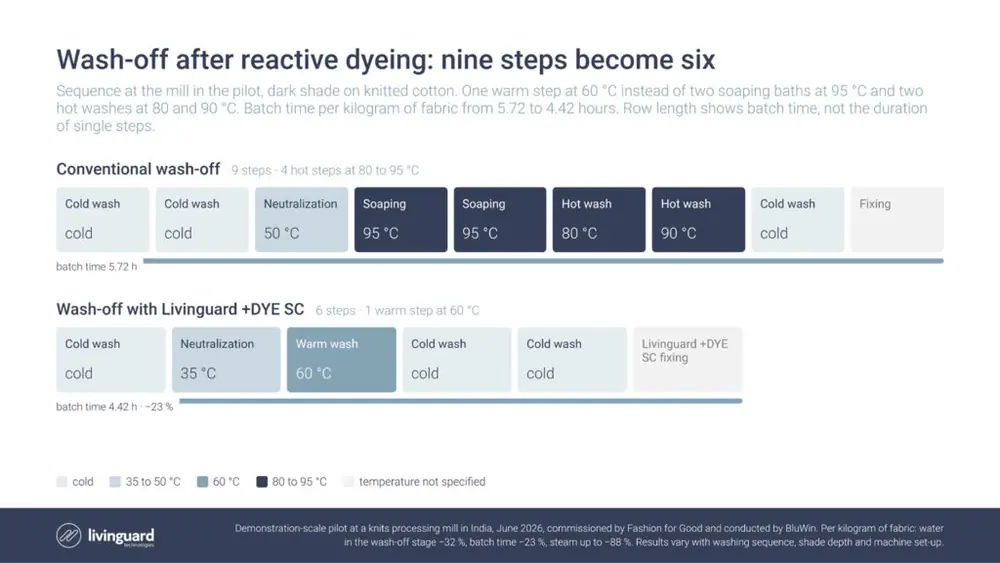
Swiss textile technology company Livinguard has demonstrated how its +DYE SC after-treatment can reduce the conventional nine-stage wash-off process following reactive dyeing of cotton to just six steps, cutting water consumption by 32% and processing time by 23%.
The results come from an independent assessment commissioned by Fashion for Good and conducted by technical consultancy BluWin at a knitwear processing mill in India. Steam consumption was reduced by up to 88%, while calculated greenhouse gas emissions fell by 29%.
Crucially, the simplified process was achieved using existing dyeing equipment, recipes and dyestuffs, without machinery modifications.
Wash-off challenge
The reactive dyeing of cotton and other cellulosic fibres requires extensive washing and soaping after dye application to remove hydrolysed dyes that have not bonded permanently with the fibres.
These processes are often carried out at high temperatures and account for a substantial proportion of the water and energy consumed during dyeing.
Livinguard +DYE SC addresses this problem through a cationic after-treatment that binds to both the fibre and hydrolysed dye, forming a charged, crosslinked network that restricts dye release during subsequent washing.
This allows the conventional wash-off sequence to be shortened considerably while maintaining the required colour fastness.
In the Indian trial, the mill’s existing nine-stage process, which included two soaping baths at 95°C and hot washes at 80°C and 90°C, was reduced to six stages incorporating a single warm wash at 60°C.
Water consumption during wash-off fell from 37.44 to 25.33 litres per kilogram of fabric, while processing time decreased from 5.72 to 4.42 hours. Steam consumption was reduced from 4.47 to 0.54 kWh per kilogram, with electricity use also falling by 23%.
Based on assumed local utility prices, the combined cost of water, effluent treatment, steam and electricity decreased from US$0.34 to US$0.10 per kilogram of fabric.
These estimates exclude chemical costs and machine time. Livinguard says its treatment is priced to be cost-neutral in chemical terms because it replaces conventional soaping and fixing agents.
Independent assessment
The trials were conducted in June 2026 under Fashion for Good’s Advanced Processing Matrix initiative, which evaluates emerging textile processing technologies against conventional production methods.
The assessment used a 15kg sample dyeing machine processing knitted cotton in a dark shade, with results adjusted to reflect the liquor ratio used in bulk production.
Wash and rub fastness were comparable with conventional processing, while additional laboratory testing across four shades confirmed that the required fastness standards could be maintained.
The findings nevertheless relate to a demonstration-scale assessment rather than extended commercial production. Actual savings will depend on factors including shade depth, washing sequences, machine insulation and local utility costs.
Livinguard believes the technology offers particular advantages for medium and dark shades, where conventional wash-off sequences are generally longer and more resource-intensive.
In addition to reducing operating costs, shorter processing cycles could increase throughput on existing equipment, providing mills with additional capacity without capital investment.
“Collective efforts to reduce the environmental impact of textile production are losing pace in a difficult economic environment,” said Michel Waegli, global head of business development at Livinguard Technologies. “Livinguard +DYE SC changes the equation for manufacturers. It improves their cost competitiveness and reduces resource use at the same time, on the equipment a mill already has.”
Fashion for Good plans to share the assessment findings with its brand and manufacturing partners to support further adoption.
Livinguard, headquartered in Pfäffikon, Switzerland, is now working with mills in Turkey, India, Pakistan and Sri Lanka on implementing the technology.