
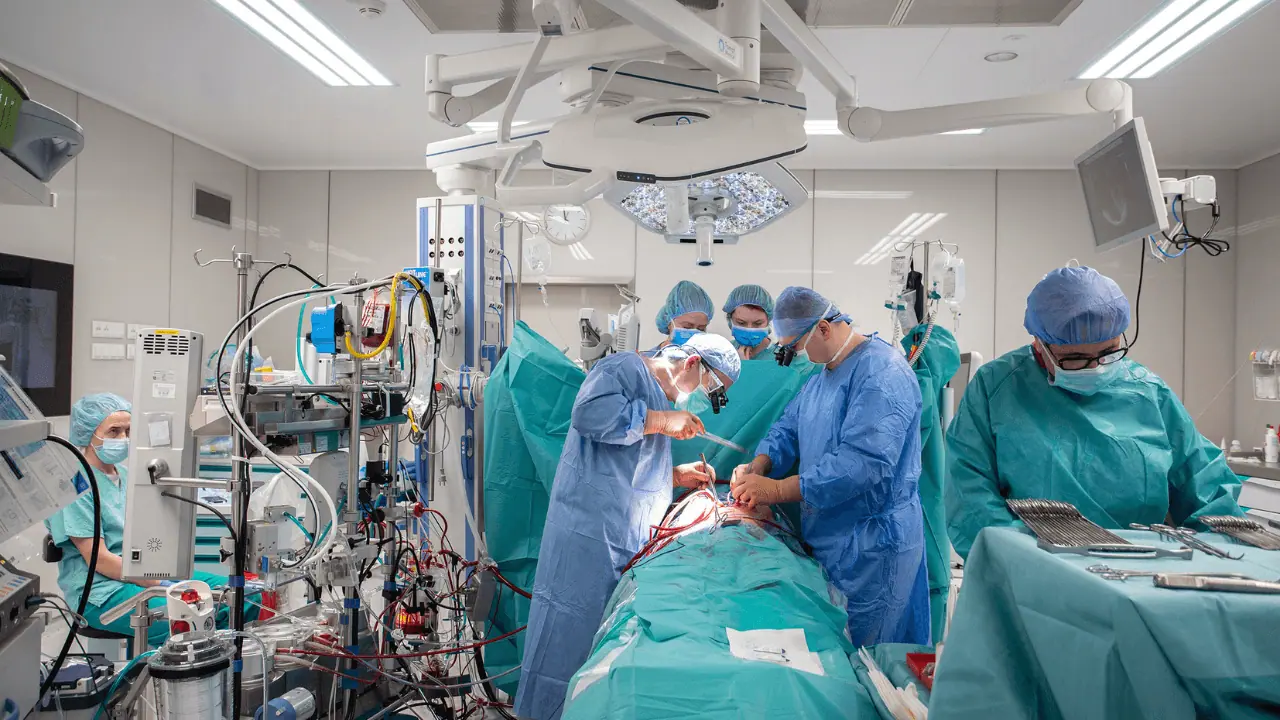
US-European founded startup VitVio is bringing its AI-powered surgical operating system, Vetro, to Poland for the first time through a new partnership with the University Clinical Centre in Gdańsk (UCK), one of the country's largest public teaching hospitals.
Founded in 2024 by Thomas Knox (CEO), Dr Peter Rennert (CTO), Maks Kozarzewski (COO), and Aleks Pajewski (CPO), VitVio uses computer vision and ambient sensing to create a real-time, 3D representation of operating rooms. Vetro uses AI agents to automate tasks such as logging surgical milestones, identifying delays, and providing real-time information to hospital coordinators.
I spoke to Maks Kozarzewski, co-founder and COO of VitVio, to learn more.
Starting with orthopaedics and neurosurgery
The initial deployment at UCK Gdańsk will involve a small number of operating rooms across orthopaedics and neurosurgery. Following the pilot, VitVio and the hospital will review the results before planning a broader rollout.
The installation is being coordinated in partnership with Medim, a Polish medical equipment distributor and healthcare solutions supplier.
Each participating operating room will be fitted with multiple cameras and ambient sensors that capture spatial information.
VitVio's Spatial Context Engine processes this information to create a live 3D model of the room. The technology is designed to recognise surgical activities and their progression rather than identify individual clinicians.
According to Kozarzewski, the company will establish a baseline before evaluating the pilot's impact on operating room performance.
"It's too early for results at UCK Gdańsk. The pilot starts with a baseline, so we'll measure against how their ORs run today: throughput, on-time first starts, turnover time, overruns and the time nurses spend logging by hand."
VitVio also says studies are underway with other health systems to evaluate its technology, with findings to be published alongside hospital partners following independent review.
Why 3D modelling matters in the operating room
Unlike surgical AI tools that rely on individual cameras to identify specific events, Vetro builds a spatial model of the entire operating room, tracking where people and equipment are positioned and how surgical activity progresses. Kozarzewski explained:
"Think of it as an extra team member in every room without a physical presence. It understands the whole room and takes tedious administrative work off the clinical team."
Operating rooms are crowded environments where people and equipment frequently obstruct individual cameras. By combining information from multiple sensors, Vetro can reconstruct parts of the room that may be hidden from a single viewpoint. This allows the system to identify potential causes of delays, such as missing instrument trays or patient positioning taking longer than expected.
As Kozarzewski explained:
"Most questions that matter in an OR are about whether the right things are in the right place at the right time. Is the right tray next to the patient or still across the room? Is the equipment for the next step in position?"
From workflow monitoring to automated surgical documentation Vetro's core perioperative workflow capabilities are already in clinical use. The system automatically detects surgical milestones, provides coordinators with a live overview of operating room activity, and keeps teams informed as procedures progress.
The company is now beginning to roll out two-way voice interaction, allowing surgical teams to ask Vetro questions and receive information without stepping away from the patient. Instrument detection is also in early rollout, to help hospitals optimise the composition and use of surgical instrument trays.
A further capability under development is automated operative note drafting.
"Voice interaction also paves the way for automated operative notes, combining what Vetro observes in the operating room with information provided verbally by the surgical team."
VitVio intends Vetro to serve as a common platform for multiple aspects of surgical operations, rather than introducing separate tools for each application.
Protecting clinician privacy
Introducing cameras and AI into operating rooms raises questions about patient privacy, data protection, and the potential for monitoring individual clinicians.
Kozarzewski stressed that Vetro is designed to document surgical workflows rather than evaluate staff performance.
"Vetro records a timeline of each case: the same milestones nurses already log by hand, such as patient entry, incision and closure. It doesn't score or rank individual staff."
Sensor data is processed on servers inside the hospital, where heads are pixelated, written information is removed, and original footage is deleted. Only the surgical case timeline leaves the hospital in real time.
The company says the remaining de-identified sensor data is automatically deleted after a short retention period, usually seven days, although a small proportion of anonymised clips is retained to verify the system's detection capabilities. Historical case information used for scheduling is aggregated across a minimum number of procedures rather than used to assess individual clinicians. Voice functionality is optional, with each hospital deciding whether to enable it.
Further, VitVio acts as the data processor, while the hospital remains the data controller. Each hospital also has its own isolated environment within its geographic region.
Giving surgical teams more time for patients and training
For UCK Gdańsk, the deployment aims to reduce time spent on administrative tasks and make better use of operating room capacity, potentially allowing more procedures within existing operating hours. As a teaching hospital, UCK also sees an opportunity to give clinicians more time for training.
Dr Adam Sudoł, VP of Medical Logistics at UCK Gdańsk, said:
"As a teaching hospital, we want our surgical teams focused on patients and on training the clinicians who come after them, not on paperwork. What we learn in these first rooms will shape how we run the rest, and how we continue to set the standard for surgical care across Poland."
Jakub Kraszewski, CEO of UCK Gdańsk, described the deployment as an example of technology supporting medical professionals rather than replacing them.
"We believe that intelligent AI-based solutions will play an increasingly important role in how healthcare is organised in the coming years, and UCK wants to play an active part in that transformation."
Kozarzewski highlighted the significance of bringing the technology to Poland, particularly given the founders' connections to the country.
"UCK Gdańsk trains many of the surgeons, anaesthetists and nurses who go on to work across Poland, so what happens in its operating rooms shapes surgical care far beyond Gdańsk. Every minute in a surgical suite carries clinical and financial weight, and too many are lost to paperwork and avoidable delays."
He added:
"Our job is to give that time back to clinicians, their patients and the next generation they're training. With Polish roots in our founding team, starting in Poland with a hospital of UCK's standing means a great deal to us."
The challenges of bringing AI into hospitals
UCK Gdańsk joins VitVio's existing hospital deployments across the US, UK, Mexico, and other European markets. In July, the company also opened access to Vetro for hospitals and health systems in additional markets, including the Middle East.
Kozarzewski said the biggest obstacles to adoption are increasingly organisational rather than technical. Electronic health record integration can be time-consuming, so VitVio allows hospitals to start using Vetro through an interim workflow while integration takes place in parallel. Security assessments and procurement processes can also slow deployments, particularly in publicly funded healthcare systems. According to Kozarzewski, budgets are the biggest barrier for publicly funded hospitals.
"A new capital purchase can take a year to approve," he shared.
To address this, VitVio aims to minimise upfront capital expenditure, with most costs covered through hospital operating budgets.
The company encourages hospitals to begin with a limited number of operating rooms, measure performance against an established baseline, and expand after evaluating the results.
"We prove results in their own rooms and improve multiple challenges they face in the OR before asking them to scale."
VitVio has raised $10 million in total funding, including an $8 million seed round closed in October 2025, led by Bek Ventures with participation from LDV Capital and Balnord. Its angel investors include ElevenLabs co-founder Mati Staniszewski.
Further hospital deployment announcements are expected in the coming months.
Write Comment