
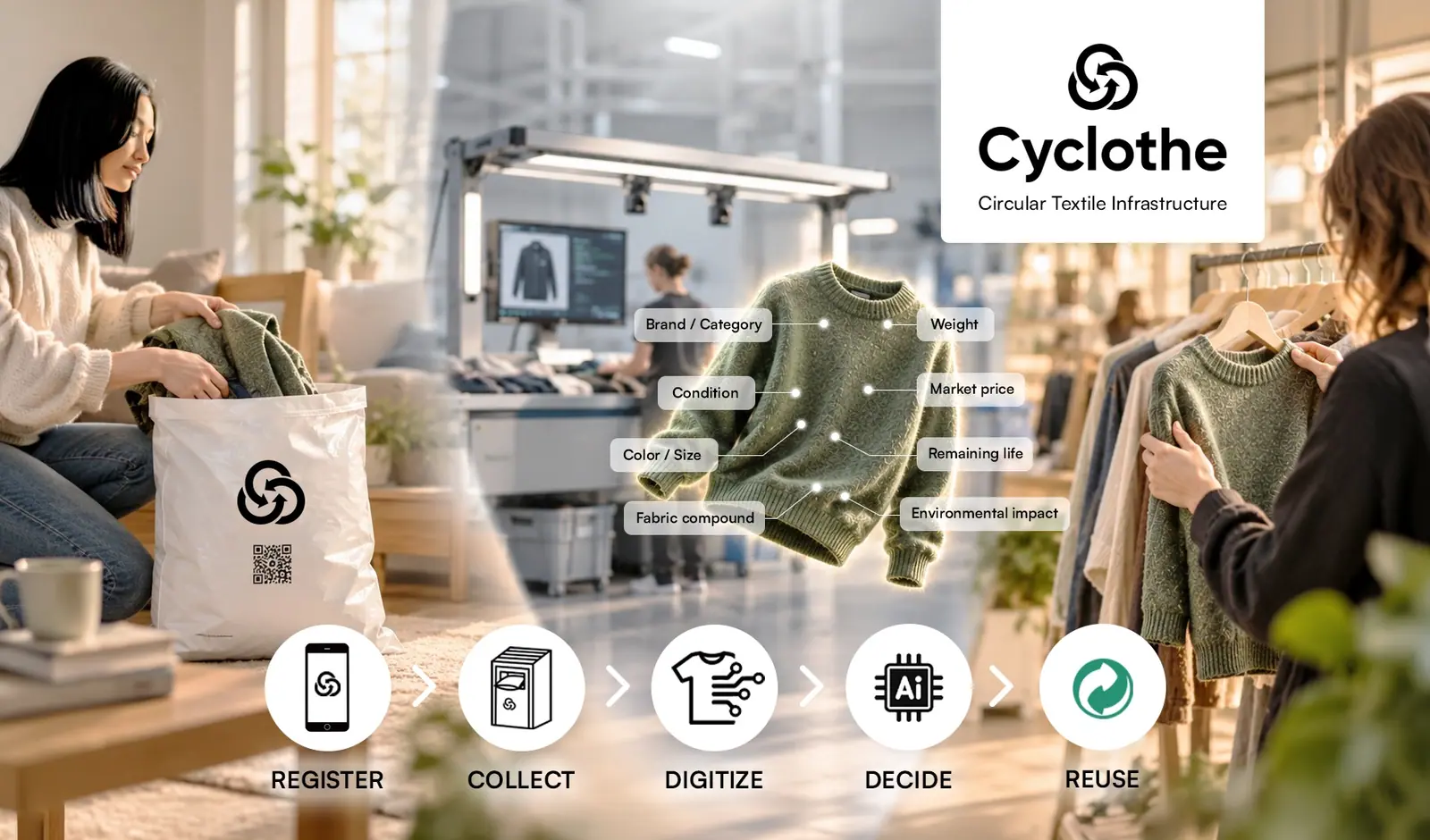
Swedish company is developing an integrated collection, sorting and recovery network and led by former Ikea executive.
14th October 2026
Innovation in Textiles
| Sweden
Sustainable, Clothing/Footwear
Swedish technology company Cyclothe is developing an integrated system for collecting, identifying and sorting discarded textiles, with the aim of addressing one of the biggest obstacles to Europe’s emerging circular textile economy – the lack of infrastructure connecting waste collection with commercially viable reuse and recycling operations.
The company’s approach combines smart collection points, automated material identification, AI-supported sorting decisions and digital traceability to direct discarded textiles towards their most appropriate destinations.
Rather than concentrating exclusively on recycling, Cyclothe aims to prioritise reuse, repair and resale wherever possible, before directing materials that cannot be recovered in these ways towards textile recycling operations.
The intention is to connect consumers, retailers, municipalities, logistics providers and recycling companies through a common physical and digital infrastructure, enabling collected materials to be identified, tracked and channelled into appropriate markets.
The mandatory separate collection of textiles was introduced in Europe at the beginning of 2025, but the infrastructure needed to process the resulting material streams remains fragmented.
The introduction of extended producer responsibility (EPR) requirements is expected to increase pressure on brands and retailers to participate in more effective systems for recovering discarded products.
Cyclothe is now preparing to expand its technology across the Nordic countries and wider Europe, appointing Calvin Woolley, formerly sustainable business manager for textiles at Inter Ikea, as co-founder and CEO to lead the next stage of its development.
Woolley has more than 25 years of international textile industry experience, including 15 years working on textile sustainability and circularity initiatives at Ikea.
“It is clear that the textile sector does not suffer from a lack of circular ambition,” he says. “It suffers from a lack of functioning infrastructure. What we’re missing is an infrastructure capable of managing new legislation in a commercially viable way – where measurable, high-value reverse flows can actually be built at scale.”
Cyclothe founder Halit Kosmaz says the appointment marks a transition from developing the company’s proprietary technology towards its commercial deployment.
The next phase will involve expanding its smart collection network and AI-supported sorting systems, alongside establishing commercial relationships with reuse, resale and textile recycling businesses.
Cyclothe also intends to develop a traceable downstream marketplace, allowing recovered materials to be directed towards suitable buyers and processors.
The commercial challenge will be to demonstrate that these different elements can operate together economically at scale, particularly as Europe’s textile recovery sector faces increasing collection volumes, variable material quality and insufficient sorting and recycling capacity.