
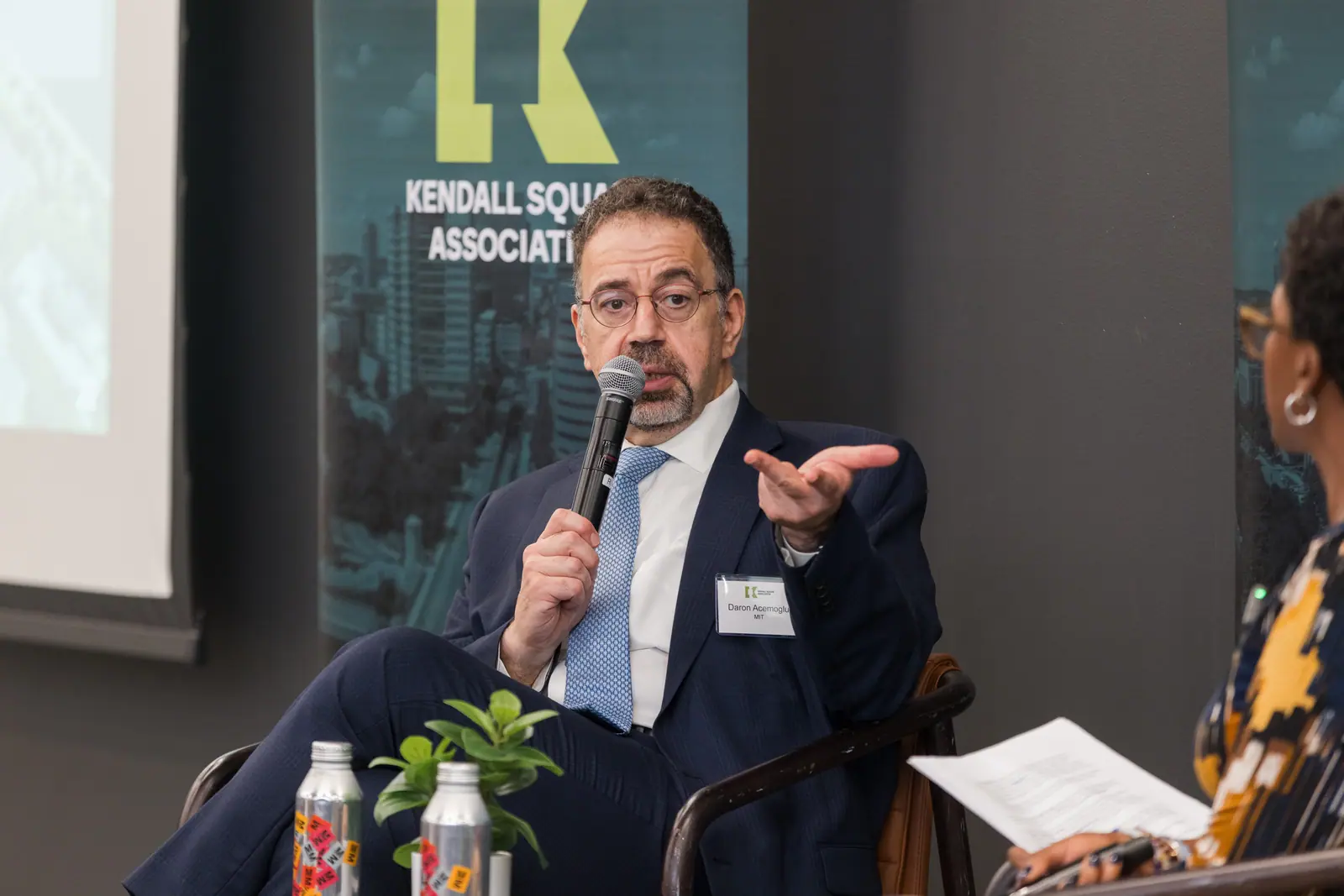
Kendall Square in Cambridge, Massachusetts, is often cited as the most innovative square mile in the world. But when the Kendall Square Association gathered local stakeholders for its 18th Annual Meeting Thursday, the conversation focused on innovation primarily in the context of community.
The event, which took place at the nonprofit startup incubator The Engine, attracted people from across Cambridge, including business leaders, elected officials, local residents, and students, for a night of local food and conversation about the advance of technologies like artificial intelligence and what they mean for society.
“How can we make AI not an enemy of work, but a tool for workers to expand their capabilities and build new expertise or do new things?” asked MIT Institute Professor Daron Acemoglu in a keynote talk. “The world is at a point in time where we need new innovations and new adaptations to growing challenges.”
Acemoglu’s keynote was one of several presentations at the event, which also featured music from the Kendall Square Orchestra, a vote on new KSA board members, and awards for organizations making a positive impact through innovation.
KSA is a nonprofit made up of over 150 organizations across Kendall Square, from major companies to universities, research organizations, and the independent shops and restaurants that give Kendall Square its distinct character.
“People come to Kendall Square to make the world better,” said KSA Executive Director Beth O’Neill Maloney in her opening remarks. “People come here to improve the human condition, people come here to solve big problems, and people come here to innovate for good.”
Acemoglu, who shared the Nobel Prize in economics in 2024 for his work studying how institutions affect prosperity, spoke on the subject of his new book, “What Happened to Liberal Democracy?”
Acemoglu says liberal democracy is under siege as trust in liberal institutions decline, political polarization rises, and people lose faith in elected officials. He acknowledged that the shared prosperity liberal democracy promised has not always been delivered, especially over the last 50 years, but insisted it is the best path forward and in need of renewed support.
“I believe liberal democratic institutions, together with the norms that support them, are one of the greatest human achievements,” Acemoglu said. “It would be unthinkable for people who lived 300 years ago that we could live in societies consisting of hundreds of millions of people with diverse interests, different views, doing different things, and people still participate in politics and reach compromises, and we have state institutions that, by and large, actually provide services and do things for the people, and that we build opportunities for prosperity from which most people benefit while social freedoms are largely upheld.”
Cambridge Mayor Sumbul Siddiqui also spoke at the event. Siddiqui began her talk by telling the story of Cambridge residents working with biotech labs in the 1970s to create a groundbreaking policy on recombinant DNA research, which helped turn Kendall Square into the life science hub it is today.
“All these years later I think that story captures what makes Kendall Square so special: It’s our willingness to work together even when we face big challenges,” Siddiqui said. “It isn’t just the universities or labs, it’s also the culture of collaboration among nonprofits, governments, and residents.”
Broad Institute Chief Communications Officer Lee McGuire started his talk by reviewing a 2009 report on what made Kendall Square such a powerful driver of innovation, noting that factors like talent density, education, and a collective voice remain strong in the area today.
“This report was brilliant in that it captures so many of the special things that matter for a place like Kendall,” McGuire said. “It is the job of the Kendall Square Association and all of us to help protect those things, make sure we name them, understand them, and see them as essential elements of making sure this community stays what it is no matter what happens. As long as there’s a good idea, this is the place that’s going to get that idea moving and scale it up to change the world.”