TRESPASSING: Tokyo lodged a strong protest with Moscow when Russian military planes, believed to be the same ones that flew near Taiwan, entered its airspace
- By Ben Blanchard and Kaori Kaneko / Reuters, TAIPEI and TOKYO
The Ministry of National Defense yesterday said it detected two Russian military aircraft flying off the nation’s east coast, while Japan protested to Moscow after two aircraft believed to be Russian violated its airspace the same day.
The reports, probably about the same aircraft, come ahead of Russian President Vladimir Putin’s arrival in Shenzhen, China, for this week’s summit of APEC leaders.
After flying through airspace to the nation’s east, the Russian aircraft, whose type it did not identify, exited Taiwan’s air defense identification zone (ADIZ) south of Taitung County, the ministry said.
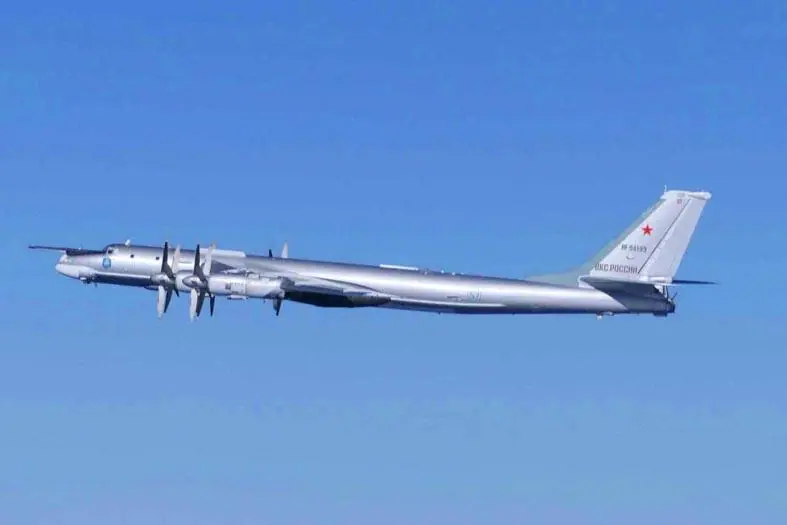
A handout photo taken on Dec. 9 last year and received on Dec. 10 from the Japanese Ministry of Defense shows a Russian Tu-95 bomber flying over the sea near Japan.Photo: AFP / Japanese Ministry of Defense
The ministry used joint intelligence, surveillance and reconnaissance to monitor the full course of the activity and “responded appropriately,” it said in a statement, without giving details.
Earlier yesterday, Tokyo lodged a strong protest with Moscow after two aircraft believed to be Russian violated its airspace off the island of Okinoshima in southwestern Fukuoka, Japanese Chief Cabinet Secretary Minoru Kihara said.
“The violation of Japan’s airspace by Russian aircraft is a serious infringement of Japan’s sovereignty,” Kihara said, adding that the safety threat was completely unacceptable. “We lodged a strong protest with Russia and urged it to prevent a recurrence.”
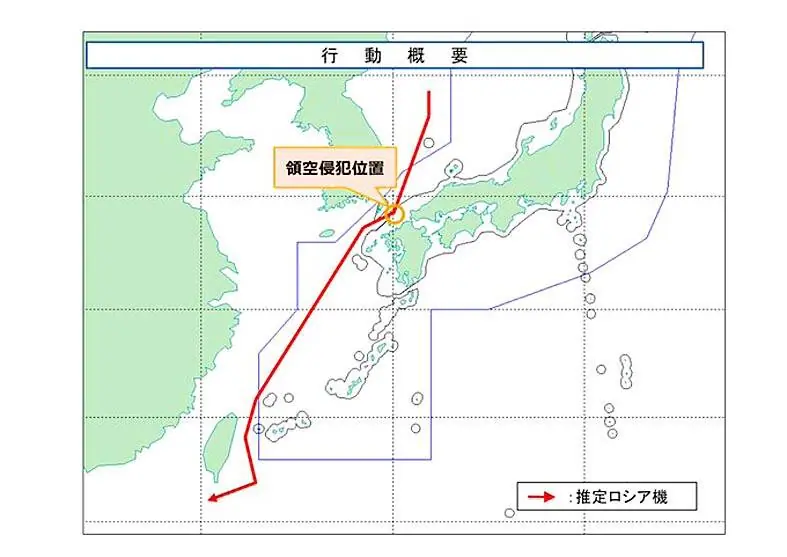
A map shows the flight path taken by two Russian military aircraft yesterday.Photo courtesy of the Japanese Ministry of Defense
The Japan Self-Defense Forces scrambled fighter aircraft and took necessary measures in response, such as issuing warnings and notifications, the Japanese Ministry of Defense said.
The suspected Russian aircraft were subsequently confirmed to have transited the Tsushima Strait, passed between Yonaguni Island and Taiwan, and proceeded into the Pacific Ocean, it added, also without identifying the aircraft type.
Yonaguni is the Japanese island closest to Taiwan, about 100km off its east coast.
A map issued by Japan’s defense ministry showed a flight path to Taiwan’s east, heading in a southerly direction, implying the aircraft were the ones Taiwan spotted later.
The last confirmed violation of Japan’s airspace by Russian aircraft was off Rebun Island off Hokkaido in September 2024, the Japanese ministry said.
In 2023, Taiwan spotted two Russian warships off its eastern coast and sent its own aircraft and ships to keep watch.
Although it was not the first time Russian or former Soviet military aircraft had entered Taiwan’s ADIZ, such flights have become much less frequent since the Cold War, said Chieh Chung (揭仲), an adjunct assistant professor in Tamkang University’s Graduate Institute of International Affairs and Strategic Studies.
Chieh cited a 2010 incident in which a Russian Tu-95 strategic bomber entered Taiwan’s northeastern ADIZ before turning toward Japan’s Ryukyu Islands after Taiwan’s military issued a radio warning.
The aircraft’s identity was confirmed several days later through intelligence exchanges with neighboring countries, he said.
During the Cold War, Soviet aircraft flying to Cam Ranh Bay in Vietnam occasionally entered Taiwan’s ADIZ to shorten their routes or conduct electronic reconnaissance, Chieh said.
Yesterday’s flight was noteworthy, as it came ahead of the two-day APEC meeting that starts today and a planned US-China-Russia leaders’ summit tomorrow, Chieh said.
Moscow would have known that Japan was likely to publicize the aircraft’s movements, he said.
Chieh urged the Ministry of National Defense to disclose more details, including flight paths and entry times, as Japan had done.
Taiwanese fighter jets were likely scrambled to monitor the aircraft and should have been able to identify their models and possibly obtain photographic evidence, he said.
Releasing such information would demonstrate the military’s ability to monitor developments around Taiwan, Chieh added.
Additional reporting by CNA