
- AP, WASHINGTON
US President Donald Trump’s administration on Monday issued new rules to restrict remote access to advanced US computing chips and servers, its latest step to limit China’s abilities to use US chips to train their best artificial intelligence (AI) models.
Last week, Nvidia Corp cofounder Jensen Huang resigned as CEO following scrutiny of his ties to a Chinese executive who used to lead Singapore-based Megaspeed International, which is suspected of diverting advanced Nvidia chips to China in violation of US export controls. The company provides computing power to Chinese companies using chips housed in Southeast Asian data centers, including facilities in Malaysia.
“The rule is designed to ensure that existing restrictions on access to sensitive American technology cannot be circumvented through remote computing arrangements involving data centers in third countries,” the US Bureau of Industry and Security said in issuing the rule that took effect immediately.
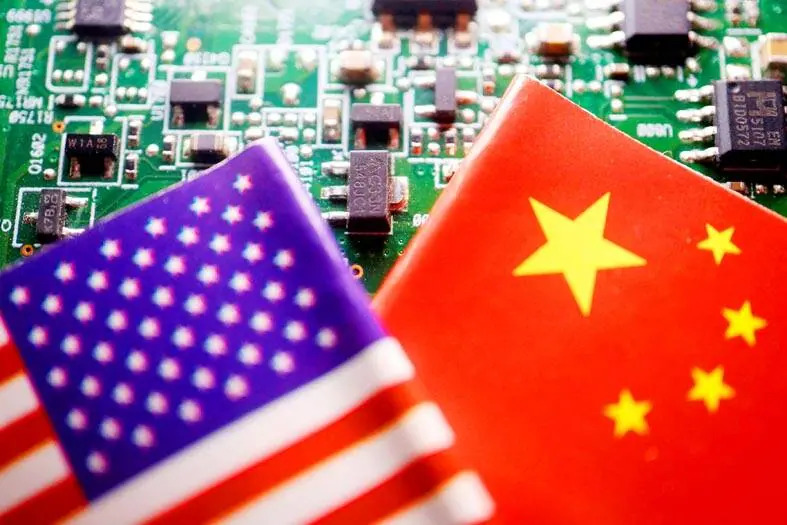
Flags of China, left, and the US are displayed on a printed circuit board with semiconductor chips in an illustration photographed on Feb. 17, 2023.Photo: Reuters
The rule came on the same day Trump departed for a trip to Asia, where he expects to meet Chinese President Xi Jinping (習近平) for the third time this year amid a fragile truce on trade.
Under the new rule, overseas data centers that serve companies in countries including China, Russia, Iran and Cuba are required to identify their end users. There will also be additional licensing requirements for sales of chips for Indonesia, Malaysia, Singapore, Thailand or Brazil — countries that “present a higher-than-normal risk of diversion” to unauthorized destinations, the rule says.
In Beijing, Chinese Ministry of Foreign Affairs spokesman Guo Jiakun (郭嘉昆) accused the US of arbitrarily interfering with China’s trade and technological cooperation with other countries and suppressing the development of its high-tech industries.
“This is a typical example of economic coercion and long-arm jurisdiction, runs counter to the common understanding between the two sides,” he told reporters, adding that it infringes upon the rights of Chinese companies and disrupts the stability of global supply chains.
He said China would take necessary measures to safeguard its interests.
In addition to the remote access rule, US lawmakers are weighing a series of measures that would put more curbs on sales of AI chips and further limit China’s access to sophisticated chipmaking machinery from ASML Holding. The measures would be attached to annual defense legislation that must pass before the end of the year.
Additional reporting by Bloomberg