Central bank estimates fewer than one in 100 borrowers owe more on their home than its worth
Get our breaking news email, free app or daily news podcast
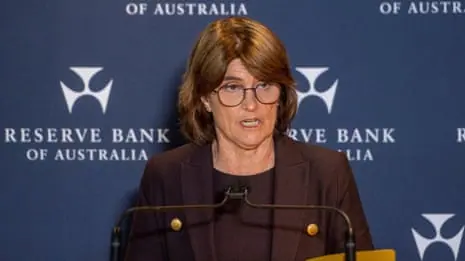
The Reserve Bank says households are well placed to weather the twin storm of rising interest rates and falling property prices, although it says recent borrowers who have taken out big loans are most at risk of falling into negative equity.
Despite a deepening property price slump concentrated in Sydney and Melbourne, the RBA’s analysis suggested that fewer than one in 100 borrowers owe more on their home than it’s worth.
Those included first home buyers who took advantage of the government’s 5% home guarantee scheme, the RBA said, although evidence suggested that the share of these borrowers falling behind on their payments remained “contained”.
The RBA also estimated that even a 20% property price crash would only push about 5% of mortgages into negative equity – a testament to the fact most homeowners have enjoyed significant value gains over the years.
The RBA also found that most indebted homeowners were coping with higher borrowing costs and wages that were not keeping up with the recent burst of inflation.
The analysis showed a little under 2% of mortgaged homeowners didn’t have enough income to cover essentials and the mortgage payments, similar to six months earlier. That share would stay roughly the same “for some time”, based on the RBA’s forecasts, and well below the recent peak of nearly 5% in 2024.
“While some households continue to experience hardship, the estimated share of mortgagors in severe financial stress or in arrears has, so far, remained low, supported by the strong labour market and mortgagors’ savings and equity buffers,” the report said.
“Negative equity is insufficient to trigger default if borrowers remain able to service their loans, which remains the case for the vast majority of these households.”
The central bank’s latest financial stability review – a biannual assessment of the financial system – said the “threats to global financial stability continue to mount”.
The governor of the RBA, Michele Bullock, last month said AI could be a bubble, and that “all central banks are a little bit worried about that”.
This concern was reiterated in the financial stability review, which said high valuations in global corporate debt and share markets meant they were vulnerable to a “disorderly” correction.
“One possible trigger could be a shift in sentiment towards the AI investment boom, which is increasingly fuelled by expectations of sustained rapid earnings growth and a debt-financing cycle that is becoming more opaque and circular,” the report said.
“Australia is unlikely to be immune” from the impact, it said.
Alongside the huge sums being invested in artificial intelligence, two ongoing conflicts – in the Middle East and Ukraine – alongside “intensifying strategic competition among major powers” underscored these threats, the RBA said.
The RBA also warned of the rising risk of cyber-attacks, potentially facilitated by AI, and a sudden sell-off in global bond markets.
“These external factors are the most prominent threats to financial stability in Australia.”
Explore more on these topicsShareReuse this content