
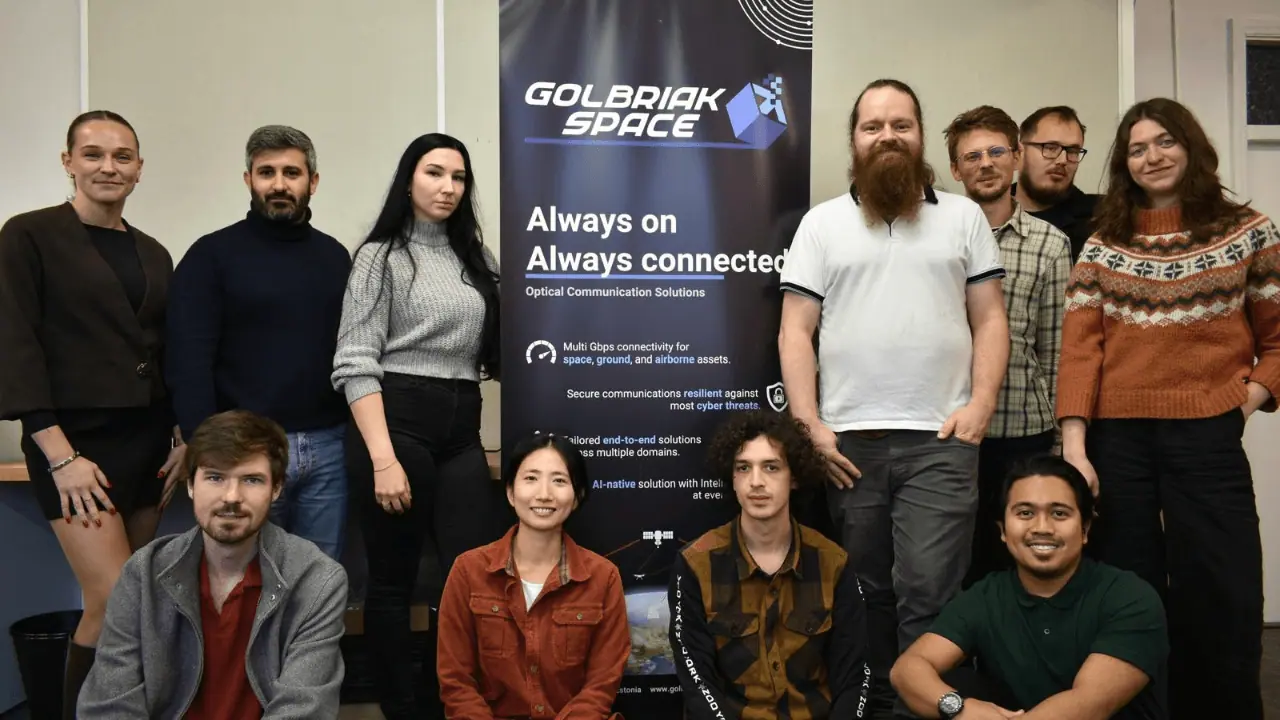
Estonia’s Golbriak Space has secured €4 million in fresh financing to accelerate the industrialisation of its technology and expand production capacity as customers move towards embedding optical terminals at scale.
The company designs, engineers and manufactures laser communication systems for space and airborne applications. Its technology is designed to reduce integration complexity and make optical communications easier to manufacture, operate and deploy across different platforms, networks and missions.
The seed round was co-led by Join Capital and PhotonVentures, with participation from Takeoff, the acceleration program of the CDP Venture Capital National Accelerator Network for aerospace and advanced hardware startups, managed by Plug and Play.
Specifically, the investment was made into Golbriak Space’s Italian holding company, Iribits S.r.l., and will be used to accelerate the development and industrialisation of its Estonian operating subsidiary, Golbriak Space OÜ.
It comes as Golbriak advances commercial negotiations for programmes involving several thousand terminals. Making laser communications work at scale
The performance advantages of laser communications have been understood for decades. Optical links can move large volumes of data without relying on the increasingly congested radio-frequency spectrum.
Because their beams are narrow and highly directional, they are also considerably harder to intercept or disrupt: an adversary would typically need access to the beam path or precise alignment with the receiver. The harder problem has been developing terminals that can be manufactured economically at scale and readily integrated and operated by customers.
Demand for optical terminals is growing as satellite networks become larger, more interconnected and generate more data, with individual constellation programmes potentially requiring hundreds or thousands of terminals.
Golbriak’s terminals reduce their dependence on the pointing capabilities of the satellite, drone or other host platform, easing integration and allowing multiple terminals to operate on the same spacecraft or aircraft.
Golbriak designs and engineers the optical, electronic, mechanical and software elements of its systems in-house. This control over the complete communications chain allows the company to optimise performance, integration, manufacturability and quality as production volumes increase.
The company is scaling production of two principal product families: ERMESAI+ for space applications and ARES for airborne platforms. Both are built on a common, software-defined architecture designed to make high-capacity optical communications easier to integrate, operate and deploy across different platforms and networks.
“Closing this round marks a turning point for Golbriak,” said Nicola Garzaniti, founder and CEO of Golbriak Space.
“Years of research, specialised engineering and customer validation have gone into solving the practical challenges that determine whether laser communications can operate reliably at scale.
We have addressed the key challenges required for large-scale deployment of optical communications. We have functioning products, paying customers and demand that is now expanding towards programmes involving thousands of terminals."
“Golbriak already has functioning technology, paying customers and clear demand from operators planning the next generation of satellite networks. Years of specialised engineering have created a significant technological and commercial lead. This investment accelerates the company’s ability to manufacture at the scale its customers will require,” said Jan Borgstädt, Founding Partner at Join Capital.
“Golbriak combines advanced photonics with a highly scalable architecture. With demand moving towards constellation-scale deployments, we see significant potential for Golbriak to become a leading supplier of optical communication terminals for the global space industry,” said Pieter Klinkert, Co-founder and General Partner at PhotonVentures.
Golbriak is in advanced negotiations for programmes collectively involving several thousand systems. The company’s upcoming customer-funded deployments across multiple commercial space programmes will expand its operational footprint from 2027, while additional ARES systems are being prepared for airborne applications.