Introduction: Gold hits highest level in three months as traders worry about US inflation and bond market jitters
Good morning, and welcome to our rolling coverage of the global economy, the financial markets, the eurozone and business.
Gold has climbed further, hitting its highest level since mid-May, as traders and investors worry about the outlook for US inflation and bond market jitters.
Spot gold hit almost $4,700 an ounce earlier and is now trading at $4,649 an ounce.
Prices jumped last week after the US Treasury Department said it would double its debt purchases of longer-dated bonds, as it scrambled to calm the bond market after a sharp rise in yields. The focus is now on US inflation data and a speech by Federal Reserve chair Kevin Warsh on Friday for clues on interest rate hikes and the bond market.
Cryptocurrencies are also rallying. Bitcoin rose through $80,000 for the first time since May, rising to $80,453 this morning, up more than a quarter in the past week. However the cryptocurrency remains well below the all-time peak of $126,000 reached last year. Ether also climbed, to $2,503.
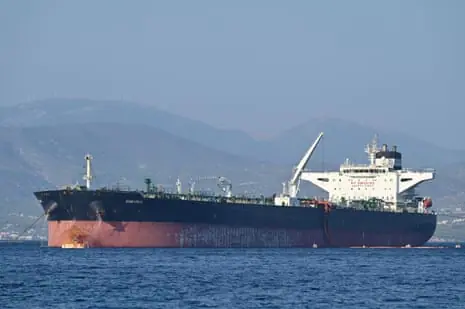
Meanwhile in the Middle East, just two commodity vessels transited the strait of Hormuz on Monday, the lowest daily tally since early May, with both entering the Gulf, according to shipping data.
The figure was also well below the 10-day average of 14, Reuters reported. However, some ships switch off their navigation transponders on their way through so the real figure could be higher.
Iran said on Monday it had backlisted 45 tankers for violating its rules on passage through the key waterway and threatened action such as fines against vessels engaging in ship to ship transfers with them.
Oil and stock markets have shrugged off the threat of severe sanctions against Iran or any entity maintaining economic ties with Iran from the US, after nearly six months of war.
Brent crude, the global benchmark, has fallen further this morning to $91.41 a barrel, down 76 cents or 0.8%.
Asian stock markets are mostly higher, with Japan’s Nikkei up 0.5% and South Korea’s Kospi rising 0.7% while Hong Kong’s Hang Seng dipped 0.15%.
Launching what he called Operation Economic Outcast on Monday, the US treasury secretary, Scott Bessent, called it an unprecedented campaign and compared it with the D-day Normandy landings, a turning point in the second world war.
However, when asked by a reporter why the US wasn’t imposing immediate sanctions, Bessent replied:
Well, we are giving everyone the opportunity to remedy bad behaviour. Why would I want to blow up the global financial system? We believe that it is important to level set and give people a cure period, but they should know that that will move very quickly and that we are serious.
It is unclear how far the Trump administration is prepared to go in confronting China, Iran’s biggest trading partner. Tehran vowed retaliation against any country that took part in the US-led isolation campaign.
Germany, Europe’s biggest economy, grew 0.3% in the second quarter compared with the previous quarter, driven by exports, according to official figures. That’s slightly higher than a preliminary estimate of 0.2%.
Ruth Brand, president of the Federal Statistical Office, said:
The German economy is maintaining the growth momentum seen at the start of the year. As in the first quarter, growth was primarily driven by the positive development of exports.
Total exports of goods and services rose 2%. And wholesale and retail trade performed much better than expected, while investment dipped 0.2%.
The Agenda
9am BST: Germany Ifo business confidence for August
10am BST: UK gilt auction of 2033 bonds
2pm BST: US S&P/Case-Shiller 20-City Home Price Index
3pm BST: US Conference Board consumer confidence for August
3pm BST: US New home sales for July