
PRAGMATIC: ‘Regardless of support ratings today, the only thing that counts is the votes in the ballot boxes,’ Taipei mayoral candidate for the DPP Puma Shen said
- By Huang Chin-hsuang and Jonathan Chin / Staff reporter, with staff writer
Democratic Progressive Party (DPP) Taipei mayoral candidate Puma Shen (沈伯洋) yesterday urged supporters to come out and vote in the local elections next month, after a poll put him ahead of Taipei Mayor Chiang Wan-an (蔣萬安) of the Chinese Nationalist Party (KMT).
A survey published by the pan-blue camp Chinese-language newspaper United Daily News (UND) showed that Shen commanded a 45 percent support rating, four points higher than Chiang’s 41 percent.
When asked, Shen, who is a legislator, told reporters on the sidelines of a legislative meeting that his campaign uses polls for reference only.
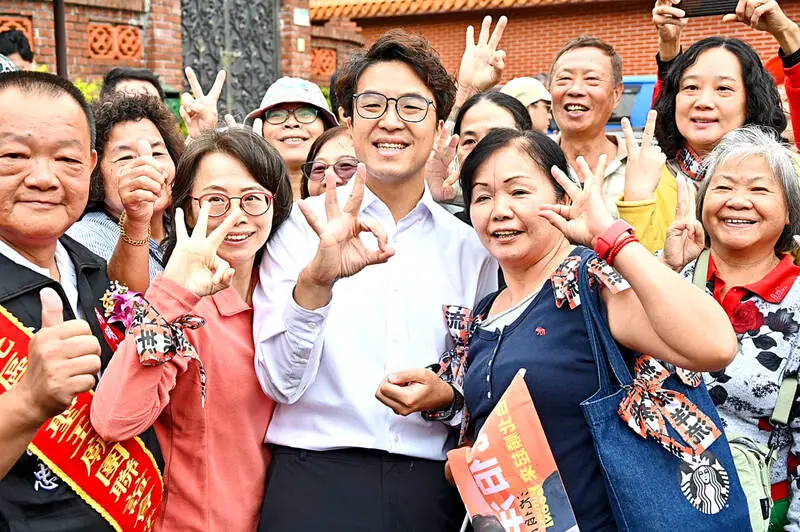
Democratic Progressive Party Legislator and Taipei mayoral candidate Puma Shen, center, poses for a group photo with supporters at a temple in Taipei yesterday.Photo: Tu Chien-jung, Taipei Times
The survey also showed that an overwhelming majority of voters still expect Chiang to win the race, he added.
“Regardless of support ratings today, the only thing that counts is the votes in the ballot boxes,” Shen said.
The UDN poll of voting-age Taipei residents, conducted from Tuesday to Thursday last week and on Sunday, had 1,115 valid samples and a 95 percent confidence level, with a margin of error of 3 percentage points. The newspaper said that 264 would-be respondents refused to take the survey.
When asked to comment on the high number of abstentions from the poll, Shen said voters are likely tired of being bombarded by pollsters, resulting in low participation rates.
Moreover, supporters of some parties tend to abstain from polls, and no survey can escape the risk of sampling errors that skew the results, he said.
“Rather than scrutinizing polls, we prefer to go door-to-door and listen to the voice of the voters,” Shen said.
Shen’s campaign is based on serving all demographic groups included in the city’s population, not policies that please only DPP supporters, he said, adding that he does not let poll numbers dictate policy.
DPP caucus chief executive Chuang Jui-hsiung (莊瑞雄) told a news briefing that the UDN survey suggests the party’s next move should focus on energizing voters in Taipei.
That Shen took the lead from Chiang showed that many voters have changed their minds about the DPP candidate, he said.
Yet, 48 percent of voters pegged Chiang to win the election, higher than the 35 percent who believed Shen would prevail, Chuang said.
“We must work on convincing people that their votes matter,” he said.
Shen commanded a 40 percent support level among independent voters in the survey, taking the lead in that demographic, Chuang said.
This means the 24 percent undecided votes are key to winning the Taipei mayoral election, he said.
Meanwhile, KMT caucus deputy secretary-general Hsu Yu-chen (許宇甄) told a news briefing that the UDN poll suggested that many of Chiang’s supporters chose to remain silent, resulting in their underrepresentation in surveys.
Chiang’s lead in being favored to win the election is evidence of a pro-KMT silent majority, she said.
On Tuesday, Japanese political scientist Yoshiyuki Ogasawara told the Japanese newspaper Sankei Shimbun that the KMT had dealt itself a heavy blow by boycotting and delaying the central government’s annual budget.
The budget fight — which also saw the KMT blocking special funds for the government to buy mooncakes from shelters for women facing domestic abuse and people with disabilities — was bad optics that could cost the party the election, he said.
Asked about Ogasawara’s remarks, Hsu said the party humbly accepts public criticism and suggestions, before accusing the DPP of exploiting disadvantaged groups for political gain.
The budget fight was about protecting taxpayers’ hard-earned money from waste and the DPP government “should not hide behind disadvantaged people as if they were meat shields,” she said.
The KMT is optimistic that Chiang’s supporters would come out to cast their vote on election day, Hsu said.
Additional reporting by Lin Che-yuan and Lin Hsin-han