
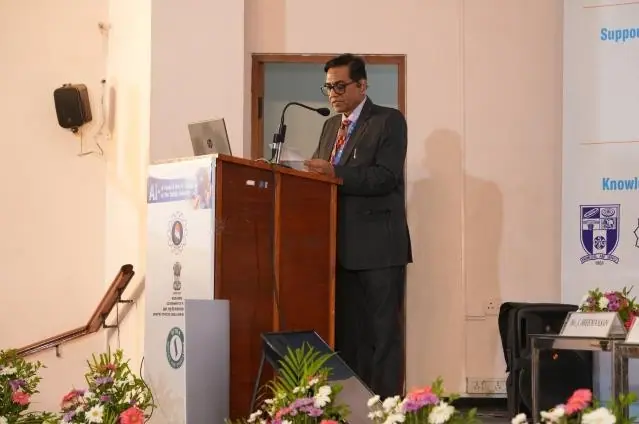
The conference opened with insights into overcoming supply chain fragmentation and driving sustainable growth across the textile sector.
The South India Textile Research Association (SITRA) Auditorium recently played host to a flagship industry conference titled “AI – A Friend and Not an Enemy of the Textile Industry.” Jointly organized by the Indian Textile Accessories & Machinery Manufacturers’ Association (ITAMMA) and SITRA, the day-long summit challenged the prevailing narrative around workforce displacement, positioning artificial intelligence instead as an indispensable operational partner for modern mill operators.
Key takeaways at a glance
- Focus on real problems: Successful adoption starts with defining specific operational pain points rather than buying software for its own sake.
- Preserve human expertise: AI algorithms are meant to assist and recommend; experienced domain experts must make final decisions.
- Build on clean data: Machine interoperability, reliable sensor data, and accurate historical records dictate the success of any project.
- Leverage institutional support: Small and medium enterprises (MSMEs) can access testing, research, and financial backing through SITRA, ITAMMA, and government schemes like RAMP and ZED.
Leadership and strategic directions
The conference opened with insights into overcoming supply chain fragmentation and driving sustainable growth across the textile sector:
- Om Prakash Mantry (ITAMMA President): Addressed supply chain fragmentation, framing AI as an essential catalyst for traceability, market-aligned planning, and waste reduction.
- Vishal Masand (ITAMMA Vice President): Outlined collective support systems enabling smaller equipment and accessory manufacturers to adopt lean manufacturing and digital workflows.
- Dr. Prakash Vasudevan & J. Sreenivasan (SITRA): Urged mills to leverage existing testing and diagnostic infrastructure to identify baseline bottlenecks before committing capital to tech upgrades.
Technical and enterprise applications
Technology leaders demonstrated how artificial intelligence moves beyond basic automation into active decision-making:
- Sridhar Chitraju (Kyndryl): Keynoted on end-to-end applications—from farming and fiber blending to automated dye recipes—recommending a phased “pilot-first” deployment strategy.
- Josep Torrent (Pinter): Outlined the transition from standard machine alarms to adaptive systems that optimize mill speed and production sequencing.
- Vasileios Archontopoulos (Uster Technologies): Highlighted the role of connected quality data in tracing defect origins across the supply chain, stressing that models must be calibrated to individual mill environments.
- Ganesh Rajagopal (Sambuq.com): Introduced the OPERA framework (Observe, Predict, Enable, Recommend, Act) for layering intelligence over existing ERPs without full system replacements.
Operational impact and real-world results
Panels featuring leaders across the textile ecosystem analyzed the economic realities of implementing smart solutions on tight profit margins:
- Spinning economics & data modeling: Devadas Dhamodaraswamy (Texcoms Worldwide) presented ERP data modeling that yielded real savings, demonstrating raw-material cost reductions of Rs 0.83/kg and energy savings from 0.827 down to 0.820 kWh/kg.
- Sustainability & resource tracking: Srinivas Naik (Arvind) emphasized connecting sensor analytics directly to resource conservation, ensuring modern scheduling accounts for water and steam footprints alongside production deadlines.
- Export efficiency & digital marketing: Jayant Daga (Krios Global) showcased how smaller exporters can utilize AI tools for market research, targeted buyer outreach, and rapid digital garment prototyping to cut sample preparation times.
- Traceability & machine vision: Jaivardhan Thirupathi (CountAI / Indo Texnology) detailed the deployment of computer-vision inspection in weaving and knitting, alongside digital packing records to prevent lot mix-ups.
- Data interoperability challenges: Laxmikant Rathi (ICC Pune) identified closed machinery interfaces as a major roadblock for mill-wide integration, calling on buyers to demand open data architectures when acquiring new equipment.
- Commercial viability: Sanjay Jain (TT Ltd) reinforced that with thin margins, textile firms must focus on practical, high-return AI uses in design, imagery, and inventory planning rather than high-cost tools with uncertain returns.
Public policy and workforce readiness
Government ecosystem support
Mercy Epao, Joint Secretary at the Ministry of MSME, detailed available institutional safety nets for textile units attempting digital upgrades. Key mechanisms highlighted include:
- Udyam & Udyam Assist Platforms: Streamlining formalization and financing access.
- ZED (Zero Defect Zero Effect): Benchmarking quality standards and environmental sustainability.
- RAMP & Incubation Schemes: Funding technology access, IP support, and design innovation for MSMEs, including targeted inclusion for underrepresented groups.
Academic frameworks & workforce training
An academic discussion moderated by PT Muralidharan (Vetal) brought together representatives from SITRA (Dr R Guruprasad), Kumaraguru College of Technology (Dr M Saravanan), SVPITM (Lalitha Lakshmi), and PSG College of Technology (Dr B Vinod).
The panelists reached consensus on two key imperatives:
- Interdisciplinary curriculum: Combining textile engineering with mechatronics, sensor analytics, and digital design to prepare students for modern mill environments.
- Balanced reliance: Warning against over-dependence on generative AI tools, emphasizing that foundational domain knowledge and human intuition remain non-negotiable for troubleshooting real-world defects.