One thing I often hear from startups is that they wish their government would hire a bunch of entrepreneurs to solve its inefficiencies. Not in the vein of DOGE, with its focus on cutting government spending and jobs, but to develop better public services.
Ukraine has taken this thinking a step further with its state-backed national digital education platform, Mriia, which brings together school administration, teachers, students and parents in a single ecosystem, applying a product development approach drawn from the startup world.
On a trip to Kyiv earlier this year, I spoke to Anastasiia Kochubynska, Iryna Yashchenko and Viacheslav Miekh to learn more.
Building Mriia with a startup mindset
Kochubynska began her career as a financial analyst in banking before moving into product management during COVID, working across fintech, health and fitness.
What attracted her to Mriia was the chance to do more than build another educational platform by transforming education in Ukraine, providing more opportunities and encouraging children to become more engaged in learning.
Miekh came from the startup ecosystem, having co-created Obimy, a social communication application that reached 15 million users. Following Russia's full-scale invasion, he decided to change direction and joined Mriia, where he now leads the AI stream. Mriia aims to build a digital ecosystem covering the entire educational journey over time, from kindergarten through university and potentially adult education and career development.
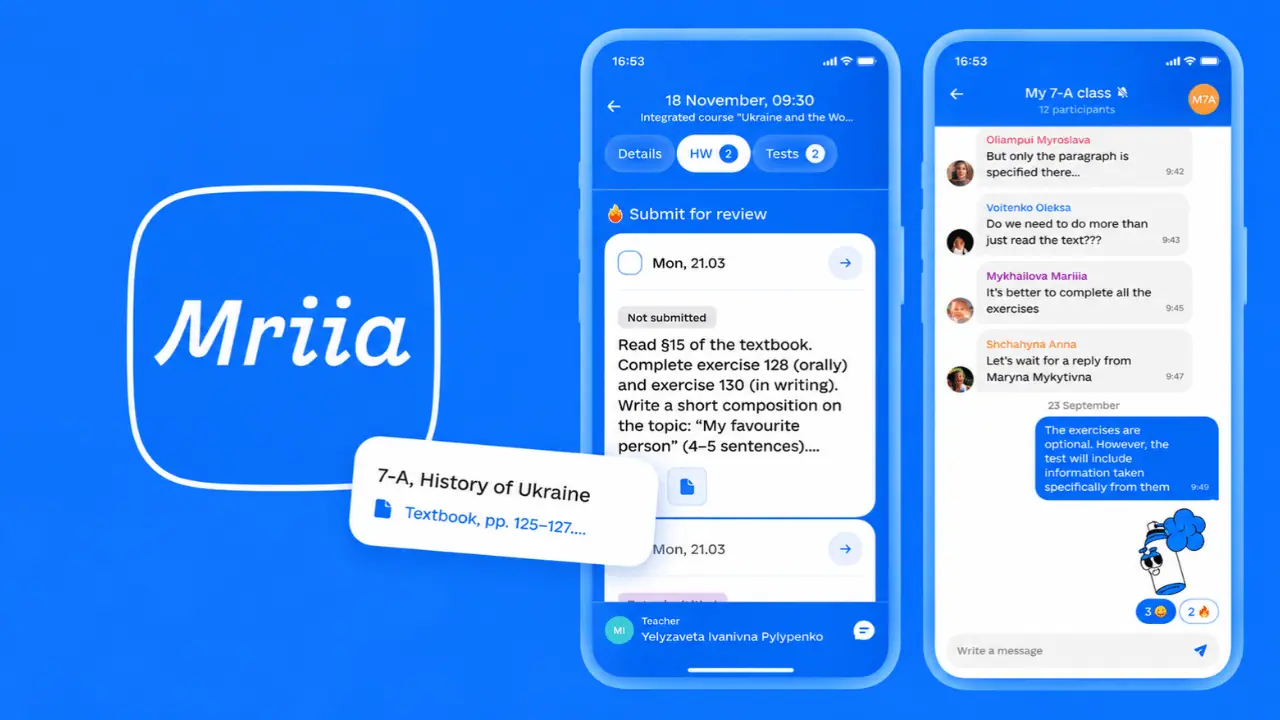
The current platform provides mobile applications for students, parents and teachers, alongside a web portal for teachers and school administrators.
Kochubynska explained that the team started with the mobile application because a smartphone is often the simplest entry point for families. If a parent or child has a phone, they can access educational information without needing a computer.
The platform brings together electronic journals, timetables, attendance, grades, homework and administrative processes, aiming to reduce repetitive work for teachers.
However, digitalisation across Ukrainian schools has been uneven, with COVID-19 and Russia's full-scale invasion accelerating the adoption of digital learning tools.
Kochubynska recalled a school displaced from Mariupol whose teachers, after relocating to western Ukraine, discovered that their digital capabilities were more advanced than those of some schools in their new communities. The school had been forced to adapt to online learning under extreme circumstances, while schools that had continued teaching in person had not necessarily needed to develop the same capabilities.
Building a national education platform at scale
Mriia is a state-backed project supported by international partners, including the Swiss-funded EGAP Program, UNICEF and Google. It entered a market where commercial providers were already digitising school processes, but with one important distinction: Mriia is free for schools and families.
According to Yashchenko, the team needed to offer the essential functionality schools expected while providing additional value.
Initially piloted with 40 schools, the platform has since expanded to more than 3,700 schools and one million users. The team aims to reach 7,000 schools and 1.5 million active users by the end of 2026.
How Mriia is using AI to reduce teachers' workloads
Mriia's approach to AI starts by identifying repetitive tasks that consume teachers' time, beginning with test generation.
"Teachers can spend hours preparing lessons, and a significant part of that work involves creating tests. With our system, they can generate tests in minutes," explained Miekh.
The system uses textbooks, Ministry of Education materials and national examination guidelines, organising educational content into pages, topics and subtopics to provide structured context for AI models. Mriia currently uses Google's Gemini models for test generation.
The approved educational materials are supplied as context rather than being used to train the models.
"We have several pipelines involving different models," Miekh explained.
The process involves structuring textbook content, generating questions and using a separate AI agent to review the results and filter out unsuitable questions. The team is also testing alternative models, including Google's Gemma and the Ukrainian model Mamai, and exploring ways to benchmark AI performance against educational materials and reference answers provided by the Ministry of Education.
Mriia is collaborating with the team developing Ukraine's national LLM and may contribute educational materials to help evaluate and improve its performance.
Because the team can identify where particular topics, illustrations and exercises appear within textbooks, it can use the same material for additional educational applications without rebuilding the underlying content structure.
Building technology around teachers, not assumptions
Kochubynska has observed that teachers moving from paper journals often adapt to Mriia surprisingly quickly, while those switching from other digital platforms sometimes find the transition more difficult.
"Like moving from Viber to WhatsApp," she explained.
One important lesson has been that what teachers say they do isn't always what they actually do. The team initially assumed teachers would open the electronic journal, record absences and then enter grades. However, usage data revealed that many went directly to entering grades. That discovery prompted the team to reduce unnecessary steps and redesign workflows around observed behaviour rather than assumptions.
Teachers are also direct with their feedback.
"They have my number, sometimes they were calling me in the middle of the night and were saying, Anastasia, it's not working," Kochubynska recalled.
For Miekh, this feedback creates a valuable connection between schools and the ministries responsible for education and digital transformation. Traditionally, such feedback can take a long time to reach decision-makers. With Mriia, the team says it can identify problems in days, sometimes even minutes, and communicate them directly to policymakers.
The platform also creates opportunities for more evidence-based education policy. Rather than relying solely on periodic reporting, the Ministry of Education can gain greater visibility into how schools operate and how digital services are used. Behavioural analysis is conducted using depersonalised information, allowing it to identify patterns without examining individual students.
Developing education technology during wartime
Building a nationwide digital platform during wartime means contending with electricity shortages, disrupted internet connections and heating outages. Mriia does not currently offer an offline mode, although the team has observed how users adapt during power outages.
"We saw the switch from the platform to the mobile app actually during the electricity shutdown," explained Kochubynska.
"Almost 30 per cent of the web users switched to the mobile phones to do their job."
Teachers who lose fixed internet access may still be able to use mobile connectivity to record grades, assign homework and access information.
However, the shift also illustrates the limits of Ukraine's digital resilience. While mobile connectivity can provide an alternative during electricity outages, Mriia's lack of offline functionality means access remains dependent on a working connection.
For Miekh, working during wartime has also shaped the team's priorities.
"When I'm talking with Europeans, for example, or Americans, I've heard a lot about how the world is uncertain," he said.
"But when I speak to Ukrainians, I see the focus."
He explained that the scale of uncertainty has made it even more important to concentrate on specific goals rather than become distracted by circumstances beyond the team's control.
"We should focus our time and attention for the particular tasks. For us it's for the future, for education."
Towards personalised and inclusive education
Mriia means "dream" in Ukrainian, a name reflecting the team's ambition to improve education even during wartime. While the platform supports individual learning arrangements, including home-based education, dedicated features for students with disabilities, neurodivergence and different learning needs remain limited.
The application supports some accessibility settings available on smartphones, but more specialised features remain on the roadmap.
Kochubynska stressed that accessibility is becoming increasingly important as the war contributes to a growing number of children living with disabilities.
For Miekh, AI offers an opportunity to support individual learning needs.
"We understand that teachers couldn't provide the personalised education for each student because they're moving at their own pace and teachers are overloaded with lots of work."
The vision is for teachers to manage the educational process with AI tools that help prepare lessons, presentations, homework and assessments, while students have access to their own AI tutors.
"We see the teacher as the manager of the educational process, who should have their own assistant, their AI right-hand," Miekh explained.
To enable this, Mriia is developing a knowledge graph with the Ministry of Education that maps relationships between educational topics, initially focusing on mathematics.
"We understand that it is very important to have these connections between topics to understand the knowledge gaps," said Miekh.
The team is also exploring computer vision to analyse photographs of students' handwritten homework, identify areas where they struggle and build a more detailed picture of their understanding beyond conventional grades.
"We will have our own metrics of students' knowledge, and we will use this for personalisation in different tasks."
These insights could eventually inform personalised homework, adapted learning materials and recommendations for students requiring additional support.
The proposed AI tutor would use the Socratic method, guiding students through questions rather than immediately supplying solutions. The aim is to identify gaps in understanding and help students work through problems themselves.
Miekh also wants the tutor integrated into classroom learning rather than operating as a substitute for teachers.
"It should be integrated in the educational process, not some GPT wrapper for answers for homework."
Beyond grades: rethinking how children learn
With students already using ChatGPT and other AI tools to complete assignments,
I was interested in how Mriia could avoid becoming another way for children to cheat. Miekh sees it as a symptom of deeper challenges within the education system. A student might have a gap in their knowledge, then encounter a new topic that builds on something they don't understand.
"They want to get a good grade, not understand the topic. Because getting a good grade is more a priority than the actual knowledge." Yashchenko argues that addressing cheating requires changing how students engage with learning long before they sit an exam. "We should work with the student's motivation," she said, explaining that understanding whether a child is interested in mathematics, entrepreneurship, or another subject could help make learning more meaningful.
This also means developing critical thinking and the ability to ask questions, rather than focusing exclusively on correct answers.
Teachers have told the team that when they cannot provide real-life examples of why something matters, they struggle to hold students' attention. Educational content could also introduce them to Ukrainian entrepreneurs, engineers and others building businesses and technologies.
"How could you want to be an engineer if you don't know about this?" Yashchenko asked.
"I think that in five years ... we will see businesses started by children, for example, a sixth-grade child."
Mriia is exploring ways to make learning more engaging through educational content, extracurricular activities and gamification. While Ukraine has no nationwide ban on smartphones in schools, individual schools can introduce restrictions, and Mriia's web platform allows teachers to share materials without requiring students to use their phones.
During tests, switching away from the application stops the timer, and the team is exploring additional ways to keep students focused during learning activities.
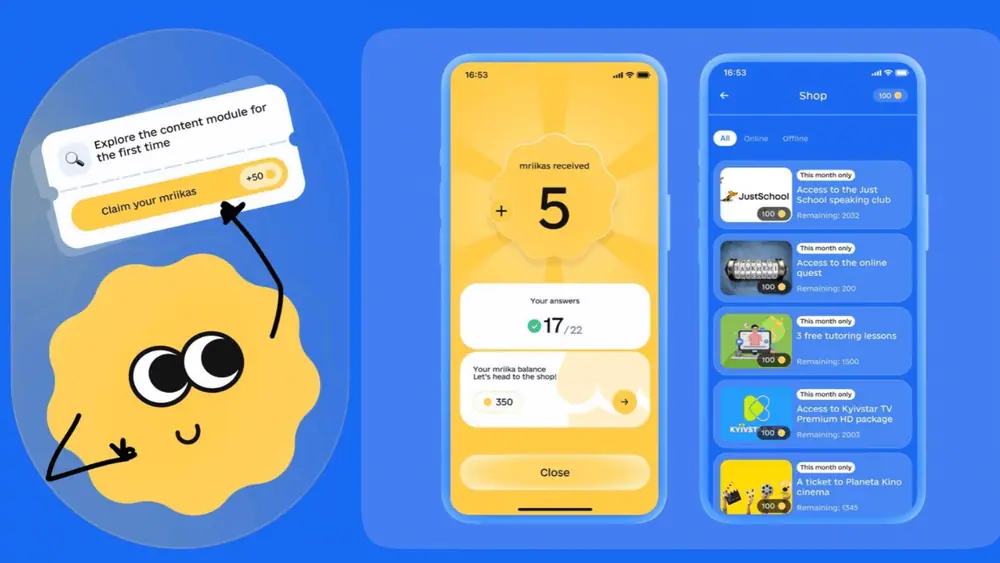
Mriia is also introducing Mriikas, a gamified rewards system designed to motivate students beyond traditional grades. By rewarding participation and educational achievements, the platform aims to make learning more engaging and encourage children to develop positive learning habits.
What governments can learn from Ukraine's startup approach
For Miekh, Mriia demonstrates how startup thinking can be applied to government technology:
"I think we're building the success case for Europe because I think there are not so many successful products in GovTech in education in the world," he said.
"The product approach, how to use startup thinking in GovTech products with the work with the ministries ... it's something unique," Kochubynska explained.
The team has already held conversations with representatives from other countries, including the UK, who have expressed interest in how Mriia was developed.
Although exporting Mriia itself would be complicated by differences between national education systems, the lessons from developing AI tutors, educational tools and user experiences with an agile startup mindset could nevertheless be shared internationally.