ZDNET’s key takeaways
- You can share bank information with Claude via Plaid.
- Anthropic won’t use financial conversations to train models.
- Claude and ChatGPT now offer financial analysis tools.
You can now share your financial information with Claude and ask the chatbot for insights on your spending.
Also: Researchers asked people to use AI chatbots for election info
What Personal Finance in Claude does
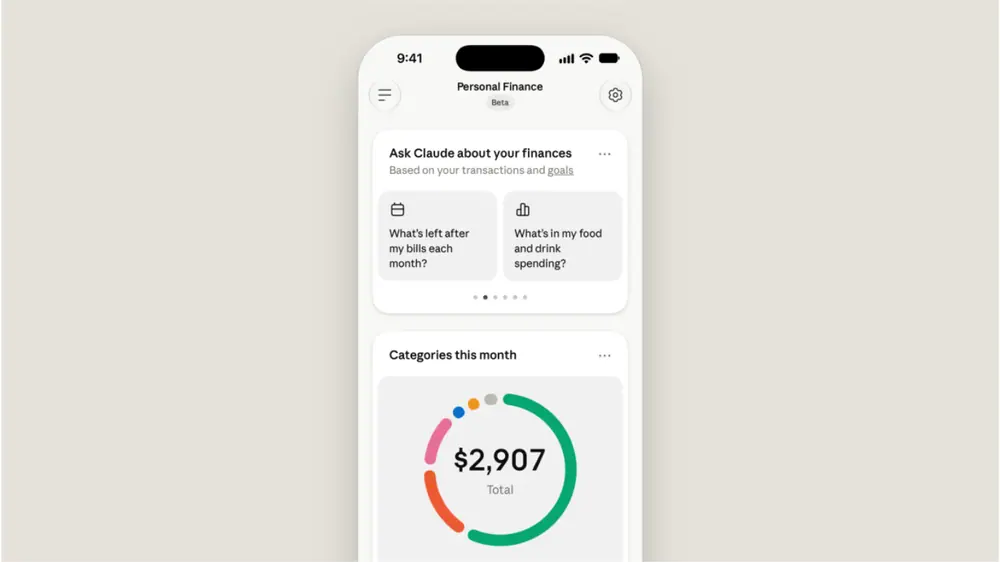
Functionally, this feature appears similar to ChatGPT Finances: It lets you link as many bank and credit card accounts as you’d like to Claude via Plaid with read-only access. You can then ask Claude where you spent your money this month or whether you can afford to take a vacation in six months, for example.
(Disclosure: Ziff Davis, ZDNET’s parent company, filed an April 2025 lawsuit against OpenAI, alleging it infringed Ziff Davis copyrights in training and operating its AI systems.)
Also: Stop sharing your passwords with AI agents
According to Anthropic, the feature is a response to existing use patterns: the company’s April usage report found that financial advice was one of the main topics users ask Claude for help with.
Given the privacy concerns around sharing sensitive data with AI systems, especially agents, Anthropic emphasized which data the new feature will access and how.
“For the accounts you choose to connect (and only those), Claude sees the bank’s name, each account’s name, type, and last four digits, balances and credit limits, and up to two years of transactions. When you chat with Claude in the Personal Finance hub, those conversations aren’t used to train our models.”
That last part is important: Personal Finance in Claude is its own mode with its own protections. If you share or discuss your financial data with Claude outside that “hub,” it’s subject only to your Claude privacy settings.
The idea behind the feature is that you can ask follow-up questions and request more insights about spending habits, trends over time, and future goals based on what Claude finds, similar to any other Claude conversation. The tool will also generate tables and charts to visualize your financial information.
“You can ask for a weekly spending chart, a calendar of what’s due, or a dashboard of the numbers you choose, and Claude builds it as an artifact you can keep adjusting and coming back to,” an Anthropic representative told ZDNET via email.
Also: I connected ChatGPT to my bank, and it’s my go-to finance app now
You can also expect an ad-free experience in the feature.
“Like the rest of Claude, Personal Finance has no ads or sponsored recommendations, and it doesn’t offer credit cards, loans, or savings accounts of its own, so your money questions get a straight answer,” the company said in the announcement.
The company added that because Claude is using actual transaction data and not memory, the feature shouldn’t hallucinate.
“It can list the exact transactions behind any number so you can check its math,” Anthropic said via email. “Like any AI, it can make mistakes, so for anything important, we recommend confirming with your bank.”
Who it’s for
For now, Personal Finance in Claude is available only to Pro, Max, and Ultra subscribers in the US. Given the many finance apps out there, it may primarily be for users who already use Claude for much of their work and day-to-day and don’t want to switch interfaces.
Still, the difference — and for many, the appeal — here is the natural language interface. Other finance apps don’t necessarily have an easy, accessible chat function where users can shoot off quick questions like they would to a human financial planner. These assistants also present historical budget analysis in plain English, rather than requiring users to interpret dashboards themselves, which users may see as a perk.
Also: 5 ways to use AI when your budget is tight
On Reddit, many users find ChatGPT Finances to be accurate and reliable. One Reddit user said ChatGPT Finance seemed to have Mint or Monarch potential, but noted it was still “weaker” than those apps in some areas, such as historical syncing, high-quality dashboards, and generating full statement PDFs.
ZDNET editor-in-chief Elyse Betters Picaro was “incredibly impressed” with ChatGPT Finances when she tried it out, and still uses it as one of several financial tools (not a replacement for professional advice). She also has her privacy settings in ChatGPT structured to reduce any security risks.
“ChatGPT has genuinely helped me make better financial decisions,” she wrote.
Anthropic noted that users shouldn’t look to Personal Finance for Claude as a total authority.
“Personal Finance is a first step. For life’s bigger money decisions, we think people are best served by Claude working alongside the licensed professionals and regulated firms they trust,” the company said in the announcement.
“We’re exploring how to make that possible in Claude, and we’d like to hear from banks, wealth managers, and financial services companies who want to help shape it” — indicating a more integrated financial planning system within Claude may be on the way.