
- By Shelley Shan / Staff reporter
Taiwanese companies seeking to invest in US data centers and other infrastructure related to artificial intelligence (AI) could face hurdles after several states passed ballot measures opposing such projects or elected governors skeptical of AI development in the midterm elections.
Forty-one ballot measures related to data center restrictions were introduced in 10 states: Ohio, Kansas, Maine, Illinois, Wisconsin, California, Florida, New Jersey, Nevada and North Dakota.
Only voters in North Dakota rejected a proposal that would have mandated industrial reviews for projects such as data centers.
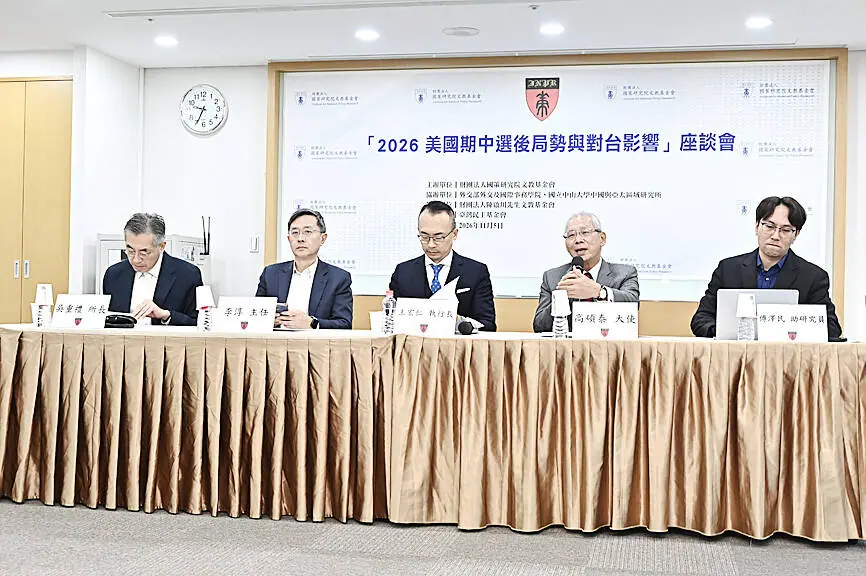
From left, Academia Sinica Institute of Political Science director Wu Chung-li, Chung-Hua Institution for Economic Research Center for Economic and Legal Studies director Roy Lee, Institute for National Policy Research chief executive Wang Hung-jen, former representative to the US Stanley Kao and Academia Sinica assistant research fellow Ronan Fu attend a symposium in Taipei yesterday.Photo: Tu Chien-jung, Taipei Times
Although Texas did not have data center-related ballot initiatives, governor-elect Gina Hinojosa campaigned on a platform that called for an immediate review of data center infrastructure and tighter regulations.
Institute of National Policy Research chairman Tien Hung-mao (田弘茂) said in the opening remarks of a panel discussion that after Arizona, Texas would be the next key destination for AI industrial clustering in the US for Taiwanese firms.
Whether a new Texas governor whose policy position is less supportive of the AI industry would affect Taiwanese companies’ willingness to make further investments in the US, particularly in data center infrastructure and semiconductor supply chain, remains to be seen, he said.
Wu Chung-li, distinguished research fellow and director of the Institute of Political Science at Academia Sinica, speaks at a symposium in Taipei yesterday.Photo: Tu Chien-jung, Taipei Times
Wu Chung-li (吳重禮), distinguished research fellow and director of the Institute of Political Science at Academia Sinica, said that US voters rejected data centers, as the facilities have caused their water and electricity bills to skyrocket and generated pollution.
State governments have the authority to grant construction permits and enforce environmental regulations, Wu said.
“If Taiwanese firms are planning to expand their AI business in the US, they could face restraints imposed by local governments and be affected by political considerations,” Wu said.
Roy Lee (李淳), director of the Center for Economic and Legal Studies under the Chung-Hua Institution for Economic Research, said that results of the US midterm elections would not change the bipartisan consensus of engaging in a strategic competition with China, particularly export control of dual-use technologies and advanced chips.
Nor would it reverse the Taiwan-US trade relations, he said.
However, a Democrat-controlled Congress might ask to review agreements that the administration signs with other countries in the next two years, Lee said, adding that agreements that the US has already signed with other countries are unlikely to change when the new congress is in session.
“The new US Congress might use a more systematic approach and verifiable indicators in the competition strategies against China,” Lee said, adding that lawmakers might seek to attract foreign investments with incentives.
Democratic lawmakers might also impose legal restrictions to curb the president’s use of the International Emergency Economic Powers Act and restrict his authority to impose tariffs under Sections 122 and 301 of the Trade Act of 1974 and Section 232 of the Trade Expansion Act of 1962, he said.
Former representative to the US Stanley Kao (高碩泰) said eight of the Senate Taiwan Caucus’ 30 members and nearly 30 of the House caucus’ 130 members are set to leave Congress.
With congressional visits to Taiwan declining in the past few years, Taiwan must urgently cultivate relationships with new lawmakers and secure bipartisan support, he said.
Academia Sinica Institute of Political Science assistant research fellow Ronan Fu (傅澤民) said the results reflected retrospective voting rather than a broader political realignment.
More than 60 percent of voters across party lines believed tariffs were hurting the economy, while the eight-month war with Iran has driven up oil and consumer prices, fueling discontent with US President Donald Trump, he said.