
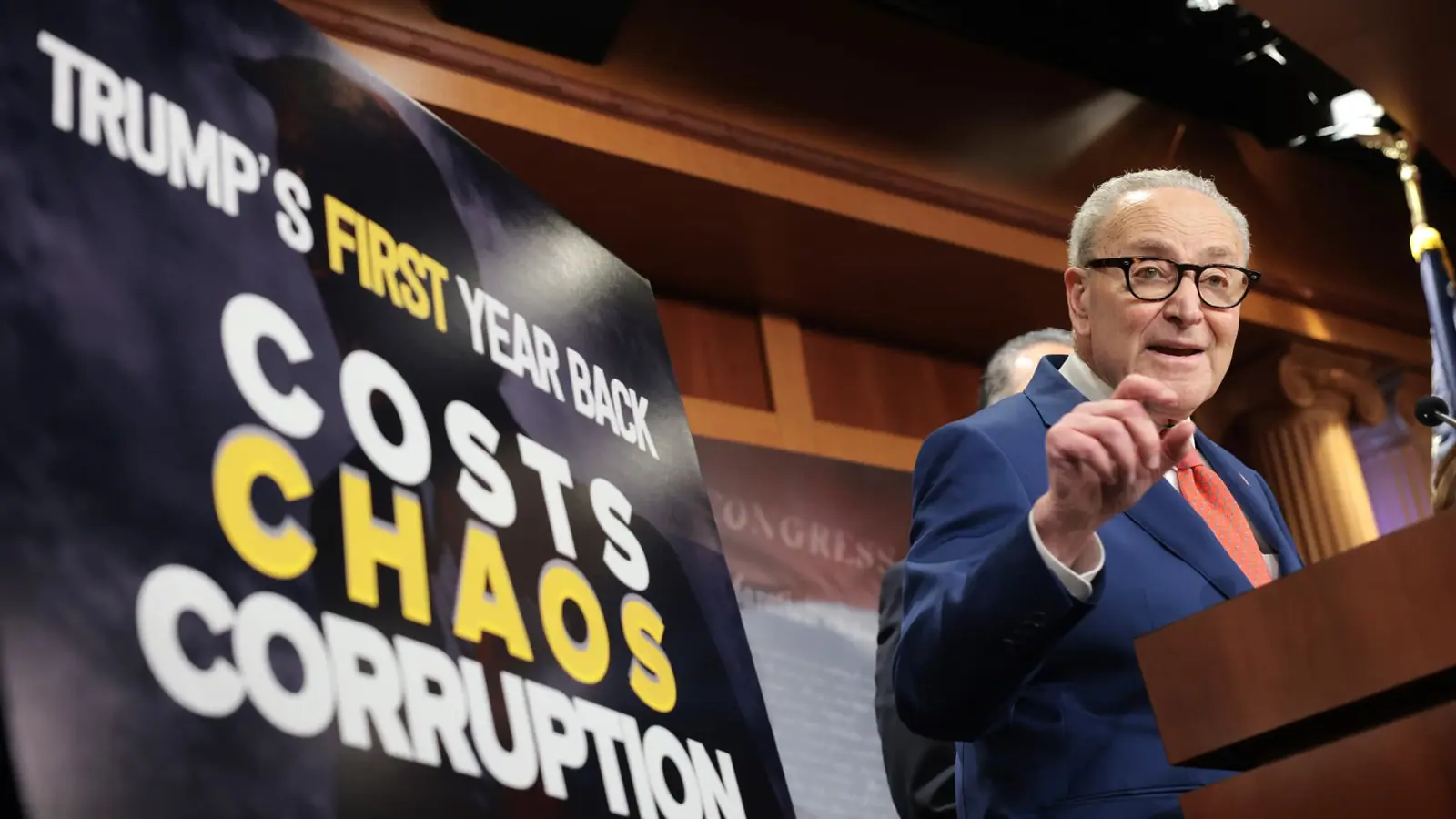
- As Democrats prepare to take back the gavels in key congressional investigative committees, outside groups are urging them to use their oversight resources to focus more on the cost of living and corporate actors than on President Donald Trump.
- Such an approach could resonate more deeply with voters, according to several groups and individuals who have been drafting oversight plans and advising members of Congress.
- Democrats are expected to aggressively pursue oversight of companies with ties to the Trump administration or family, technology companies, cryptocurrency and prediction markets.
As Democrats prepare to take back the gavels in key investigative committees in the next Congress, outside groups are urging them to use their oversight resources to focus more on the cost of living and corporate actors than on President Donald Trump.
Such an approach could resonate more deeply with voters, according to several groups and individuals who have been drafting oversight plans and advising members of Congress. Democrats are expected to launch myriad investigations into companies that have done business with the Trump administration in the technology, cryptocurrency and prediction market industries when they assume power in January.
"We were pretty worried that we were going to repeat the same mistake of 2019, where Democrats came with a big new majority ... and they spent a year-plus on impeachment," Alex Jacquez, a senior vice president of policy, advocacy and research at Groundwork Collaborative, a progressive think tank, told CNBC on Thursday.
"The issue never really resonated for people. Donald Trump was more popular the day that impeachment ended in the Senate than he was when it started in the House," he said.
- Midterm elections 2026 live updates: Economy, inflation and voter concerns
- 5 midterm election takeaways: Tech billionaires suffer as Democrats drub Republicans
- Elon Musk’s record election bet backfired. The backlash may reach beyond one billionaire
- Analysis: The Democrats have one chance to extract concessions from Trump. Markets will hate it
Several Democratic-aligned groups and strategists expressed similar sentiments to CNBC. They're urging Democrats — who won sizable majorities in both chambers and have an axe to grind against the Trump administration — to show restraint. They should avoid the mistake of spending too much time trying to remove the president from office and stay focused on affordability, Jacquez and others said.
"Voters don't want us to investigate just for the sake of political vendettas. It's not healthy for us as a democracy. It plays into a lot of what Trump has done himself," said Lucas Holtz, a senior political advisor at Third Way, a center-left think tank, which he said has been in close contact with Democratic leaders on oversight and other aspects of their congressional agenda. "Democrats hopefully have learned lessons from Trump and will responsibly investigate in a way that connects back to cost of living."
That strategy is supported by recent polling conducted by Groundwork and polling firm Hart Research that was shared exclusively with CNBC.
It found that 2 in 3 voters think investigations of corporate greed should be a high priority, more than the 58% who believe Congress should prioritize Trump's personal corruption.
And in focus groups conducted by the think tank, Jacquez said there was palpable anger aimed at CEOs and corporate leaders who voters feel have ripped them off.
"A lot of people were pessimistic … that oversight would result in anything, and so they want restitution. They want CEOs to go to jail. They want people to resign. They want prices to be lowered," Jacquez said.
"In the focus groups in particular, I was pretty shocked at how much jail time came up for CEOs," he added.
A mandate to investigate
Whether Democrats heed that advice remains to be seen.
House and Senate leaders are rolling out the foundations of their legislative and investigative agendas, and some presumptive chairs of key committees have flicked at who and what they'll target. They've so far laid out a sprawling hit list, which includes Trump, his family, Cabinet officials, big banks and tech companies.
For one, Sen. Ron Wyden of Oregon is expected to lead the Senate Finance Committee and has already set the table for an ambitious oversight agenda.
A person familiar with the matter told CNBC on Thursday that the committee would probe JPMorgan Chase's banking relationship with the late sex offender Jeffrey Epstein, and in particular decisions made by Mary Callahan Erdoes, the CEO of JPMorgan's asset and wealth management division. The person spoke on condition of anonymity because the probe of the nation's biggest bank has not been announced.
The news comes a day after Wyden said in a statement that the panel's top priorities "will be affordability for us, accountability for them."
Wyden said the committee would double down on its efforts to make sure billionaires pay their fair share in taxes, address the "corporate chokehold on our nation's health care system" and reassert congressional authority over trade. He also vowed to target the "special interests" that had cozied up to Trump in the past two years.
Presumptive House Judiciary Committee Chair Jamie Raskin, D-Md., also listed Epstein as a potential source for probes, specifically the Department of Justice's alleged efforts to cover up his human trafficking operation. Raskin also said the committee could probe Trump's $1.8 billion "lawfare fund"; the president's attempt to pardon himself, his family and their businesses; and violations of the emoluments clause by Trump and his Cabinet, which prohibits federal officials from accepting gifts from foreign states.
Another person familiar with Democrats' oversight plans, who was not authorized to speak publicly, told CNBC the strategy is to aggressively target business while also taking a more traditional watchdog role of the executive branch.
Any business that has affiliations with the Trump administration could come into the crosshairs, the person said.
Democrats believe they have a mandate after the election to conduct aggressive investigations into industries like tech, prediction markets and cryptocurrency — all of which have kowtowed to or benefited from the Trump administration over the past two years, the person said. Indeed, the CNBC Voter Poll showed voters did respond resoundingly to Democrats' anti-corruption and affordability message that put tech leaders in the spotlight. The poll was a collaborative effort across several news organizations that drew on about 100,000 interviews conducted by phone, online and in person at polling locations with a margin of error of 0.6%.
Tech companies have publicly embraced the Trump administration, attending and donating to the president's inauguration and, in some cases, giving gifts to the president. The White House has been hands off with artificial intelligence while encouraging the buildout of data centers — a massive infrastructure gambit that is now in jeopardy after data centers proved a loser at the ballot box.
Cryptocurrency and prediction markets, two relatively new players, are also going to be under the microscope, the person said. The crypto investigations will be led by Sen. Elizabeth Warren, D-Mass., the incoming chair of the Senate Banking Committee and a known critic of the industry that has dumped millions of dollars into electoral politics.
Another wrinkle for crypto is the return of Sen.-elect Sherrod Brown, D-Ohio, who lost his seat in 2024 to Sen. Bernie Moreno, R-Ohio, after crypto spent millions to have him defeated. Brown was elected Tuesday to Ohio's other Senate seat.
The Trump family has also been intertwined with prediction market companies while making billions on crypto ventures.
- Midterm elections 2026 live updates: Economy, inflation and voter concerns
- 5 midterm election takeaways: Tech billionaires suffer as Democrats drub Republicans
- Elon Musk’s record election bet backfired. The backlash may reach beyond one billionaire
- Analysis: The Democrats have one chance to extract concessions from Trump. Markets will hate it
The second person said the oversight strategy will both address the perception that companies hold undue influence with the government and benefit from it and will deter the companies from pursuing corrupt behavior or rolling over for the administration.
Democrats expect companies will try to do everything in their power to cooperate, given that the election results were so heavily in their favor, the person said. Helping their cause is that companies cannot avoid congressional subpoenas, and a company itself cannot be pardoned.
The oversight itself will also serve as a means to an end, the person said, publicly surfacing information that could later materially impact a company.
Former Federal Trade Commission Chair Lina Khan echoed that point in a post to X on Thursday.
"Why should Congressional Democrats investigate corporate America if their mandate is to deliver real economic change? Because investigations are a key catalyst for securing reform and legislation," Khan said.
She highlighted the work of the House Judiciary Committee during Trump's first term, which she said conducted an "18-month investigation into Amazon, Apple, Facebook, and Google, securing key evidence of how their business practices were undermining competition and harming people, setting the basis for both lawsuits and proposed legislation."
Choose CNBC as your preferred source on Google and never miss a moment from the most trusted name in business news.