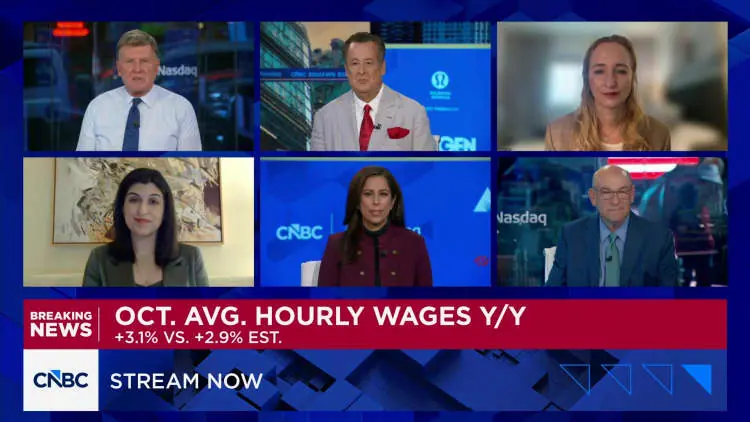
- Nonfarm payrolls increased by 165,000 in October, well above the Wall Street forecast for 59,000, while the unemployment rate edged lower to 4.1%.
- Worker pay rose by 0.4% for a 3.1% annual increase.
- Job gains came in professional and business services, healthcare and manufacturing.
The U.S. economy added jobs at a much stronger-than-expected pace in October, while the unemployment rate moved lower as the labor market showed surprising strength.
Nonfarm payrolls increased by a seasonally adjusted 165,000 for the month, compared with the Dow Jones estimate for 59,000, the Bureau of Labor Statistics reported Friday.
The unemployment rate nudged down to 4.1%, compared with the forecast for 4.2%. A more encompassing measure that includes discouraged workers and those holding part-time jobs for economic reasons rose to 7.9%, up 0.3 percentage point, amid an increase of 421,000 in the civilian labor force.
In addition to the strong payroll gains for October, prior months were revised up substantially: The August figure moved to 186,000, an upward revision of 53,000, while the September count shifted to 60,000 following an upward revision of 31,000.
Payroll gains also came in better than forecast. Average hourly earnings increased 0.4% on the month and 3.1% annually, compared with respective estimates for 0.3% and 2.9%. The average workweek was unchanged at 34.4 hours.
"Today's jobs report is a strong rebuttal to fears that the economy is heading into a meaningful slowdown," said Seema Shah, chief global strategist at Principal Asset Management. "Payrolls growth surprised firmly to the upside, unemployment fell back to 4.1%, and job creation remains broad-based, pointing to an economy that is still absorbing labor comfortably rather than one beginning to buckle under tighter financial conditions."
The breadth of job growth also was strong, contrary to a trend in which healthcare had accounted for the bulk of gains.
Professional and business services saw an increase of 70,000 to lead all sectors, while healthcare was next at 42,000. Other areas seeing notable growth included transportation and warehousing (25,000) and manufacturing (19,000).
"The overall picture is a labor market that is on much better footing than a year ago," said Heather Long, chief economist at Navy Federal Credit Union. "In 2025, the economy added barely 10,000 jobs a month and basically all were in healthcare. This year hiring is averaging nearly 75,000 a month and there's a much more broad based range of opportunities."
The report comes the same week as an election in which the economy and in particular inflation were the center of attention. Democrats staged a nationwide rout that will give the party control of both chambers of Congress after campaigning heavily on addressing affordability issues.
For the Federal Reserve, the report also comes at a pivotal time. Central bankers are weighing whether to resume raising interest rates in December as inflation remains stubbornly above the central bank's 2% target.
Traders increased the probability of another quarter percentage point hike when the Federal Open Market Committee meets Dec. 8-9. Odds rose to 76.8%, according to the CME Group's FedWatch tool, though the indicator pointed to only one more increase after. The odds of further hikes in 2027 have fallen somewhat in recent days, after the midterm election rout and Thursday's sell-off in tech stocks.
Market reaction otherwise was muted, with a mixed picture on stock market futures heading into the open. Treasury yields were higher across the board.
The share of workers either looking for a job or already working as a share of the workforce, known as the labor force participation rate, edged higher to 61.9%. The labor force had been shrinking, the result of demographic changes and immigration reductions, but expanded by 421,000 in October.
At the same time, the household report, which is used to calculate the unemployment rate, showed 463,000 more people at work.
Long-term unemployment, though, rose sharply.
The average duration of unemployment jumped to 27.1 weeks, up 2.3 weeks from the prior month to the highest since September 2021. Those unemployed for more than 27 weeks increased to 1.96 million, the most since December 2021.
Choose CNBC as your preferred source on Google and never miss a moment from the most trusted name in business news.