
GLOBAL BENEFIT: Many world leaders do not recognize the global implications of conflict in the Taiwan Strait, or the consequences for economies, lawmakers said
- Staff writer, with CNA
The annual summit of the Inter-Parliamentary Alliance on China (IPAC) yesterday named peace in the Taiwan Strait and resilience against China’s economic coercion as top priorities for the coming year.
The two priorities were selected following a vote at the summit in The Hague, which brought together 52 lawmakers from 30 countries across six continents.
The first initiative would seek to mobilize international action to highlight the importance of the strait to global security, the rule of law and economic stability. The second calls for a whole-of-society approach to building resilience, including advancing parliamentary resolutions and urging government ministers and diplomats to incorporate resilience into diplomatic and economic engagement with China.
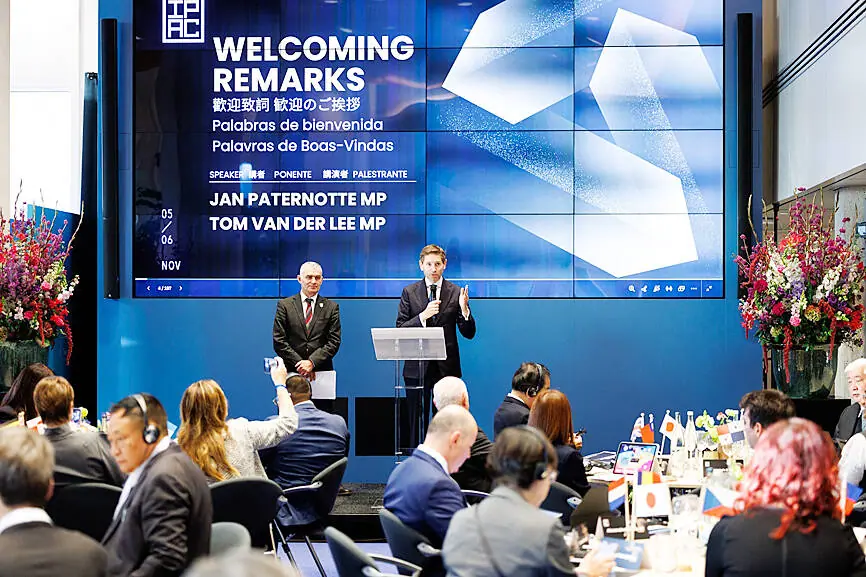
IPAC Netherlands co-chair Jan Paternotte, right, and Dutch lawmaker Tom van der Lee, left, speak at the opening of IPAC’s annual summit in The Hague on Thursday.Photo courtesy of the IPAC
During the debate, lawmakers from Australia, Japan, the Czech Republic, the Netherlands and Panama, among others, said that countries across the Indo-Pacific region understood the importance of peace and stability in the South China Sea and Taiwan Strait. However, many world leaders had yet to fully recognize the global implications of developments in the region, which have fundamental consequences for economies and security worldwide, they added.
IPAC Netherlands co-chair Jan Paternotte said that, given the volume of international trade passing through the Taiwan Strait and Taiwan’s pivotal role in the semiconductor industry, an economic crisis triggered by escalating tensions could have an even greater global impact than the COVID-19 pandemic. He added that maintaining the “status quo” across the Taiwan Strait should be a top priority for the international community.
Democratic Progressive Party Legislator Ngalim Tiunn, who represented Taiwan’s legislature at the summit, said that lawmakers from IPAC member countries recognized the importance of peace in the Taiwan Strait to the global economy, but government officials did not necessarily share the same understanding. Efforts are needed to bridge the gap between legislators and executive authorities, she added.
At a post-summit press conference, Dutch lawmaker Tom van der Lee said the proposals went beyond the concerns of any single country, describing them as global issues that required international cooperation to address.
In response to media queries on how the international community should demonstrate its support for the Philippines as China continues to escalate tensions in the region, Paternotte said that the Philippines had refused to tolerate encroachments on its territory, consistently standing up to defend its rights and making its voice heard.
This deserved recognition, and the international community should follow its example by demonstrating support for international law, he said.
Under Dutch policy, the Netherlands sends warships through the Taiwan Strait and other waters every two years to demonstrate its commitment to freedom of navigation, Van der Lee said, adding that The Hague, as an important center for international law, would continue to support the Philippines in defending its rights and promoting peace.
Asked under what circumstances Japan would send troops to assist Taiwan in the event of a Chinese invasion, former Japanese minister of defense Gen Nakatani said that Japan was working with other countries to prevent such a scenario.
However, if Taiwan were invaded and Japan’s security were seriously threatened, Japan could provide support or cooperate with other countries in accordance with its laws. The extent of any involvement would depend on the circumstances of each case, he added.
Additional reporting by Fang Wei-li