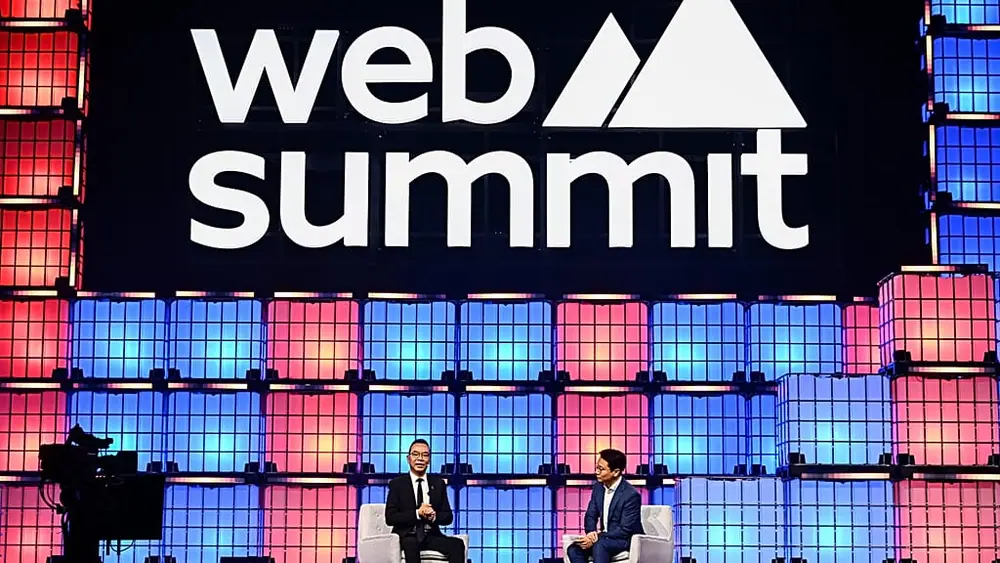
Christine Lagarde's early departure will not delay the digital euro, a European Central Bank official stated at the Web Summit in Lisbon, citing the pilot due next year and a pledge by Brussels to agree the law by the end of 2026, while dismissing fears the project threatens people's privacy.
Christine Lagarde's early exit as president of the European Central Bank will not hold up the digital euro, an ECB official said on Tuesday at the Web Summit in Lisbon, one of Europe's largest technology conferences.
ADVERTISEMENTADVERTISEMENTAlessandro Giovannini, adviser to the programme manager of the digital euro project, pointed to the pilot starting next year and a commitment by EU lawmakers to agree the law by the end of the year.
"I'm not afraid that any change or anything will impact it, because this is a strategic project," Giovannini stated at a panel moderated by Euronews, calling the digital euro "a European project" rather than the ECB's alone.
Lagarde announced last month that she would step down on 7 February 2027, almost nine months early.
Germany's Isabel Schnabel also departs the six-member Executive Board, the ECB's top management team, in January, and chief economist Philip Lane's mandate expires in May.
As Euronews previously reported, Spain's Pablo Hernández de Cos and the Netherlands' Klaas Knot are currently the two main candidates to succeed Lagarde.
Final stretch in Brussels
In March, EU leaders called for negotiations on the digital euro law to be concluded by the end of this year, ahead of the pilot programme scheduled for 2027.
"This is the commitment that we have from the co-legislators," Giovannini said, meaning the European Parliament and EU governments.
The two sides have been in trilogues, three-way negotiations with the European Commission that form the last stage of EU law-making, since July. The latest round was last Thursday, and Ireland, which chairs the talks for member states, is reportedly aiming for a deal on 18 November.
How the fees merchants pay are calculated, part of the digital euro's business model, is one of the issues still unresolved.
This is significant, as the ECB aims to be ready for a first issuance in 2029, while technical preparations are progressing independently of the ongoing discussions in Brussels.
In July, the ECB picked 36 banks and payment firms, including Deutsche Bank, UniCredit and Stripe, for a 12-month pilot starting in the second half of 2027. Last month, it chose network providers, including payments firm Nexi and telecoms group Telefónica, to connect them to its platform.
The first pilot transactions will come "in less than one year", Giovannini said, adding that the firms building the system were all "European companies controlled by other European companies".
Banks will not pay for the shared infrastructure, as Giovannini explained it would be "paid by the ECB" and "offered for free by the ECB to everyone".
The ECB has estimated development will cost around €1.3 billion before a first issuance, and running the system about €320 million a year from 2029, costs that eurozone central banks would bear, as with banknotes.
Is Europe behind?
Europe trails China, which has been piloting its digital yuan since 2019, and the US has taken the opposite path with the GENIUS Act, passed last year, which left the field to private stablecoins, crypto tokens pegged to a currency such as the US dollar.
"The best moment to plant a tree was yesterday," Giovannini acknowledged, adding that "Europe has its own time and we need to also accept the legislative pace that comes with that."
Ultimately what mattered, he said, was "that we are not losing time".
The wait until 2029 reflects the scale of the task, Giovannini noted, with more than 4,000 payment providers and millions of merchants to coordinate with.
The digital euro aims to cut Europe's reliance on international card schemes such as Visa and Mastercard. ECB board member Piero Cipollone said last week that in 13 eurozone countries, card payments in shops run entirely through non-European firms.
Unlike China, which since January has let banks pay interest on digital yuan wallets, the digital euro will pay no interest.
"As you don't get yields on your banknote, you're not going to get yields on the digital euro," Giovannini said, though banks and fintech firms could offer their own rewards.
Privacy fears
Critics warn a central bank digital currency could let the state monitor, or even control, people's spending, but Giovannini disagreed.
Handing a €20 banknote across the stage, he said offline digital euros, sent by tapping phones without an internet connection, would work like cash.
"I'm tapping your phone and no one will know that I've given €20 to you," he explained.
The system would only check that the token was genuine, leaving "no digital footprint that this comes from me and went to you, or comes from my bank".
However, such payments will be subject to limits, which lawmakers have been negotiating, to curb money laundering and terrorist financing risks.
For online payments, banks would know who paid whom, as they do today, but the ECB would only see pseudonymised data.
"The ECB that is in between will never see anything," Giovannini guaranteed, contrasting this with the card schemes that sit in the middle of payment rails today.
Go to accessibility shortcuts