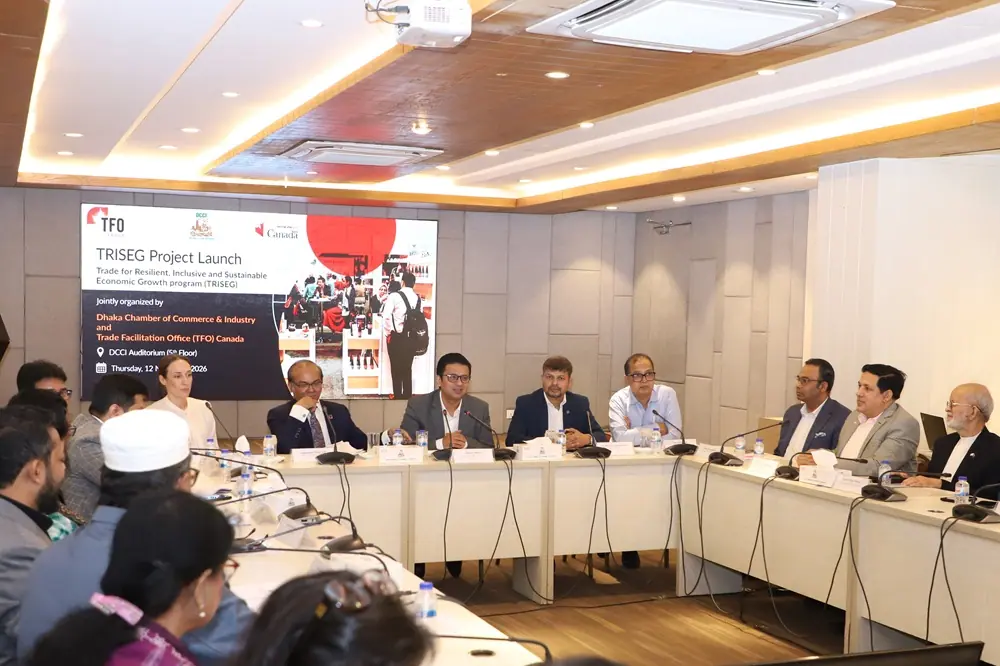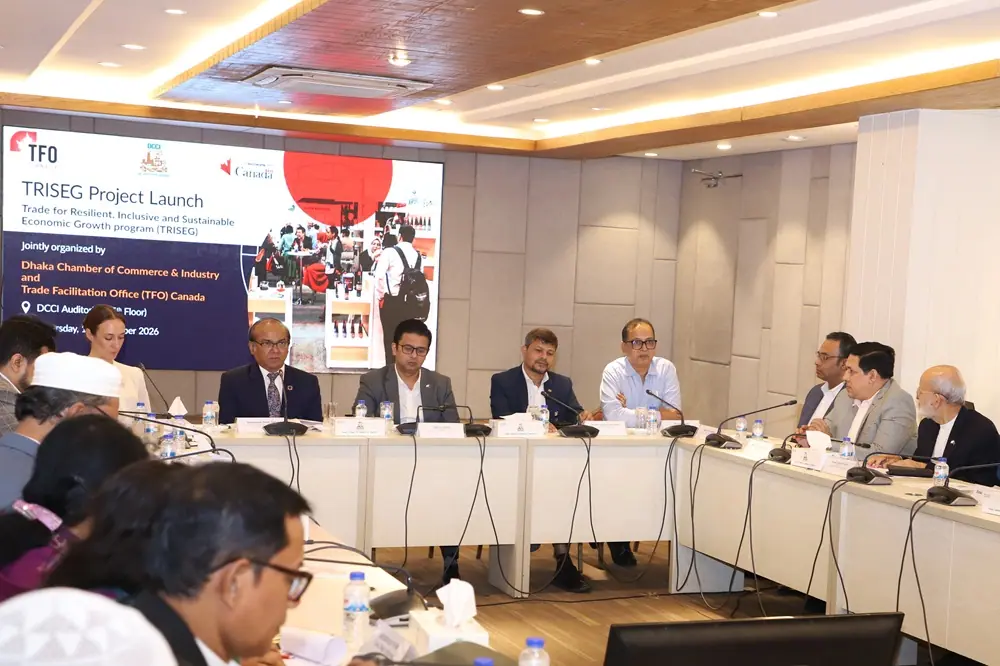
With a view to expanding the export capacity of Bangladeshi SME entrepreneurs particularly working with Jute and Jute Goods in the Canadian market, Dhaka Chamber of Commerce & Industry (DCCI), in collaboration with the Trade Facilitation Office (TFO) Canada, formally inaugurated the ‘Trade for Resilient, Inclusive and Sustainable Economic Growth (TRISEG)’ project on November 12, 2026, at the DCCI Auditorium. Mohammad Hasan Arif, Vice Chairman and Chief Executive, Export Promotion Bureau (EPB) attended the event as the Chief Guest while Khondaker Md. Nazmul Huda Shamim, Additional Secretary, Ministry of Textiles and Jute was present as the Special Guest.
In his opening remarks, DCCI President Taskeen Ahmed said that as Bangladesh prepares for graduation from the Least Developed Country (LDC) status, export diversification is no longer an option but an imperative. He emphasized that meaningfully integrating small businesses, particularly women-led enterprises and those from underrepresented groups, into global markets is essential to building a truly resilient and sustainable economy. DCCI President expressed hope that the TRISEG project would play a significant role in strengthening the export capabilities of SME entrepreneurs through targeted capacity development, specialized business advisory services and direct market linkage support. He further expressed hope that the initiative would enable SMEs to explore new business prospects and opportunities in Canada and other international markets.
During his speech as the Chief Guest Mohammad Hasan Arif, Vice Chairman and Chief Executive of EPB said that despite ongoing geopolitical turmoil, Bangladesh’s export earnings reached USD 48 billion in 2025. He informed that during the first quarter of FY 2026–27, the country’s export growth stood at 6%. He further mentioned that Canada is among the top ten export destinations for Bangladesh, with the country’s total exports to Canada reaching USD 1.5 billion. He also highlighted the positive performance of Bangladesh’s jute and jute goods sector, which maintained an upward trend, recording 25% export growth during the first quarter of the current fiscal year. Bangladesh’s export sector would face significant challenges following the LDC graduation in 2029. He emphasized that product diversification would be essential to overcoming these challenges and ensuring the sustained growth and competitiveness of Bangladesh’s export sector.
In his remark as Special Guest Khondaker Md. Nazmul Huda Shamim, Additional Secretary, Ministry of Textiles and Jute said that although Bangladesh’s jute and jute goods sector is performing reasonably well, the sector still faces challenges due to a lack of product diversification. He emphasized that expanding exports of jute goods requires developing a wider range of products in line with global market demand while ensuring compliance with international standards and maintaining high-quality standards. He expressed hope that TRISEG project would help SMEs diversify their products and improve quality and compliance, while the government would provide the necessary support to strengthen the sector’s export potential.
In his overview presentation Md. Ashraf Hossain, Project Manager, TFO Canada stated that the five-year TRISEG project, funded by the Government of Canada, is being implemented in 16 least developed and developing countries across Asia, Africa, Latin America and the Caribbean. Under this project, long-term training and support will be provided to SMEs, particularly women entrepreneurs, focusing on skills development, export readiness, digitalization, access to finance and climate resilience in sectors including Jute Diversified Products, Processed and Fresh Food, Handicrafts, Aromatherapy, Fashion Accessories, Tourism. Approximately 3,200 small and medium-sized enterprises (SMEs) will receive comprehensive support to enhance their access to the Canadian market for their locally manufactured products. Of the beneficiaries, 67% will be women entrepreneurs, while around 200 SMEs from Bangladesh will have the opportunity to benefit from this initiative. He also mentioned that under this project, they are going to provide targeted capacity building training to the SMEs involved in Jute sector to enhance their export readiness.
Omar Farhan Khan, Principal Business Consultant & Portfolio Manager, LightCastle Partners, stated that although Bangladesh is one of the largest jute-producing countries in the world, the lack of value addition has prevented the country from fully tapping into the USD 3 billion global jute market. He added that this project would help pave the way for expanding the jute sector through product diversification, value addition, innovation and greater access to international markets, thereby creating new opportunities for Bangladeshi jute entrepreneurs.
Md Jahid Hossain, Managing Director, JDPC PLC; Dina Mujic, First Secretary- Development, the High Commission of Canada to Bangladesh; Md. Mahbubur Rahman, Additional Director, SME & Special Programmes Department, Bangladesh Bank; Protima Chakraborty, Managing Director, Jute Land Bangladesh and Md. Saiful Islam, Director, Bangladesh Jute Spinners Association (BJSA) spoke during the designated discussion session.
Md. Mahbubur Rahman, Additional Director, SME & Special Programmes Department, Bangladesh Bank acknowledged that banks tend to show more interest in corporate financing than in SME financing. However, he mentioned that the central bank has instructed scheduled banks to maintain a financing distribution of 30% for retail, 35% for SMEs and 35% for corporate sectors.
Md. Saiful Islam, Director, Bangladesh Jute Spinners Association (BJSA) said SMEs in the jute and jute goods sector need capacity-building training to diversify their products and expand exports to international markets. He also emphasized that inadequate global marketing efforts are hindering the growth of Bangladesh’s jute exports.
Protima Chakraborty, Managing Director, Jute Land Bangladesh said that limited access to finance is hindering women entrepreneurs from entering international markets, as exports require substantial working capital and significant investment in meeting compliance requirements, international standards and packaging. She emphasized that Bangladesh Bank could play a vital role in facilitating access to finance for women entrepreneurs.
DCCI Senior Vice President Razeev H Chowdhury, Vice President Md. Salem Sulaiman and members of the DCCI Board of Directors were also present on the occasion.